The CX Report Card for AI Platforms: Gemini Leads, but the Real Race Is for Trust
Gemini leads on satisfaction in ACSI’s 2026 AI Platforms Study, but the scores are very close; from a CX standpoint, the real race is for trust.

Everyone in the AI world keeps circling the same question: Which is better, ChatGPT, Gemini, Claude or Copilot? It’s a perfectly reasonable question, because AI is no longer just an experimental toy for tech enthusiasts. It writes emails, summarizes reports, checks code, plans trips, supports customer service, influences purchase decisions and sometimes even helps people organize their own thoughts.
From a customer experience perspective, though, the real question is more like this:
Not “Which model is the smartest?” but “Which experience do customers trust most, find easiest to use and want to come back to?”
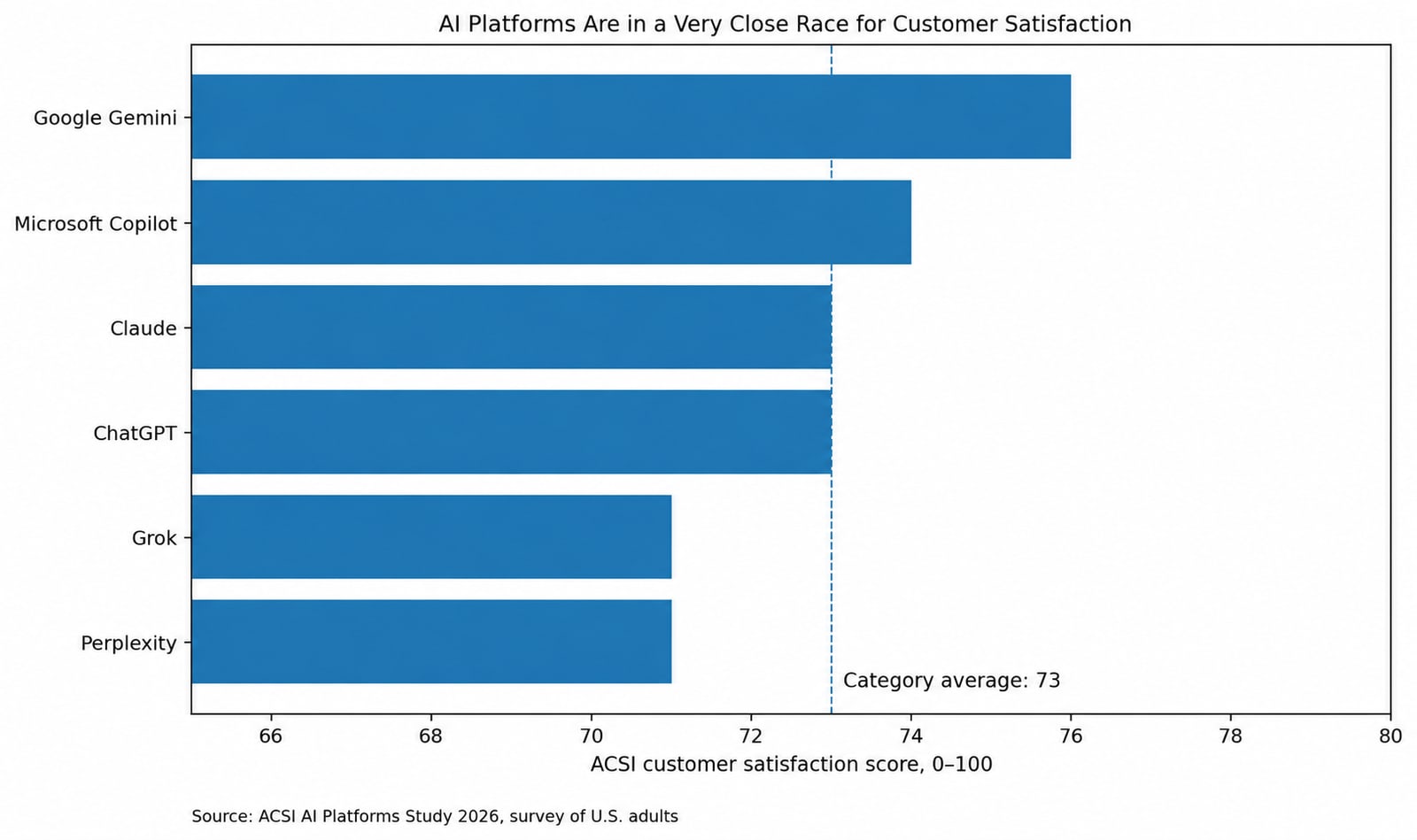
The 2026 AI Platforms Study from the American Customer Satisfaction Index offers a very valuable window into exactly this question. According to ACSI’s survey of 2,711 US adults, the AI platforms category, which includes Google Gemini, Microsoft Copilot, Claude, ChatGPT, Grok and Perplexity, has an overall customer satisfaction score of 73 out of 100. That puts AI platforms on par with energy companies and below airlines, social media and mortgage companies.
In other words, today’s shiniest technology isn’t yet in the “legendary experience” league when it comes to customer satisfaction.
Gemini Leads, but No One Has Pulled Away
According to ACSI data, Google Gemini tops the list with 76 points. Microsoft Copilot scores 74, Claude and ChatGPT 73, and Grok and Perplexity 71.
At first glance, it looks like a neat “winners list.”
But when I look at it through a CX lens, what I find most interesting isn’t Gemini’s lead; it’s how close the scores are.
The gap is only a few points. That tells me something very clearly: No AI platform has yet opened up an overwhelming customer experience advantage. Users may prefer one model over another, but that preference doesn’t yet seem to have turned into strong emotional loyalty, a deep relationship of trust or an indispensable habit.
This matters a great deal, because AI platforms are no longer simple tools. For users, they can act as a search engine one moment and a personal assistant, an editor, a career coach or a decision-support system the next. With a technology people engage with this closely, satisfaction can’t be explained by speed, answer length or a model’s technical capacity alone.
Users are asking:
“Does it really understand me?”
“Will I notice if it gets something wrong?”
“Is my data safe?”
“Is it pulling me away from people, or is it really making my life easier?”
So the race is no longer just a model race. It’s a race for trust.
AI Use Isn’t a Ladder but a Threshold
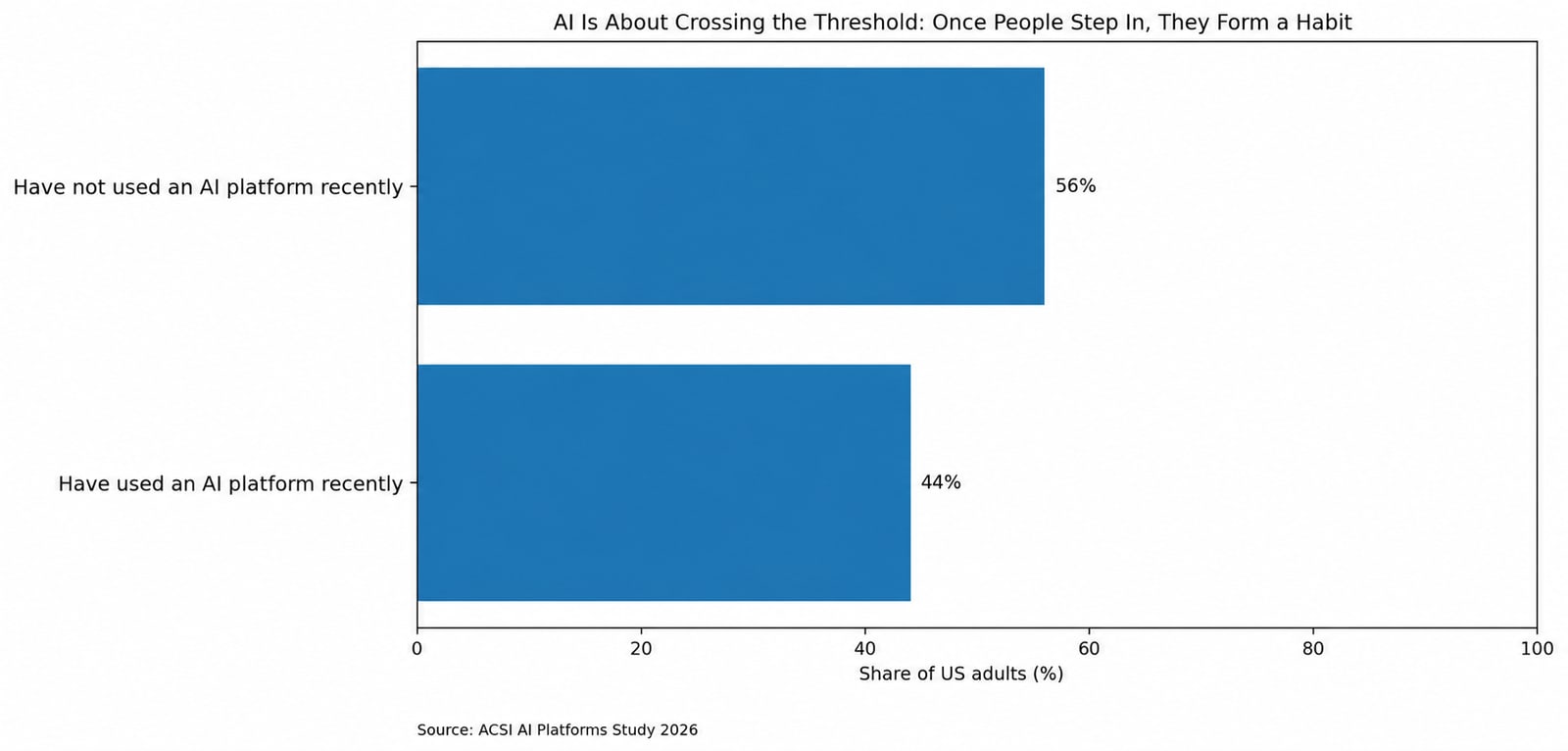
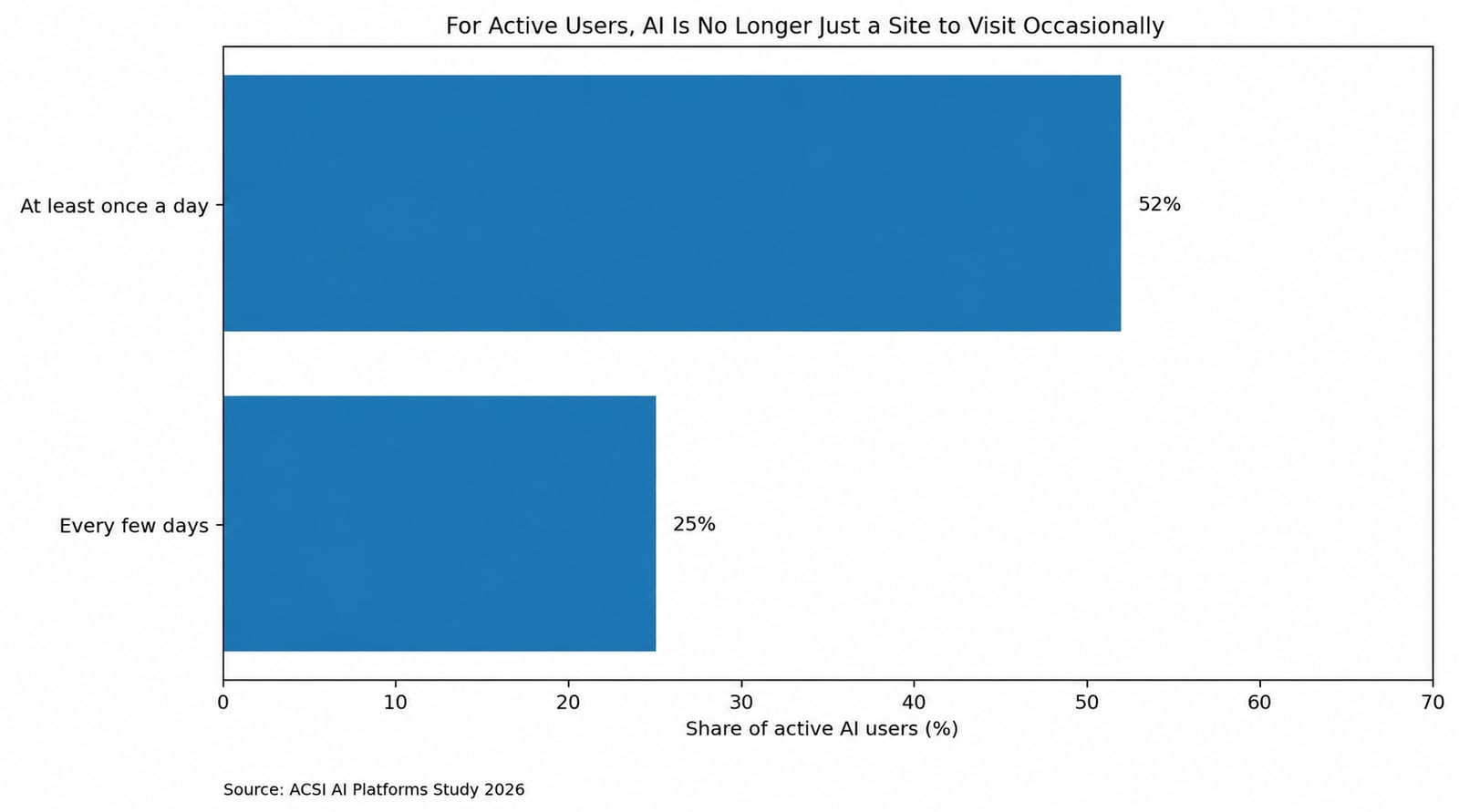
One of the most critical findings in the ACSI report concerns usage behavior. Among US adults, 56%—incredible, isn’t it?—haven’t used any AI platform recently. But among the 44% who have, engagement is quite intense: 52% of active users use AI at least once a day, and 25% every few days.
What this data tells me is that AI adoption doesn’t progress like a smooth ramp. It works more like a threshold. A large group is still standing outside the door. But those who step through stay inside for a long time.
This finding is very valuable for CX designers. Brands usually look at AI projects from the inside: model selection, integration, cost, automation rate, call reduction, handling time…
Customers, however, see it from a different vantage point:
“Did it wear me out the first time I used it?”
“Could I trust its answer?”
“Did it stand in my way when I needed to reach a human?”
“Did it save me time, or did it open up a new digital maze?”
I reached the same conclusion earlier in CX Bulletin when I examined why AI investments in customer operations haven’t produced the expected returns: Trying to measure a new world with old metrics is like judging a smartphone by the standards of the telegraph. Classic indicators such as AHT, FCR and resolution rate still matter, but in the AI era we also need to bring new areas of measurement to the table, such as intent recognition accuracy, sentiment shift and the quality of the resolution path.
After all, if the first AI experience is poorly designed, customers don’t just abandon a feature. They also start to question whether they can trust the brand’s technology promise.
The Biggest Fear Isn’t Losing Jobs but Losing the Human Touch
To me, the ACSI report’s most striking finding lies right here.
Among respondents, 43% cite reduced human-to-human interaction as their top concern about AI. That’s higher than worries about job losses for future generations (37%) and the perceived risk to their own jobs (31%).
So people aren’t just asking, “Will robots take our jobs?”
They’re asking something deeper:
Will there still be a human involved?
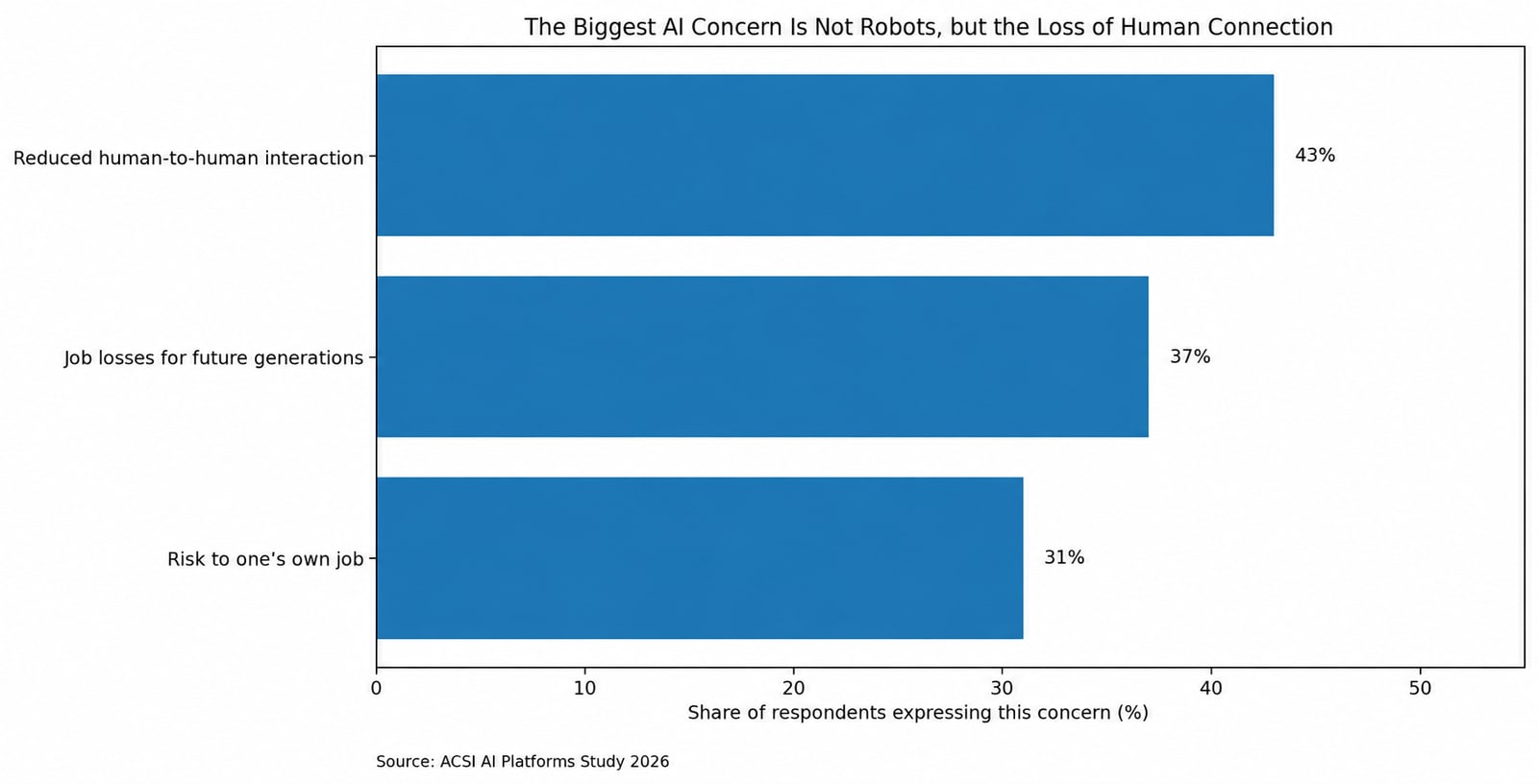
This finding is a wake-up call for CX professionals. Companies mostly describe AI projects in the language of efficiency: faster service, lower costs, less waiting, more automation. All of that is valuable. But customers may not always feel the same way.
The company says “efficiency.”
The customer feels, “They’re brushing me off.”
The company says “self-service.”
The customer feels, “I’ve been left on my own.”
The company says “AI-powered solution.”
The customer worries, “Will I be able to reach a human?”
I discussed exactly this feeling earlier when I wrote in CX Bulletin about disappointment with AI in customer service. The picture there was very similar: The problem was often not the technology itself but the way brands put technology in front of customers as a barrier.
The ACSI report confirms the same picture from another angle: The problem isn’t the presence of technology but how that technology makes customers feel.
The Trust Gap Is Really a CX Gap
ACSI notes that two of the strongest factors driving satisfaction with AI platforms are functional reliability and trust in data security.
That sentence belongs in the brief for every AI project.
After all, an AI error doesn’t feel like an ordinary digital glitch. If a button on a website doesn’t work, you get annoyed. But if AI steers you wrong, your trust is shaken. In that case, the system isn’t just carrying out a transaction; it’s advising you, offering recommendations, sometimes becoming a partner in your decision-making. That’s why a hallucination is more than a technical problem. From a CX standpoint, it’s a breach of trust.
As Forrest Morgeson points out in the ACSI study, the skepticism consumers developed over the past decade about how social media platforms use their data is now carrying over to AI platforms. And with AI, the risk is higher, because in their prompts people may share far more sensitive information about their work, health, finances and personal decisions.
Seen this way, AI security isn’t a compliance item sitting in the legal department’s back room. It is the customer experience itself.
My analysis of the Gartner 2026 customer trust report in CX Bulletin carried a similar warning: Technology can deliver speed, but human nature still puts a premium on trust and authenticity.
This is where AI’s real test begins. Customers won’t judge AI by how brilliant it is, but by how reliably it behaves at the critical moment.
Gen Z Uses It More but Is Less Satisfied
One of the report’s intriguing paradoxes lies in the generational gap.
Gen Z uses AI for a broader range of tasks, such as email drafts, long-form writing, data analysis, gaming and entertainment. Even so, Gen Z’s satisfaction score is 69. Among Millennials, Gen X and Baby Boomers, the score is 74.
At first glance, that seems odd. Why would the generation that uses it more be less satisfied?
I think the answer is very simple: Gen Z pushes AI harder.
When users simply ask AI, “Tell me about this topic,” the answers they get may often seem good enough. But when the same users expect creative writing, complex analysis, decision support, high-quality text or an enjoyable and consistent interaction from AI, the bar goes up.
AI can be impressive on simple tasks. On hard tasks, its true character shows.
That’s an important lesson for brands: Measuring AI satisfaction with a single average score is misleading. It needs to be measured by use case.
Complaint resolution in customer service is one experience.
Product recommendations are another.
Financial decision support is yet another.
Looking for health information is something else entirely.
Lumping them all into the same “AI satisfaction” bucket blurs the reality on the ground.
What Does Premium AI Tell Us?
Another important signal in the ACSI data comes from premium users. Among premium subscribers, ChatGPT’s score rises to 80 and Google Gemini’s to 82.
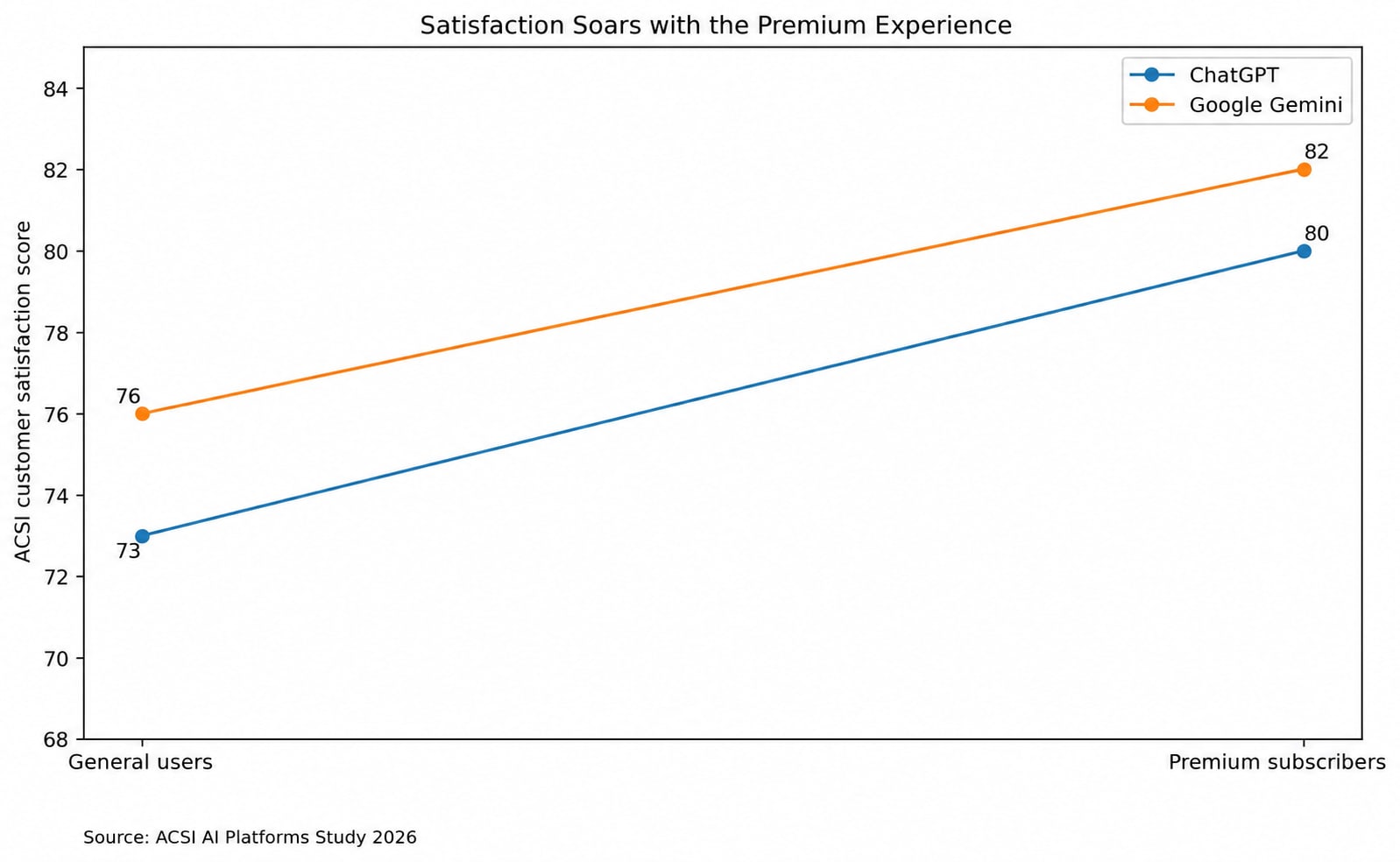
What this finding tells me is that users aren’t rejecting AI. When it works better, is more reliable and delivers more value, satisfaction goes up.
Many factors could be behind premium subscribers’ satisfaction: more advanced models, faster responses, better access, fewer interruptions, more powerful features, or users approaching the experience more deliberately because they’re paying for it.
But whatever the reason, the takeaway matters: When the AI experience improves, customers notice.
This carries a very clear message for brands, too. The era of “let’s just put a chatbot in the customer journey” is over. Poorly designed, half-trained bots that don’t understand the brand’s language and keep trapping customers in loops are now seen not as innovation but as digital torment.
I made a point of stressing this distinction when I looked at T-Mobile’s IntentCX approach in CX Bulletin: AI should be used not to build a wall between customer and brand but to make the experience more personal and more seamless. In T-Mobile’s approach, technology is positioned not as something that takes employees out of the loop but as a system that empowers them with better tools.
The distinction may seem small. But for customers, it makes an enormous difference in how they feel.
Where Value Is Greatest, So Is Concern
The ACSI report also paints a striking picture by sector. Technology tops the list of areas where Americans see the most value from AI: 50% see value, while 27% are concerned. In healthcare, 34% see value and 29% are concerned. In finance, 26% see value and 27% are concerned.
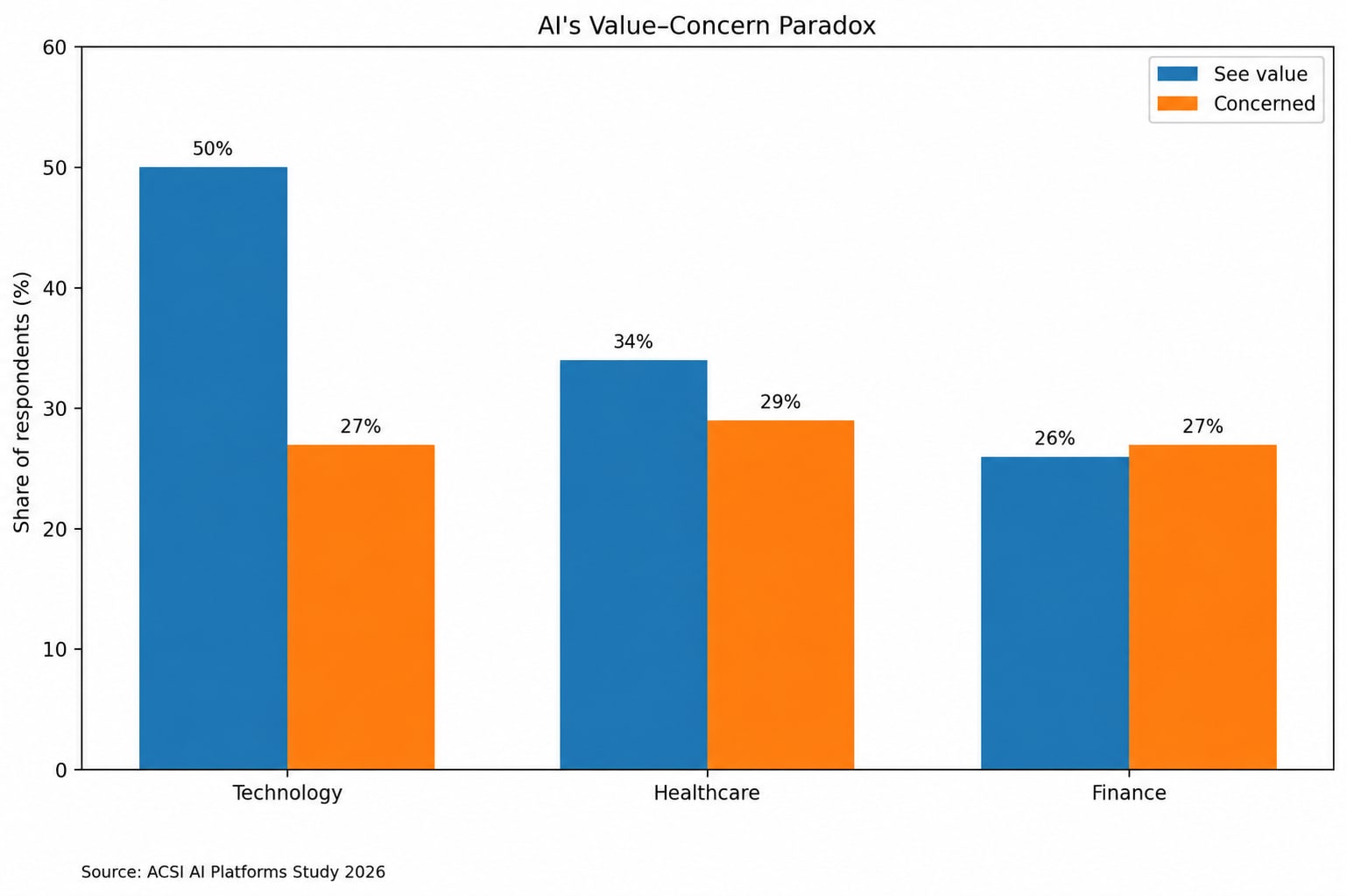
This picture reminds me of a simple but powerful truth: AI creates the most value in areas that are complex, high-risk and directly touch our lives. But that’s exactly why the biggest questions of trust arise there too.
In healthcare, if AI works well, life gets easier. But if it gets things wrong, the consequences are serious.
In finance, if AI works well, decision quality improves. But a faulty recommendation destroys trust.
In customer service, if AI works well, wait times drop. But if it wipes out human contact, the brand loses its warmth.
In other words, high potential value comes with a heavy responsibility to be trustworthy.
The agentic commerce example that Walmart and Google have built on Gemini also sends an important signal here. As I wrote earlier in CX Bulletin, customers no longer just search for products; they describe their intent. Instead of searching for “camping tent prices,” they ask, “How can I have a great time outdoors this weekend?” and that’s where the experience begins.
That’s why, in the future, we’ll need to design around intent, not just interfaces.
But designing around intent also means designing for the customer’s privacy and sense of control. Otherwise, personalization feels less like convenience and more like surveillance.
5 Lessons for CX Leaders
I draw five clear lessons from this report for CX leaders.
1. AI shouldn’t distance customers from people; it should get them to the right person faster.
A good AI experience doesn’t trap customers inside automation. When needed, it hands them off to the right agent with context intact.
2. Trust isn’t a product feature; it’s an experience promise.
How data is used, where AI steps in and when the customer is handed off to a human should all be clearly designed.
3. An average satisfaction score isn’t enough.
The AI experience needs to be measured by use case. Research, writing, recommendations, complaints, technical support and sales support are not the same thing.
4. The first experience is the gateway to adoption.
If users don’t feel safe and successful on their first try, a second try may never come.
5. The goal of AI should be not just to cut costs but to lighten the customer’s load.
Sometimes the two lead to the same place. But not always.
It’s also worth recalling the core principle I underlined in my piece on calculating ROI on customer experience investments: Experience investments win lasting support only when they’re tied to financial and behavioral outcomes. Saying “customers love us” isn’t enough; you have to show how trust translates into retention, lower cost to serve, higher usage frequency and stronger loyalty.
The employee–customer disconnect I explored through the Ipsos 2026 report is also critical here. When AI projects are designed solely by the technology team, an invisible gap can open up between frontline employees and customers’ real needs. Expecting a real leap forward in CX from AI before that gap is closed would be overly optimistic.
Conclusion: AI Can Be Artificial, but Experience Can’t
ACSI’s 2026 AI Platforms Study paints a very clear picture. AI platforms are no longer experimental toys on the sidelines of our lives. For active users, they’ve become a daily habit. At the same time, a large group is still outside the door. And those inside expect more.
Gemini may lead on satisfaction today. ChatGPT may be posting a big jump among premium subscribers. Copilot, Claude, Grok and Perplexity may be competing in their own lanes.
But from a CX perspective, here’s where the real race will begin:
Which platform will users trust more?
Which platform will handle its mistakes better?
Which platform will strengthen human contact rather than wipe it out?
Which brand will place AI not as a wall in front of customers but as a support system behind them?
The future of AI, after all, won’t be decided by model size, benchmark scores or technical capabilities alone.
What will decide it is the feeling customers are left with when they step away from the screen.
And that feeling is entirely human.
This piece was first published in Turkish in CX Bulletin on April 27, 2026. English translation.