The AI Letdown in Customer Service: Why Consumers Are Still Looking for a Human
A Pega and YouGov survey of more than 4,700 consumers shows they are angry not at the technology itself but at how brands use AI.
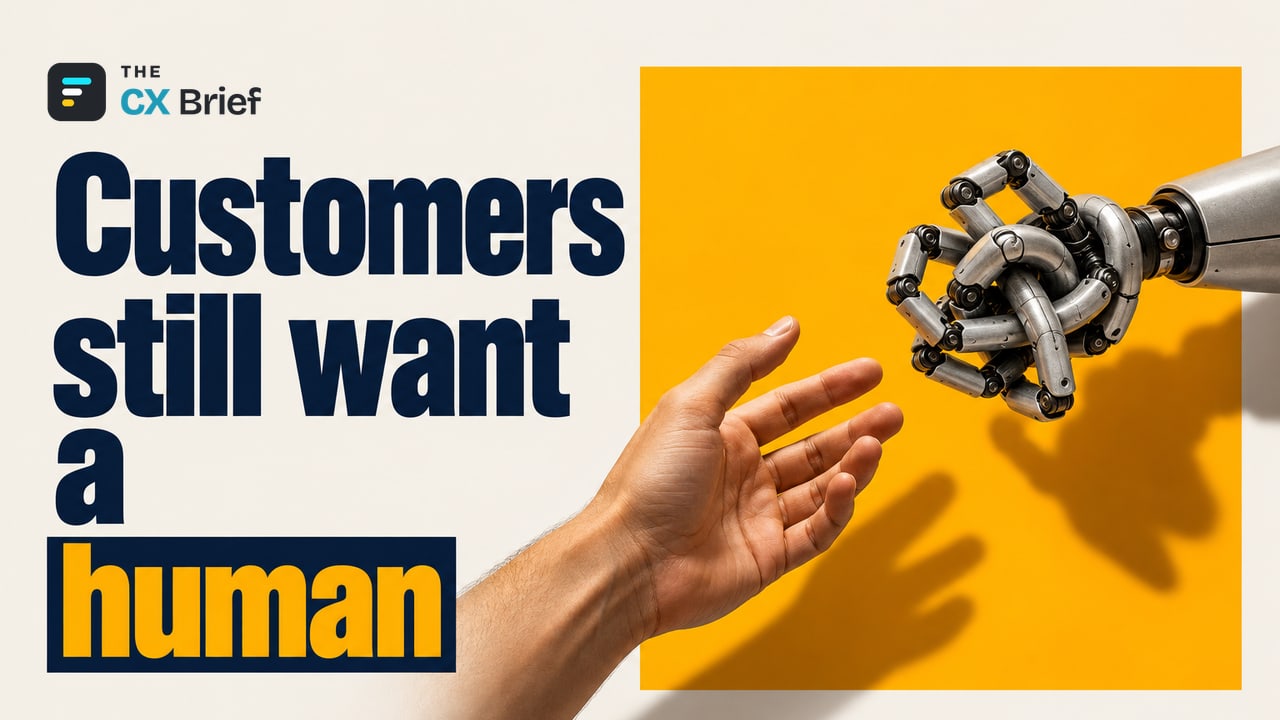
It has happened to all of us: instead of joining that long line at the supermarket checkout, you head for the digital “express” self-checkout, hoping to be done in seconds. You’re scanning barcodes at a great clip when suddenly that infuriating red light starts flashing and a mechanical warning appears on the screen: “Unexpected item in bagging area!” You tap the screen, lift the item and put it back, but the system has completely locked up. In that moment, all that wonderful automation and speed mean nothing; your eyes start searching desperately for a flesh-and-blood store employee who can scan their badge and rescue you from that digital limbo.
That is exactly how customers generally feel today about the digital assistants brands are investing so heavily in. The latest research data from Pegasystems (Pega) and YouGov, gathered in November 2025 from more than 4,700 consumers in the US and the UK and published in February 2026, lays this deep disappointment bare. Consumers are angry not at the technology itself but at “how” brands use it.
The Trust Gap and the Age of Doubt
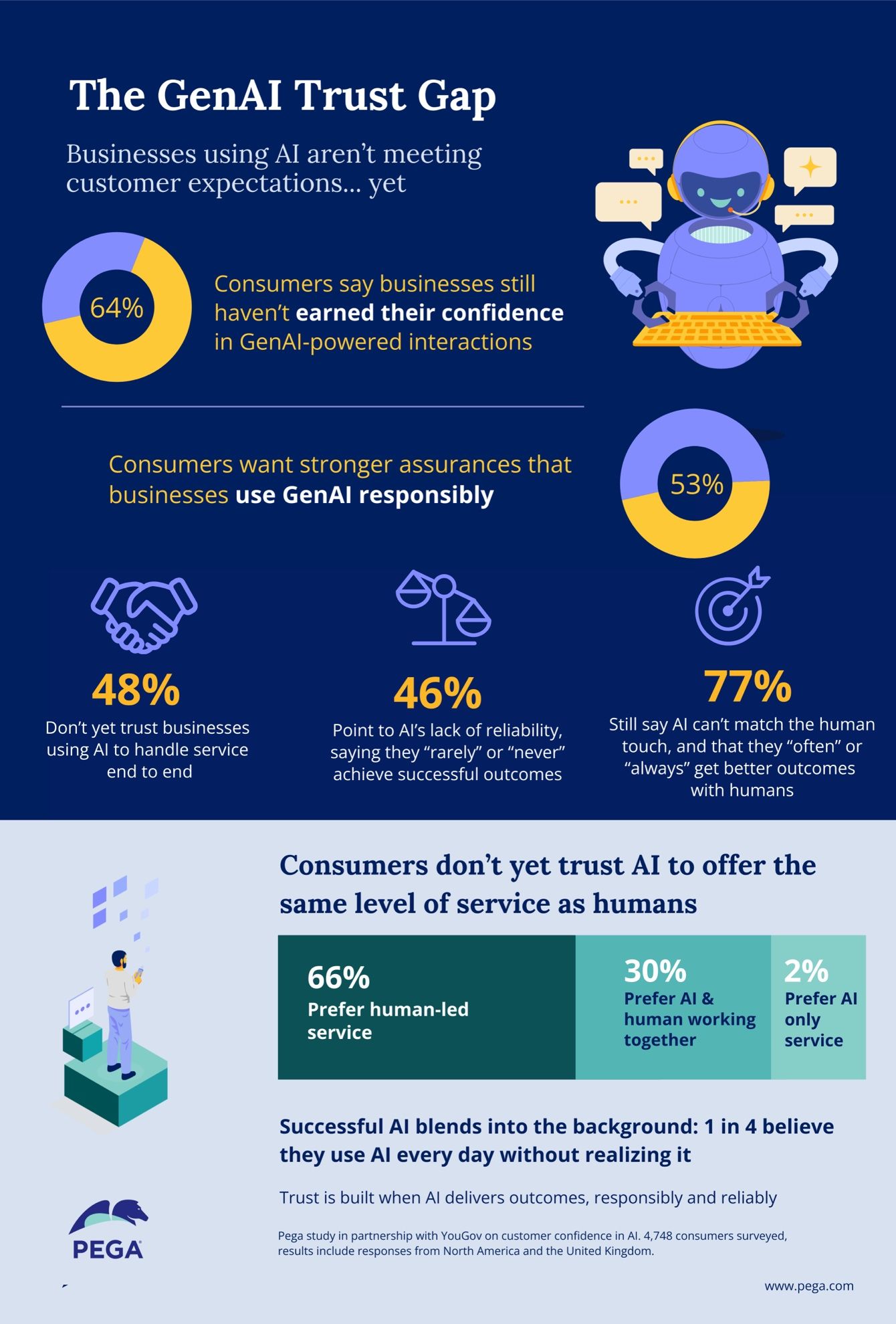
One of the study’s most striking findings concerns a lack of trust. Among consumers, 64% don’t trust brands’ ability to use generative AI accurately and competently when interacting with them. Worse still, 53% have serious doubts that organizations are using this technology ethically and responsibly.
Your customers feel that the smart algorithms running in the background are designed not so much to solve their problems as to cut costs and brush them off as quickly as possible. In fact, this picture is all too familiar to us. We recently took a detailed look at how Gartner’s 2026 Customer Trust Report sounded a similar alarm, finding that 50% of consumers prefer brands that don’t use AI. All the reputable research in the industry points to the same thing: trust is worth far more than the speed of algorithms.
A Competence Crisis and the Triumph of the Human Touch
How well the technology actually performs in the field is a crisis in its own right. According to Pega’s data, 46% of users say they “rarely” or “never” reach a successful outcome with AI-powered tools. In other words, systems that cost millions of dollars, far from solving customers’ problems, add even more friction to the journey.
Given this, it’s hardly surprising that 77% of consumers say they get better results when resolving their issues with a person. Only a tiny minority of respondents, 2%, want to resolve their issues entirely through chatbots. That figure tells us, loud and clear, that we need to shake off our technology fetishism and return to realistic experience design. Remember: a digital assistant that doesn’t work and wears customers out doesn’t cut costs; on the contrary, it sends the customer churn rate through the roof, and churn is one of the biggest drains on the ROI of customer experience investments.
From Chatbots to Agents: How Do We Correct Course?
So how do we get out of this digital dead end? As Pega Director Simon Thorpe put it, if companies want to rebuild consumer trust, they need to set aside the simple, rule-based chatbots that so often lead consumers down blind alleys.
The future lies in generative AI agents that get the job done: agents that anticipate what customers want and can handle back-end operational work on their own. The fact that 24% of consumers don’t realize they actually use AI every day supports this thesis. The most successful technology isn’t the kind shoved in your face; it’s the kind that makes life easier without users even noticing.
When designing customer journeys, positioning technology as a quiet helper that makes life easier, rather than as a showpiece, will be the most productive path forward for all of us. If an algorithm doesn’t save customers time or make them feel valued, the impact of that investment on our financial statements will, unfortunately, remain limited. Perhaps the real magic lies in confidently letting people take over in those delicate moments that call for empathy and compassion, while building frictionless systems instead of chasing complex automation.
This piece was first published in Turkish in CX Bulletin on March 23, 2026. English translation.