Could Your Brand's Infatuation with AI Be Driving Your Customers Away?
Imagine that a robot barista has just arrived in your neighborhood — very sleek, ultramodern and able to whip up anything in seconds. At first, everyone lines up to see the shiny new toy. But after a while, you go back to the old corner coffee shop, where you can tell someone what's on your mind and they listen, asking how you've been while making your coffee exactly the way you like it. After all, technology may deliver speed, but people, by nature, will always pay for trust and authenticity.

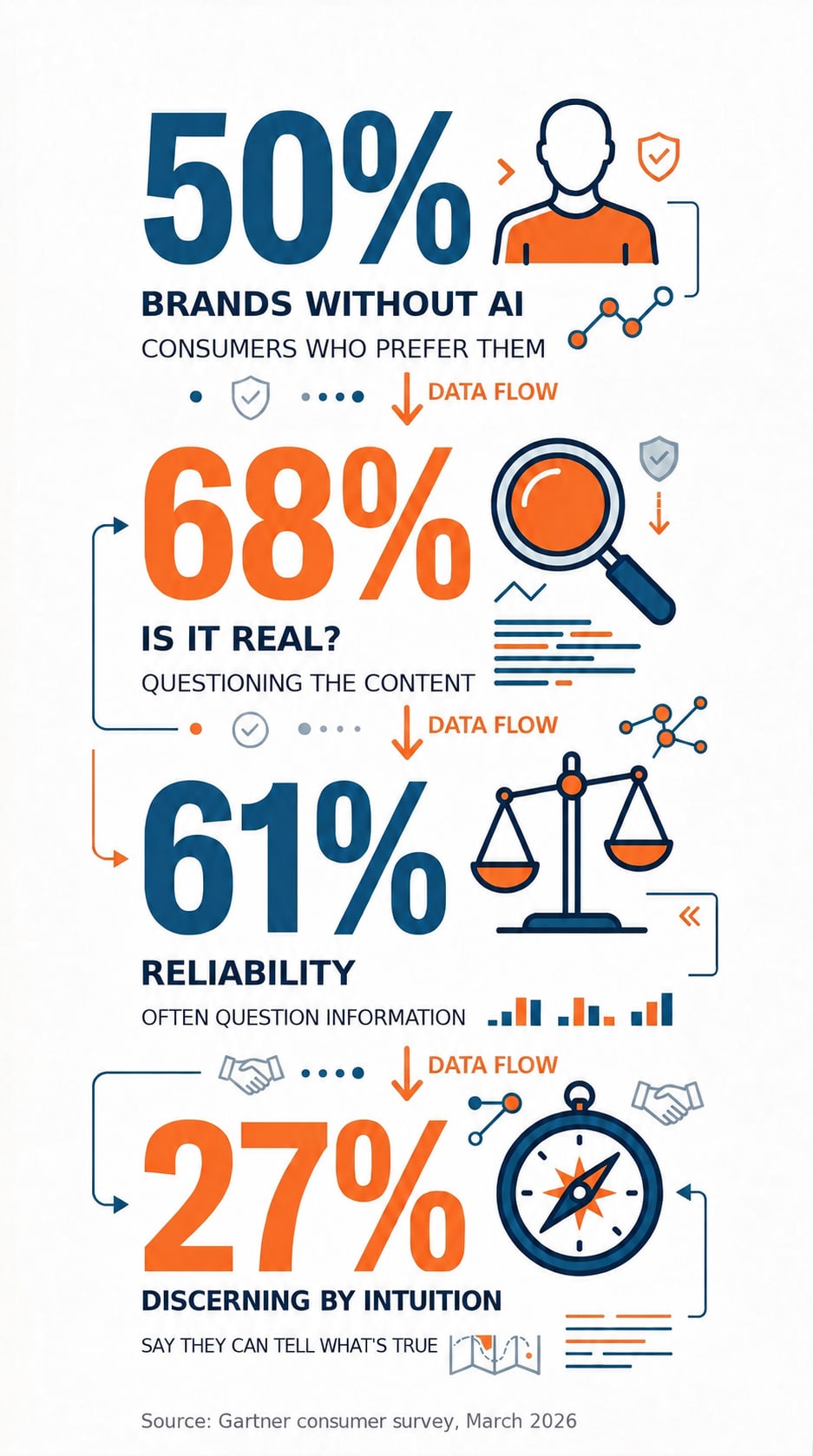
This is exactly the lens through which we need to view the GenAI frenzy that has swept through the business world lately. While companies are racing to reinvent all their operations with the magic wand of algorithms, a startling report Gartner published on March 16, 2026 comes as a wake-up call for all of us: a full 50% of consumers prefer to do business with brands that don’t use generative AI in their consumer-facing content. Yes, you read that right. That oh-so-cool, cost-cutting technology you’ve rolled out may actually be quietly showing half your customers the door.
This is the clearest proof of a truth that has echoed through the digital world for years: just because consumers use technology doesn’t mean they like your brand using it against them.
The Erosion of Trust and the Age of Doubt
Digging deeper into Gartner’s research, we find even more striking data: 61% of consumers say they frequently question the reliability of the information they use to make everyday decisions, and 68% wonder whether the content they see is real. More interesting still, as of the end of 2025, only 27% of consumers say they can tell intuitively whether a piece of information is accurate. In other words, the era of “It feels right, so it must be true” is officially over; it has given way to the skepticism of “I need to verify this.”
(It looks like we’ll soon be hearing the phrase “trust-building” as often as “AI.” We also recommend reading our article based on McKinsey’s research report on the subject.)
As Gartner Senior Principal Analyst Emily Weiss so elegantly summed it up, marketers have to treat generative AI not just as a technology decision but also as a “trust decision.” Academic research and behavioral analyses from across the internet ecosystem also strongly support this thesis. Recent industry studies on explainable AI show that when a system’s workings aren’t explained transparently, consumers feel trapped in a “black box” and immediately distance themselves from the brand.
After all the years we’ve spent in the attention economy and the inflationary turbulence we’ve been through, consumers are now all too aware of a harsh truth: if they’re not paying for something, they are the product. Consumers suspect that brands use AI as an optimization tool to get more money out of their wallets rather than to serve them better.
A Brief Aside on the Turkish Market
So what does this global picture mean for Türkiye? Culturally, we look for “eye contact” and “the warmth of the neighborhood shopkeeper” in business relationships, and we value relational trust and warmth even above contracts. Given that, every synthetic layer brands put between themselves and the customer could alienate customers much faster and more sharply in the Turkish market. AI’s flawless but cold, sometimes overly “mechanical” diction can damage local consumers’ sense of belonging to a brand far more deeply than it does on average worldwide. In this part of the world, putting people at the center while embracing technology isn’t just a strategy; it’s a matter of survival.
Recalculating the Route: Strategies That Build Trust
So how will brands get past this AI fatigue? When we combine the world’s best consulting practices with reputable analyses of consumer behavior from across the internet, a clear roadmap emerges.
First, transparency is a prerequisite, not a favor. Rather than hiding their use of AI like a “secret formula,” brands should label it proudly but honestly. Consumers should know within seconds whether they’re dealing with a bot or a human. Disclosing AI use earns a brand major points for honesty.
The second critical point is to hand control back to its rightful owner: the customer. In customer experience design, AI tools should be offered as options (opt-in/opt-out), not as requirements. Forcing technology on people instantly drives tech-wary audiences away from the brand.
Finally, technology has to be placed at the right point in the journey. AI shines brightest in the research, inspiration and opportunity-spotting stages at the very start of the customer journey. In low-risk, high-benefit “assistant” roles such as search engine optimization, personalized product recommendations or data classification, AI works wonders. But when it comes to solving problems, showing empathy or making critical decisions, there must always be a human hand on the wheel.
This piece was first published in Turkish in CX Bulletin on March 23, 2026. English translation.