Everyone Is Chasing Agentic AI, but Only a Handful Are Catching Up
Forrester's 2026 report: three-quarters of organizations are adopting autonomous AI, but very few are putting it into production. My take on what it means for brands in Türkiye.

Last week in CX Bulletin, I covered FIFA entrusting its World Cup operation to Salesforce’s Slack and Agentforce platforms: a concrete case for agentic AI, made on a stage watched by millions of fans. The first reaction to the piece “The World Cup’s Invisible Squad” was: “So it can be done.” It can, yes — but that stage is the exception, not the rule. Forrester’s The State of Agentic AI, 2026 report, published at the start of this month, puts numbers on the distance between the exception and the rule — and the picture looks quite different from the excitement on conference stages.
Brian Hopkins and colleagues sum up the report in a single sentence: the technology is accelerating like a runaway train, and the organization is the heavy load it has to pull. It’s a familiar story, really. A new wave of capability arrives, everyone chases it, and then the quiet gulf between “acquiring” and “using” opens up. What’s new this time is how fast the train is going.
Chasing is free, catching up is expensive
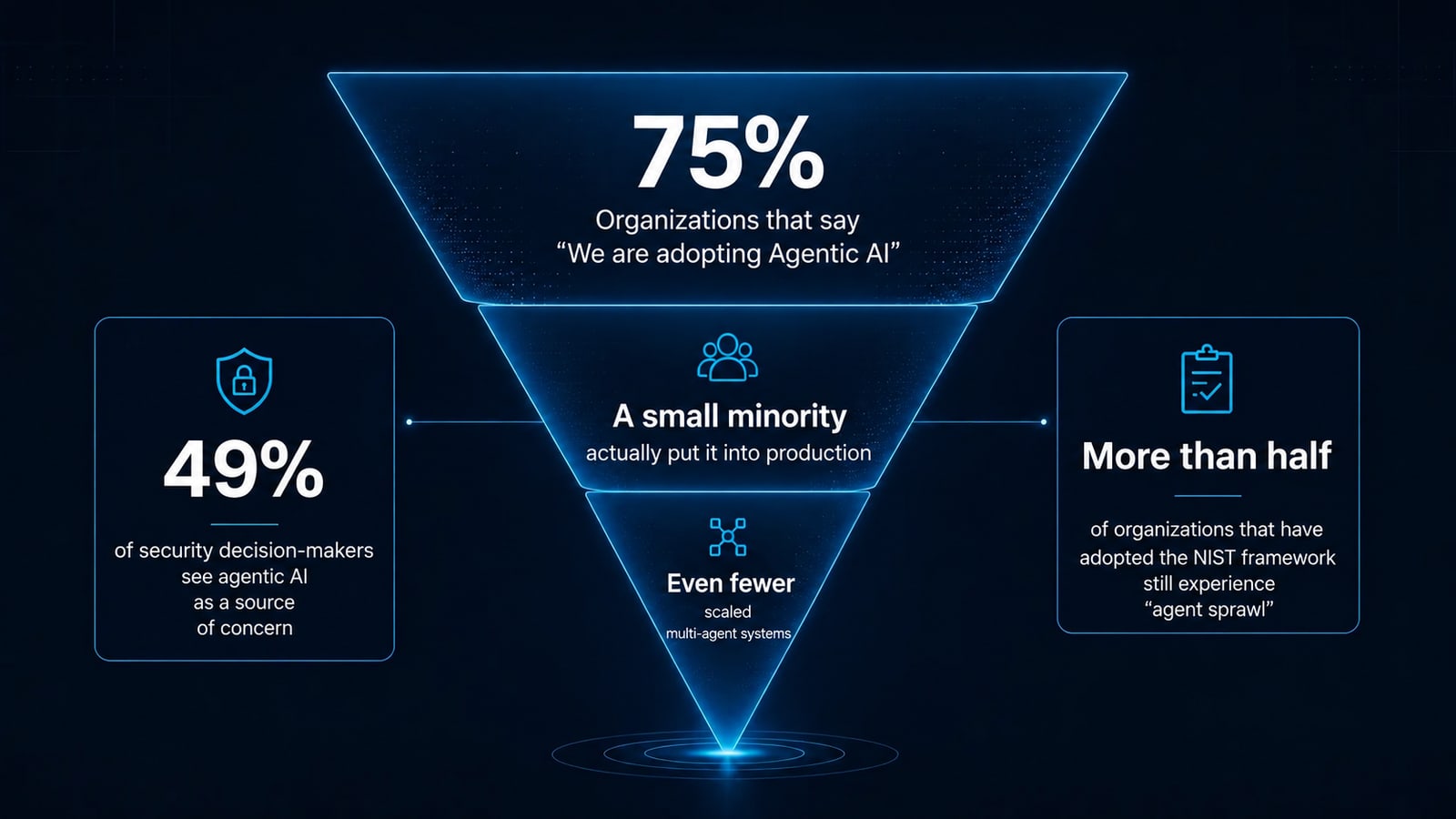
According to Forrester, roughly three-quarters of enterprise leaders say “we’re adopting agentic AI.” But only a small minority can run it in a meaningful production environment, beyond “fake AI” solutions dressed up as chatbots. Truly scaled multi-agent systems that talk to one another are rarer still. In other words, interest is everywhere; scale is almost nowhere.
You don’t have to look far to find the Turkish version of this picture. It’s hard to keep count of how many brands have announced “agentic AI-powered customer service” in the past few months, but underneath those announcements there is often an old IVR tree or a chatbot running a pre-written script. This year, the AloTech CX Summit made its theme, quite explicitly, “The Future of Customer Experience with Agentic AI”; it captured the industry’s mood. But the gap Forrester points to still stands, untouched, between a brand having agentic AI on its agenda and the same brand running an agent that can close a customer request end to end with no human intervention.
Agents that run for months, not hours
The real shift is this: agents now run not for minutes but for hours, days, even months. Forrester cites OpenAI’s internal software workflows, which have run almost hands-free for months; Cursor’s long-running coding agents; and Anthropic’s research agents that run for days. The evidence is plain to see.
As Forrester observes, a long-running agent doesn’t behave like a chatbot; it behaves like a distributed system. That demands a discipline most companies have never developed: orchestration, identity and context management. The report highlights a subtle point here: what breaks scaling is task complexity, not the number of agents. Stitch ten isolated agents together without a shared registry or routing logic, and what you’re left with is duplication and drift instead of coordination.
Look at customer service, and the difference becomes even clearer. An FAQ bot is not the same kind of creature as an agent that initiates a customer’s return, checks inventory, triggers shipping, asks about satisfaction three days later and, if necessary, hands off to a human representative. The second carries an entire workflow from start to finish. Which means it can also carry a single misstep all the way through. Whatever makes autonomy attractive in customer experience is also what makes it risky.
The real bottleneck is trust, not technology
Forrester groups the reasons catching up is expensive under four headings, and all four are already on the agendas of CX leaders in Türkiye. The first is money: ROI uncertainty traps enterprise enthusiasm in the pilot stage, because most companies can’t make the case for a production rollout beyond narrow efficiency gains. The second is the governance gap: even among organizations that have adopted NIST’s AI risk framework, more than half say they are experiencing uncontrolled agent proliferation — “agentic sprawl,” in the report’s words — because a policy document can’t oversee an autonomous system that calls tools. The third is platform confusion: decision-making stalls while teams argue: “Off-the-shelf SaaS agent, integrator-built system, or build our own from scratch?”
Underneath them all lies a trust tax. Every autonomous action needs to be logged and defensible to an auditor; right now, that cost is too high. Those furthest ahead feel it most. Forrester’s example is Bank of New York, which has pushed as far ahead as a regulated institution can; even so, it has not yet captured the full value that agentic AI promises. But BNY has something most organizations lack: a workforce ready to manage highly autonomous agents inside a tightly regulated business. Forrester describes this readiness as “gold.” In my view, that’s also the report’s most valuable sentence for Türkiye.
That’s because the trust tax is even heavier here. For a bank supervised by the BDDK, an insurer or a telecom operator, an autonomous customer-facing decision that turns out wrong isn’t a technical incident; it’s a matter of reputation, compliance and sometimes law. There is a world of difference between a bot giving a wrong FAQ answer and an autonomous agent processing a return incorrectly or making a customer a promise it can’t keep. As I noted in my piece on building a customer experience organization from scratch, what comes before the technology is the structure that will carry it.
Source: Forrester, The State of Agentic AI, 2026 · Chart: CX Bulletin
You can’t manage risk with quarterly reviews
This is also the part executives most underestimate. In Forrester’s 2026 security research, 49% of security decision-makers flagged agentic AI as a source of concern. And these threats are new not in degree but in kind. Agents can impersonate one another and escalate privileges — because nonhuman identity management is still in disarray. The agent population is growing faster than anyone can track, and when coordination breaks down, a small miscalculation turns into a major outage.
Forrester’s recommendation is clear: a system like this can’t be governed through quarterly reviews. It is governed by a monitoring layer that runs alongside the agent as it works, and by identity and policy enforced as code, not put down on paper with fingers crossed. In customer experience, that means this: before scaling autonomy, the answer to the question “what exactly can this agent do, on whose behalf, and up to what limit?” must be observable in real time.
Those who catch the train aren’t the ones with the most agents
So what are the leaders doing? Forrester’s answer is a little counterintuitive: those pulling ahead aren’t the ones with the most agents, but the ones who lay the track in advance for the train to run on. Three moves stand out, and all three are more about structure than technology.
The first is orchestration before agents. Without shared registries and handoff patterns, agents can’t work as a single whole; each one ends up rowing alone. The second is redesigning the work itself, not the tool. An agent bolted onto an old workflow built for human speed saves a few steps; it doesn’t deliver a leap. You have to pick a few high-friction flows and rebuild roles and approval mechanisms around autonomy — which is more an operational redesign than a technology project. The third is treating every agent as a managed identity: unique credentials, least privilege, full logging and a named owner who manages its life cycle. No ownerless autonomy. Then comes phased scaling: start with clearly bounded tasks, with approval gates and rollback paths in place, and expand autonomy only as the controls prove themselves.
The invisible common denominator of these three moves is people. What set BNY apart wasn’t its technology but a workforce ready to manage that technology. That is exactly what I meant when I wrote that the invisible root of customer experience is employee experience: no matter how many agents you add to a team whose engagement has hit rock bottom and that doesn’t know how to work with agentic systems, the result is uncontrolled sprawl. A ready workforce is the most expensive and, at the same time, the most valuable component you can buy.
AI conversations in North America have long since moved on from the “which model is better” debate to the question of “who has actually put it into production”; that is where the divide on the ground now begins.
The question left as the year ends
Forrester’s report closes with an image I like: the train is moving, and moving fast; the only question left is whether the train is headed where we want to go. Let me sharpen this a little for CX leaders in Türkiye. Will we spend 2026 piling up pilots, or building the control plane? By year-end, after all, plenty of brands will say “we’re using agentic AI.” The real divide will be between those who have an agent on a slide and those who have built autonomy their customers can genuinely trust.
The train is leaving. The point isn’t to board it; it’s to have already laid the track toward our own destination.
This piece was first published in Turkish in CX Bulletin on June 21, 2026. English translation.