How to Build a Customer Experience Organization from Scratch: 10 Steps to a Successful Structure
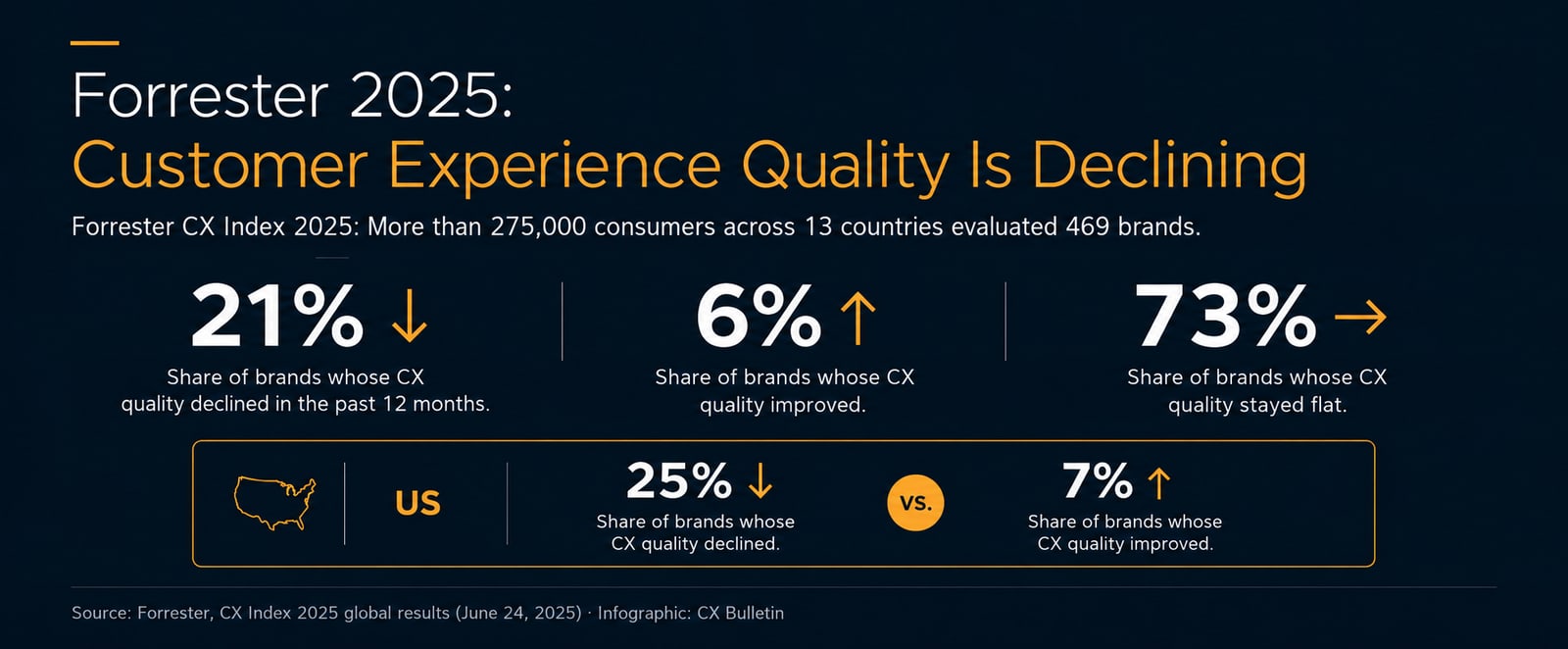
Forrester’s 2025 Global Customer Experience Index shows CX quality in North America has fallen to its lowest level ever; the author traces the cause not to the budget but to the org chart, and lays out ten steps for building a CX structure from scratch.

In recent years, customer experience has become firmly embedded in the corporate vocabulary. New titles have been created; practically every company now measures NPS, and CX has started to feature regularly in investor presentations, too. “Customer centricity” has been added to many companies’ lists of values. The effort and budget poured into all this are nothing to scoff at.
Yet where we have ended up globally is hardly encouraging: Forrester’s 2025 Global Customer Experience Index shows that CX quality in North America has fallen to its lowest level ever. Globally, only 6% of brands managed to raise their scores, 21% declined, and the vast majority stood still; in the US, the share of brands that declined rises to a quarter. What’s more, this was the latest chapter in a multiyear streak of declines. The new results Forrester shared in June 2026 offer the first sign of recovery in North America (26% of brands improved, 7% declined); even so, most brands are still treading water.
I have long seen this picture as a paradox. The decline is not happening because companies aren’t spending enough on customer experience. The cause is usually more structural. Because the customer experience function is bolted on after the fact to an org chart that was set up long ago and designed around product and channel silos, it cannot overcome that structure’s natural resistance or take root within it, no matter how hard it pushes.
This is exactly where the idea of “starting from scratch” makes sense. Trying to turn an organization that was never designed around the customer into a customer-centric one by adding a department after the fact is like trying to shore up a building with a faulty foundation by painting it. What the brands at the top of the index — names such as Chewy, USAA, Navy Federal and Zappos — have in common is striking: none of them set up customer experience as a unit tacked on later; they built the company around the customer from the very start.
Why rebuild rather than repair?
Rebuilding is a radical proposal; I’m well aware of that. But two developments make this radical option more reasonable than ever.
The first is the speed at which AI is changing the nature of work. I recently examined a striking Forrester prediction in a separate piece — the thesis that nearly half of customer service jobs will be handed over to AI by 2030. This is not just a cost story; it is also a rare window of opportunity. As most operational tasks move to automation, now may well be the best moment to design the organization around the customer journey from the outset, rather than piecing it back together around old job descriptions.
The second is that customer expectations themselves have changed. As I noted in my analysis of the endurance economy, today’s customers look for fairness, certainty and control before sparkle. These are not things any single department can deliver; they require the whole organization, from pricing to operations and from legal to product, to work in concert. As Forrester’s report on customer-obsessed organizational structures underscores, customer advocates, specialized roles and permanent functions are not enough on their own — but when they are set up correctly, they are the real levers that bring an organization closer to the customer.
So if you are starting with a clean slate, what steps does it take to build this structure? Blending my own observations from the field with Forrester’s operating model framework, I will walk through the ten steps I consider critical, in order.
1. Start with “why”: A corporate purpose and a clear customer promise
What comes before the org chart is a clear answer to what the organization exists to do for its customers. Without that answer, every unit you set up will sooner or later chase its own internal goals, and the customer will fall through the cracks between departments. A customer promise is not a nice line in a marketing brochure; it is a concrete commitment the organization pledges to keep at every touchpoint. In Türkiye, I see many brands set out with an abstract goal such as “customer satisfaction” without ever pinning down what they are promising, to which customer, and at what moment. Before the structure’s framework is in place, this promise has to be expressible in a single sentence — because all nine of the steps that follow will serve that sentence.
2. A real owner in top management — not a symbolic title
It is not enough for customer experience to have an owner on paper; it needs a real owner who can shape budgets, decisions and priorities. One of the reasons behind the decline Forrester points to in the index is “waning customer obsession” — in other words, senior management’s attention drifting over time. In any structure where the CX leader sits under marketing or the contact center, customer experience is doomed to be pushed to the bottom of the priority list. The most critical decision in building from scratch is where this role sits at the table. CX ownership without a real sponsor at board level, its own resources and an equal voice alongside the other functions is toothless before it even gets off the ground.
3. An honest map of the current experience
Rebuilding does not mean ignoring the past. Before design begins, you need to take an honest look at what customers actually experience today. This is not an idealized journey drawn from the inside; it is a map of the complaints, the drop-off points, the silent anger and the places where value melts away. Together with friends of mine who are directors at Customer Institute, I have pinned down one error in particular: organizations mistake their own processes for the customer’s journey. Yet the two rarely overlap. Any structure built without an honest end-to-end diagnosis tends either to solve a problem that doesn’t exist or to ignore the real one. This step is exhausting and sometimes bruises egos inside the organization — but skip it, and everything else is built on guesswork.
4. The framework: Centralized, federated or distributed?
This is where the real architectural decision lies. A centralized model gathers all CX capability under one roof and ensures consistency, but in large organizations it risks becoming detached from the business units. A distributed model makes the experience the responsibility of each unit; it boosts agility but makes consistency harder. Between the two, the federated (hub-and-spoke) model looks like the most realistic balance for most mid-size and large Turkish organizations: a small, strong center sets the standards, the measurement language and the methodology, while “spoke” roles in the business units apply them in their own context. In organizations that are mature in CX, customer experience has a real place on the org chart and a real budget. In those that lag on CX outcomes, it is often an add-on duty that some other function takes on voluntarily. The right framework is chosen to fit the organization’s size and maturity — not copied.
5. Clear roles, ownership and accountability
Once the framework is in place, the next layer is clear roles: journey owners, experience design, customer insight and operational execution. The most common mistake here is a fuzzy structure in which everyone is responsible but no one is accountable. Every critical moment in the customer journey should have an owner — someone who can be held accountable for the experience at that moment. In an era when AI will take over operational work, it pays to look ahead when defining these roles: as repetitive tasks shift to automation, human roles will increasingly move toward design, exception handling and relationships that call for empathy. Roles should be designed not around today’s workload but in anticipation of this shift; otherwise the structure starts to age while it is still being built.
6. Bringing the customer’s voice inside: VoC and the insight engine
A CX organization cannot stand without a mechanism that systematically brings the customer’s voice inside. That is not just sending out surveys; it means collecting feedback, making sense of it, getting it to the right decision-makers and closing the loop. In Türkiye, it saddens me to see many organizations collect NPS or CSAT yet fail to connect that data to decision-making, treating these scores as an end rather than a means — the score gets measured, posted on a dashboard and left there. Yet the value of an insight engine lies in its ability to turn what it measures into the next product, process or operational decision. When building from scratch, this mechanism should be positioned not as a tool to bolt on later but as the organization’s central nervous system.
7. The right metrics and solid governance
What you measure shapes how the organization behaves — and that is where the danger lies. Metrics should be tied to business outcomes (retention, lifetime value, repeat purchase) rather than used merely for show. Just as important is the governance of those metrics: a regular cadence, the right forums and a mechanism that triggers decisions. One warning bears repeating here. As I explained in my piece on Starbucks tying employee bonuses to customer scores, linking a metric too tightly to incentives invites the “training the customer” trap: employees focus on collecting high scores instead of genuinely helping customers. Good governance uses the score as a compass, not a goal.
8. Employee experience: A non-negotiable prerequisite
Chief among the reasons Forrester cites for the decline in the index is “weakening employee experience” — and that is no coincidence. If the employees who deal with customers are burned out, lack authority or have a poor experience themselves, no design can make up for it. A CX organization built from scratch has to treat employee experience as a prerequisite for customer experience — not as an HR project to be added later. An experience that isn’t lived on the inside can’t be expected to show on the outside.
9. Process and technology come last
Here, sequence is everything. Most organizations do the exact opposite: they buy technology first, then build the organization around it. Indeed, one of the reasons for the decline that Forrester lists in the index is “disappointing technology implementations” — that is, the tool we thought was the solution becoming the problem itself. Process should serve the experience you have designed, and technology should serve that process. AI is no exception to this logic: it is not a strategy but a lever that, when set up correctly, accelerates strategy. First the customer promise, then journey design, then the process that makes it possible, and last of all the technology that scales that process. Breaking this sequence is the most common reason structures end up expensive but ineffective.
10. Culture and continuity: Making change stick
The last step is actually the one that determines how long the other nine will last. Even the best structure erodes over time without a culture and a mechanism for continuity to keep the organization from sliding back into its old silo habits. That means recurring rituals, a shared language, consistent behavior from leaders and a deliberate effort to manage change. Real maturity in customer experience is not a badge you earn when a project wraps up; it is a habit that has become the way the organization breathes. That, ultimately, is the point of building from scratch: putting the customer at the center stops being a slogan that has to be recalled at every new decision and becomes the organization’s default way of working.
The real strategy is the org chart itself
For years, we have talked about customer experience as a campaign, a tool or a score. Yet the problem is largely structural. With AI taking care of operational work and customers expecting fairness, certainty and control, an organization’s most strategic decision may turn out to be not which AI it buys, but whether it has the courage to redraw its org chart around the customer.
As planning for the next six months gets under way, will customer experience have a real place and a real budget on the chart — or will it once again remain an add-on duty that some other function takes on voluntarily? The way out of the decline the index has charted lies in the answer to that question.
This piece was first published in Turkish in CX Bulletin on June 11, 2026. English translation.