The Hidden Root of Customer Experience: 10 Steps for Companies That Want to Focus on Employee Experience
Employee engagement has hit rock bottom. Yet the formula for customer loyalty hasn't changed: Everything starts with an engaged employee.

The agendas of customer experience leaders tend to look alike: real-time NPS scores, meticulously updated journey maps and massive data sets built from customer feedback. Yet in this seemingly flawless system, a vital piece is usually missing: the voice of the frontline employee who actually delivers the experience to the customer, offers the first smile at the door, answers the phone and takes the initiative to solve the problem.
This gap is no longer just a hunch; it has become a measurable reality. This year’s edition of Gallup’s State of the Global Workplace report shows that global employee engagement declined for the second year in a row, falling to its lowest level since 2020. Only about one in five employees is truly engaged at work, and no region saw an increase. Each one-point drop equals 21 million employees who are not engaged in their work. Low engagement costs the world economy an estimated $10 trillion in lost productivity — roughly 9% of global GDP.
These figures usually stay buried in HR newsletters. In my view, their real audience is customer experience executives.
This Isn’t an HR Issue — It’s a CX Issue
The “service-profit chain” defined thirty years ago by Harvard’s Heskett, Sasser and Schlesinger still holds today. Profit and growth are driven by customer loyalty, loyalty by satisfaction, and satisfaction by the value delivered to the customer. And the only people who can create that value are employees with high job satisfaction who are committed to their company. If customer experience is the last link in the chain, employee experience is the first.
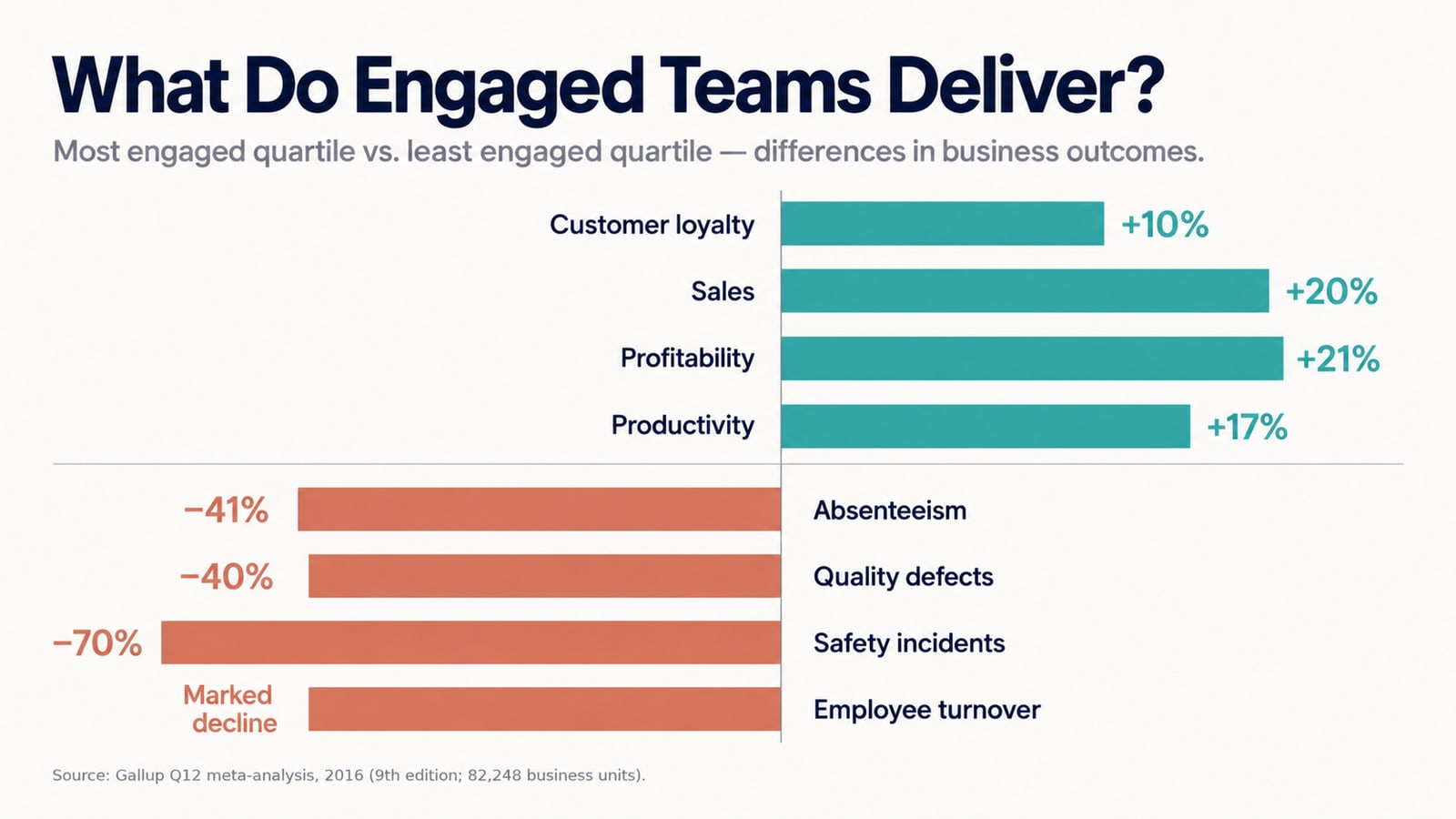
Gallup’s 2016 Q12 meta-analysis, compiled from more than 82,000 business units, shows that teams in the top quartile of engagement outperform those in the bottom quartile by 10% in customer loyalty, 20% in sales and 21% in profitability. The 2024 edition, covering more than 180,000 business units, confirms the same pattern: a 23% gap in profitability and 18% in sales. The same teams fare markedly better on absenteeism, turnover, quality defects and safety lapses. This correlation remains remarkably consistent from industry to industry.
No matter how much advanced technology you build into the system, if engagement is low among the people using it, the value that reaches the customer will remain limited. The experience takes shape at the last point where it passes through human hands.
In recent weeks, I wrote about the risk in Starbucks’ move to tie employee bonuses to customer scores as part of its “Back to Starbucks” transformation. While linking employee experience to business outcomes is the right strategy, tying it to the wrong targets pushes employees toward manipulative behavior with customers. The real issue is building the system around the right metrics.
At the Center of the Crisis: The Manager
The most striking finding in Gallup’s data points to the center of the decline: managers. Managers, who for years enjoyed a higher “engagement premium” than their teams, are seeing that advantage erode. The manager is the very lens through which employees experience the company. According to earlier Gallup research, at least 70% of the variance in engagement across teams is attributable to the manager.
This is a clear warning for CX professionals. A frontline employee’s daily experience is shaped not by senior management’s visionary strategies but by their direct supervisor. A tired manager who is disconnected from the system will smother even the best-designed CX vision before it ever reaches the customer. That said, the data show that some companies achieve manager engagement rates four times the global average.
Laying the Groundwork: Listening and Mapping
Turning this around is, of course, possible. For organizations that want to rebuild the process from the ground up, the ten steps below offer a foundation in which each step naturally reinforces the others:
1. Map the employee journey with the same rigor as the customer journey. The analytical care given to customer journey maps has to be turned inward. You need to pinpoint the turning points along the way, from hiring through professional development to departure. The disorganization an employee experiences on day one is a rehearsal for a breakdown that reaches the customer weeks later.
2. Listen first, then act. Instead of general satisfaction surveys run once a year, you need to build an internal and agile version of a “Voice of the Customer” program. If the data you measure doesn’t turn into action, to employees it is nothing more than bureaucracy.
3. Choose the critical moments and focus. Rather than trying to improve every process at once, it is more effective to concentrate on one or two stages, such as the first 90 days, the window in which early departures are triggered. One tangible improvement employees can feel is worth more than ten invisible initiatives on paper.
The Real Lever: Managers and the Front Line
4. Put managers at the center. The most rational investment in employee experience is an investment in managers themselves. Good managers must be carefully selected, continually trained and supported. A manager engagement dashboard must be on the radar of every leader who tracks customer experience.
5. Link the experience to business metrics the right way. Employee experience isn’t a social responsibility project but a rational business strategy. However, tying an NPS score directly to an employee’s bonus may improve the scores without fixing the experience itself. The focus should be not on the score itself but on improving the underlying process.
6. Give the front line room to decide. You need to give the person who delivers the experience to the customer the authority to make decisions on their own. As I stressed earlier in my piece on the power of the human touch in retail: technology and efficiency will carry you only so far; the rest depends on the moment when an employee can “bend the rules and do the right thing.” A front line without authority is helpless, even at its most courteous.
7. Position technology to support employees. This is where the AI debate comes to a head. A separate employee survey Gallup conducted in the US in the first quarter of 2026 says something striking: the strongest predictor of whether an employee will adopt AI — after technical integration — is whether their direct manager champions it. At the same time, nearly a third of employees in finance, insurance and technology take seriously the possibility of losing their jobs to AI within the next five years. Fear is no tonic for engagement; it’s poison. As I argued in my piece on the AI-driven transformation of the customer service workforce, companies that position AI not as a rival to employees but as a partner that frees them from tedious work win over both employees and customers.
Alignment and Continuity
8. Embed fairness and recognition in the corporate culture. Work that goes unseen and unacknowledged eventually leads employees to disengage from the system. The answer to the question “Am I being treated fairly?” directly affects the quality of the service delivered to customers.
9. Match the internal experience to the external promise. The gulf between the “great experience” promised in ads and the cumbersome processes people find inside is where disengagement is born. Unless the image the organization projects is backed by its internal reality, the brand perception it creates won’t last.
10. Build a continuous loop. Employee experience should not be a time-limited campaign but one of the company’s core operating systems: collect the data, analyze it, take action and repeat the process.
The Türkiye Lens: In the Shadow of Hierarchy
Although these steps rest on universal principles, the dynamics of the Turkish market make the process harder. Because our business culture is hierarchical and decisions are always expected to come from the top, implementing the steps that put managers at the center becomes critical. High staff turnover in sectors such as contact centers and retail stems not only from pay policies but largely from weak relationships with direct supervisors and from employees being unable to make their voices heard.
When I review entries in international CX competitions, a clear distinction emerges here too: strong journey maps and high automation rates may look impressive, but a program’s real success is measured by how well employees are integrated into that system. An experience model that employees themselves don’t believe in can’t last.
The Real Number on the Dashboard
Countless metrics are tracked on customer experience dashboards, yet the truly critical indicator usually stays in the background: how much the employees who run the system believe in the service they deliver.
In an organization where automation takes over routine operations, the customer interactions left to people become far more complex and demand empathy. Only employees who are committed to their company can handle these interactions well. The real CX race ahead will be won not by whoever has the best AI infrastructure, but by whoever can blend that technology with the most engaged workforce.
At the end of the day, everything comes down to a single truth: whether the employee who creates your organization’s most loyal customer will walk through the door tomorrow morning with the same conviction…
This piece was first published in Turkish in CX Bulletin on June 11, 2026. English translation.