The World Cup's Invisible Squad
FIFA has entrusted its World Cup operation to Salesforce's Slack and Agentforce platforms. I look at agentic AI's most public test yet and what it means for CX teams in Türkiye.

I’m writing this in Waterloo, near Toronto, as Canada, one of the World Cup’s hosts, kicks off. The match is in Toronto, and we only noticed that detail once we hit the crazy Toronto traffic 😄. My daughter Deniz will represent Ottawa at the provincial piano finals. Two tournaments’ worth of excitement in our family at once. 😀 As Turks in Canada, of course, we all feel a special thrill: Türkiye is back at the World Cup exactly twenty-four years after that unforgettable third-place finish in 2002. This time we’re on this side of the Atlantic, eagerly waiting for the Crescent-Stars to take on Australia on June 14. The hunt for match tickets and the planning of watch parties are in full swing.
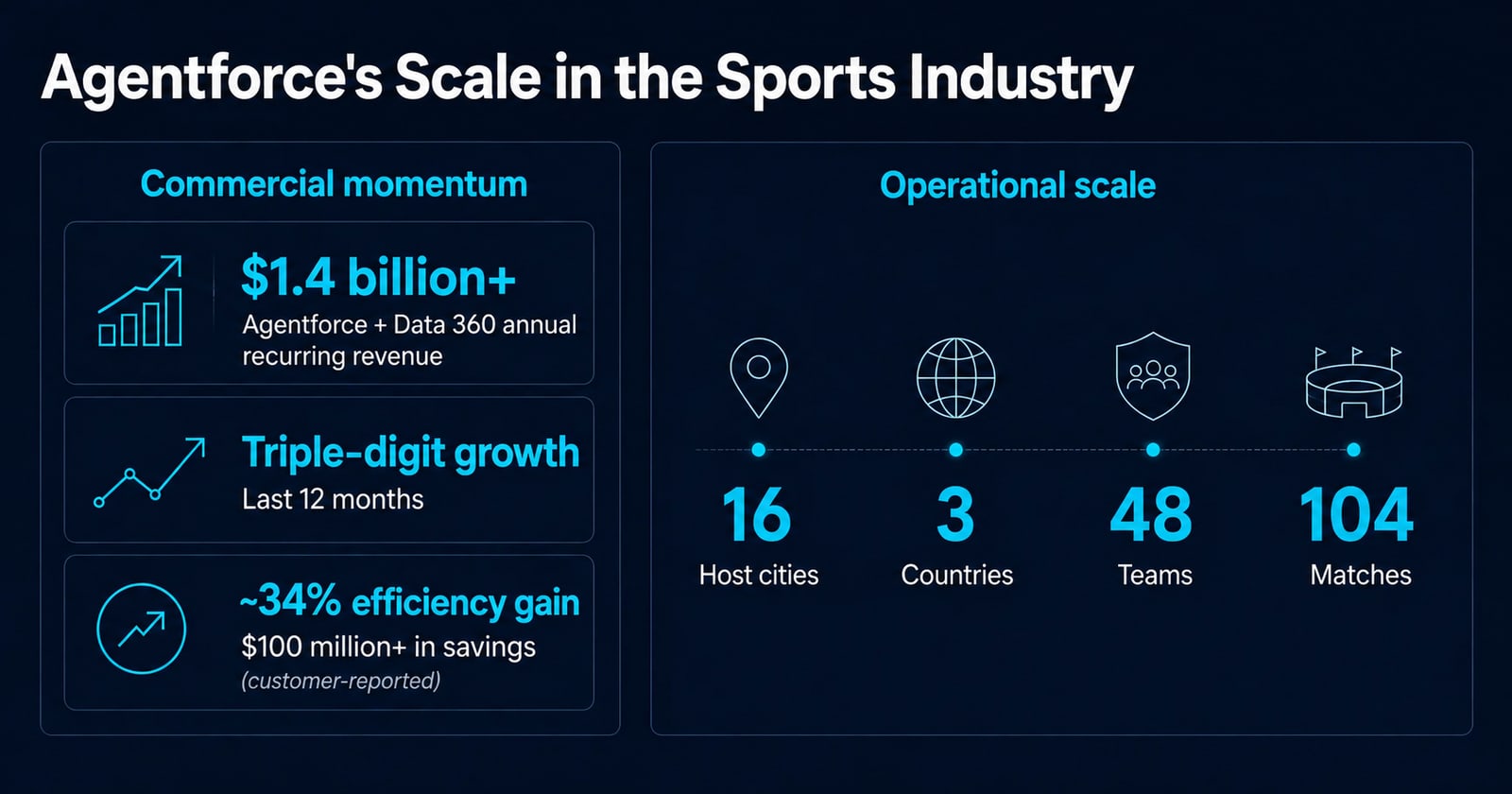
As forty-eight teams take the field, there’s another squad nobody in the stands will ever see: the invisible operations team that has to keep sixteen cities, three countries, multiple time zones and thousands of volunteers working in sync in real time. This year, FIFA entrusted the backbone of that work to a software company: Salesforce.
As Customer Experience Magazine reported, FIFA named Salesforce an official tournament supporter of the 2026 Men’s World Cup. According to Salesforce’s own announcement, in 2026 Slack will handle volunteer and staff coordination across the sixteen host cities, while Agentforce’s service, sales and marketing agents will take on communications with host cities, suppliers and stakeholders. The deal also covers the 2027 Women’s World Cup in Brazil — which will be the tournament’s first edition in South America. That is where autonomous agents serving fans directly will really take the stage.
Brands sponsoring a sporting event is nothing new. What really interests me here is not so much the sponsor logos sprinkled all around the pitch as the big claim behind this partnership. The deal is an attempt to show what agentic AI — AI that doesn’t just put information in front of us but acts on it, routes tasks, coordinates teams and runs workflows without waiting for a human command at every step — can do on a stage where the margin for error is almost zero.
In my previous piece, I looked at Forrester’s prediction that “49 percent of customer service jobs will disappear by 2030” and argued that the real question isn’t how many people will go, but what those who stay will do. The World Cup operation is the other side of the same coin. Here, AI isn’t replacing a contact center; it’s sustaining an operation that no human team could coordinate by hand at this scale. The point isn’t replacement, but a kind of coordination that has never been possible before.
Why is Salesforce taking the field for this match?
As Customer Experience Magazine’s analysis also stresses, the role Salesforce has taken on at the World Cup is essentially one giant “reference site.” Picture it: each of the sixteen cities has its own logistics, its own relationships with local authorities and its own volunteer and staff structure. Layer on three different countries and multiple time zones, and you get a level of complexity beyond what people can manage by hand. If the platform handles this complexity cleanly, Salesforce will have a case study that no analyst report could ever produce. That’s because the operational challenge here is visible, real and — unlike demos — not staged.
The real challenge is that everything happens at once. The system has to maintain a single, coherent, real-time view of these three countries, sixteen cities and interlocking schedules. And FIFA isn’t the only one in that picture: host city governments, commercial partners, volunteer teams and broadcasters are all moving at the same time, each at its own pace and with its own priorities. This isn’t a concert or a single-city event; it’s a network of moving parts that constantly affect one another. The consequences of any disruption are real and instantly visible — which means the system’s successes and failures alike can’t be hidden. The job handed to Agentforce is precisely to keep this network running at every moment.
This is exactly where the difference between a traditional chatbot and the agentic AI we’re talking about today comes into view. An older-generation bot answers a question, fetches a piece of information and stops; it waits for the human’s next command. An AI agent, by contrast, takes a goal, breaks it into steps, pulls data from wherever it needs to, routes the work to the right team and follows up on the outcome. In a setting like the World Cup, it comes down to this: when a gap opens up in a volunteer shift in one city, does the system spot it and replan, or do you wait for someone to notice and report it and for someone else to act? So what is Salesforce putting on the table for this enormous gamble?
The numbers behind the bet
To understand why Salesforce is going all in on this, you only need to look at its financials. According to the quarterly results the company announced in December 2025, annual recurring revenue for Agentforce and its data platform, Data 360, quickly approached $1.4 billion; this revenue line grew at a triple-digit pace over the past year. In the February 2026 results, the same figure passed $2.9 billion. The Agentforce 360 platform became generally available in October 2025, the number of paid deals rose above nine thousand, and the company, citing its customers’ own reports, points to more than one hundred million dollars in annual cost savings and an efficiency gain of about 34%. Salesforce has even defined a new metric, the “agentic work unit,” to measure the volume of work carried out by AI.
The part the highlights don’t show: data and governance
The organizations getting the most out of Agentforce have one thing in common: they put their data and governance in order long before setting up the agent. In one industry example, a company’s data cleanup took longer than deploying the agent. It sounds boring, I know; nobody films a clean data table and shares the video. But the real magic at the World Cup isn’t the agent itself, either; it’s the clean, integrated, governed data and processes underneath it, built up over years.
And here is one of the steps most often skipped in Türkiye: buying an agent is easy; putting in place the data, processes and rules that agent will rely on is the real work — and usually work that shows up in nobody’s budget. Feed an AI agent bad data, and you get a much faster error machine that repeats, thousands of times a second, the mistake one person used to make. Scale also punishes a weak foundation.
What does this tell CX teams in Türkiye?
These days, agentic AI is being pitched to almost every contact center, bank, telecom operator, e-commerce and retail player in Türkiye. What this World Cup project gives CX leaders in Türkiye is a far more solid reference point than any sales presentation: a chance to watch, live, how agentic AI behaves under pressure as it manages distributed teams and handles high-volume stakeholder communications.
In fact, this use case is very familiar to us. Distributed teams, heavy communication traffic, the need to maintain service quality under time pressure — these are almost exactly what our contact center and CX directors live with every day. Think of a bank’s month-end rush, the surge of calls an e-commerce brand sees at its November campaign peaks, or an airline’s winter-weather operational chaos. What they all have in common is the struggle to handle high volumes coming in through many channels within a short window, without letting quality slip. The World Cup operation is the global-scale version of that.
But the transferable lesson is operational, not magical. The trap is importing the agent without importing the data discipline. In the piece where I discussed the endurance economy, drawing on Ipsos data, I noted that today’s customers look first for fairness, certainty and control, and only later for status and sparkle. In an economy where every lira has to be accounted for, agentic AI’s job isn’t to cut headcount; it’s to reduce friction and give customers back that sense of certainty and control. If the agent turns into a new wall that bounces customers from one menu to the next, no efficiency figure will save it.
I’d also like to clear up a misunderstanding here: the goal isn’t to take humans out of the equation. The most valuable interactions — complex complaints, customers in vulnerable situations, high-value decisions — still require a human, but now an augmented one. The agent’s job is to clear away the routine and make room for the human team to focus on the genuinely hard, genuinely human part. In North America, I’ve seen brands rush agentic tools into service and then quietly pull them back because their data wasn’t ready; the winners were the ones methodical enough to come across as boring. We’ll need to show the same patience — especially in an environment where return on investment is questioned every quarter.
In another piece, using Starbucks as an example, I argued that a premium product doesn’t automatically mean a premium experience; the same logic applies here. A shiny AI agent — the “premium product,” in other words — won’t turn into a premium experience if the operation behind it is broken. Customers don’t care how many parameters the model has; they care whether their problem gets solved. The key question teams investing in agentic AI in Türkiye should be asking themselves going forward isn’t “which agent should we buy?” but “what do we need to build underneath this agent to make it work?”
And 2027: same agent, different match
The 2027 Brazil leg of the deal is thought-provoking, too. A single host country, a different audience demographic and FIFA’s goal of growing women’s soccer on a global scale — all of this adds up to a completely different test from the logistical complexity of 2026. How Salesforce adapts its fan engagement tools there will be a good reminder for us, too: “the same AI” doesn’t produce the same result in every context. There is no copy-and-paste CX transformation. An agent setup that works at a bank may not work the same way at an airline or a retail chain. Context comes before technology.
Agents win matches, data wins championships
When the tournament is over, that long-awaited case study will be published too; Salesforce will probably tell a nice success story. But we don’t need to wait for the report to know what we should be thinking about:
“Do we have the unglamorous foundation any agent needs in order to work — clean data, clear processes, solid governance?”
The agent is the striker everyone cheers for. Data and processes are the defense and midfield nobody watches very closely. Anyone who remembers the team that carried Türkiye to the semifinals in 2002 knows: you don’t reach a semifinal with strikers alone.
This piece was first published in Turkish in CX Bulletin on June 12, 2026. English translation.