Autonomy Stops at the Channel's Edge
98% of organizations use AI, but only 15% can turn it into end-to-end resolution. Notes from Talkdesk's 2026 CXA report.

Talkdesk published a report on August 25, 2026: The State of Agentic Automation in CX. The underlying fieldwork was conducted by NewtonX in April 2026, with 252 CX, IT, operations and AI strategy leaders across North America, EMEA, LATAM and APAC. But the findings only came out in August 2026, so what we have is a snapshot that is both fresh and four months old. One point in the report stopped me. Among respondents, 98% use at least one type of AI in customer experience. The share able to combine agentic AI with cross-departmental orchestration, by contrast, is 15%.
The gap between those two numbers sums up the industry’s last two years all too well.
In my June 2026 piece on Forrester’s agentic AI report, we looked at a similar picture: adoption is widespread, scale is rare. What Talkdesk adds is a description of what “scale” means in operational terms. The report calls it CXA — Customer Experience Automation — and defines it not as a product category but as an operating model in which AI agents, human employees, data, the knowledge base, workflows and governance all run as a single system. The terminology may sound like consulting jargon, but the report’s data genuinely bears out the distinction.
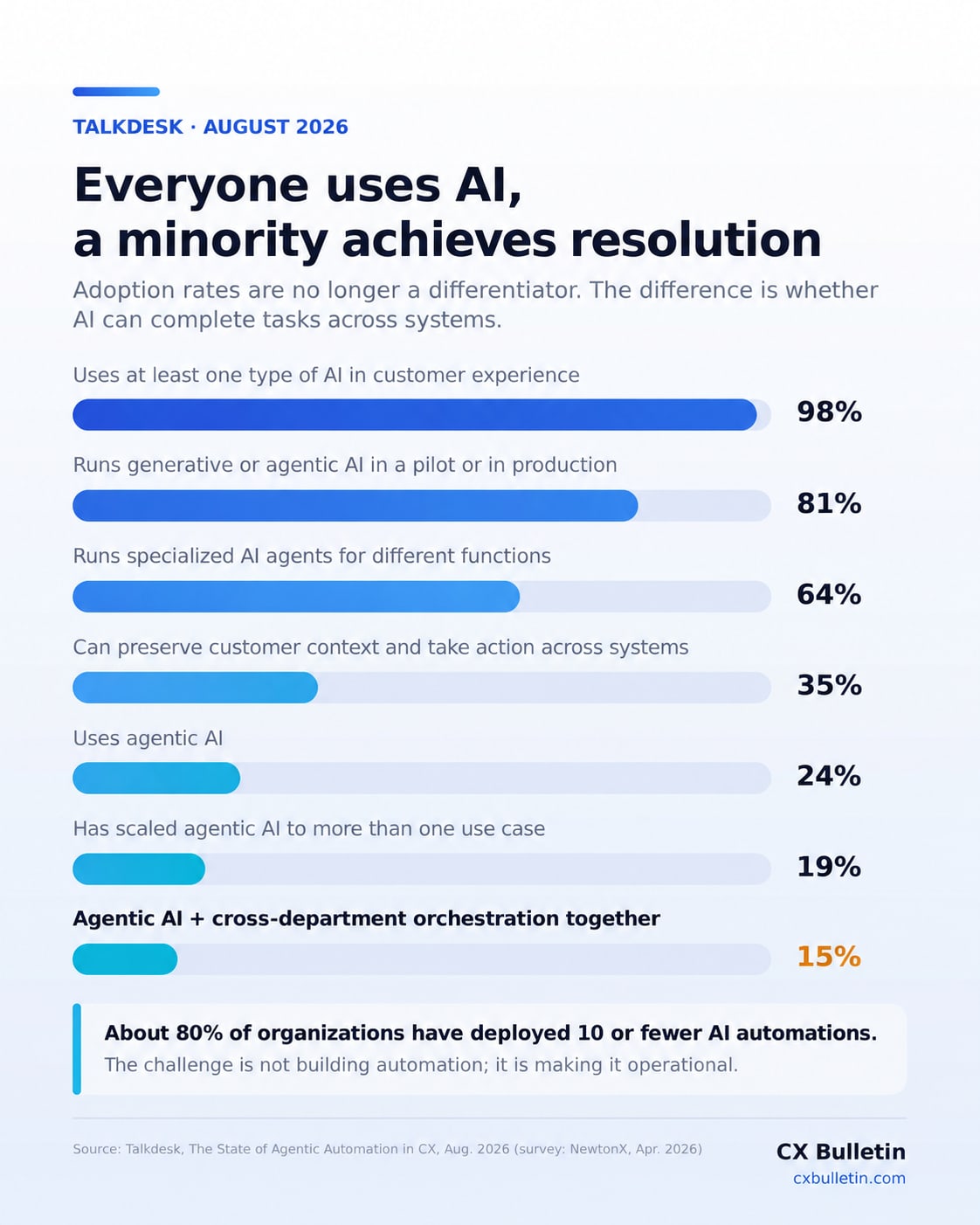
Adoption is no longer a differentiator. Source: Talkdesk, The State of Agentic Automation in CX, Aug. 2026 (survey: NewtonX, Apr. 2026) · Chart: CX Bulletin
The gap between routing and resolving
Two-thirds of organizations (64%) run AI agents specialized for different functions: one for authentication, another for billing, a third for technical support. From the outside this looks like orchestration. But if customer context and history are rebuilt from scratch at every handoff, what you have is not coordination but routing.
The data confirms it. The share who say they have AI that can preserve customer context and take action across systems — that is, actually close a request — is 35%. Those able to deliver proactive service recovery: 30%. Those able to run persistent workflows lasting days: 23%. The further down you go, the narrower it gets.
Examples aren’t hard to find in Türkiye. When you open a billing dispute in a telecom carrier’s mobile app, the assistant that greets you may be genuinely good at routing you to the right queue. But if closing the dispute requires accessing the collections system, the CRM and the campaign records all at once, that is where it stops. For the customer, this distinction isn’t technical; it’s measured by whether they end up typing the same information again two screens later.
Five tiers, two thresholds
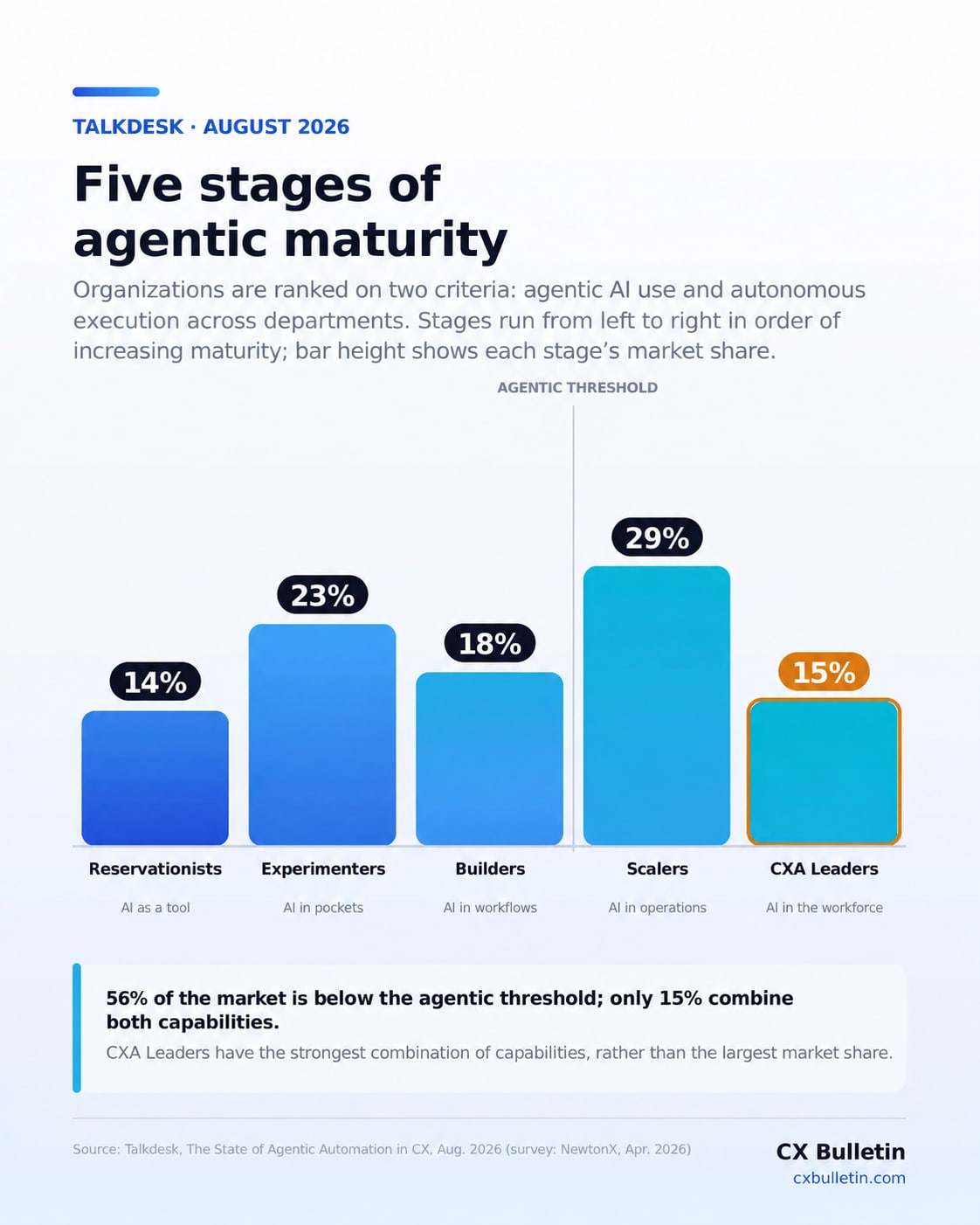
The report classifies organizations by two criteria: whether they use agentic AI, and whether they can execute autonomously across departments. The result is a five-tier ladder: the 15% with both are CXA Leaders, the 29% with one are Agentic Scalers, and the 56% with neither split into three tiers at the bottom.
The report arranges these five tiers as a ranking — one that ascends by capability, not by market share. Each step up carries more autonomy than the one before, but the number of organizations at each tier doesn’t follow that order. There are fewer Builders (18%), for example, than Experimenters one rung below them (23%), and fewer CXA Leaders (15%) than Scalers one rung below (29%). Capability rank and tier size don’t move in lockstep.
A separate breakdown in the report looks at company size — an axis distinct from the five rungs above. What caught my eye there is that size doesn’t guarantee a climb up the ladder. Large enterprises deploy more automations (an average of 8.8 versus 6.6) and are far ahead in using function-specific agents (76% versus 52%). But on outcome metrics, the two groups come out almost even. Budget buys scale; it doesn’t buy maturity.
The barriers also shift with size. Large enterprises point most often to legacy infrastructure (53%) and employees’ job-security concerns (46%). At midsize companies, distrust of AI’s decisions (57%) and a shortage of skilled people (46%) stand out. Carry this over to Türkiye and two different agendas emerge: on one side, established organizations trying to give an agentic layer access to core systems built up in layers over the years; on the other, fast-growing companies that haven’t yet assembled the team to do this work. The two can’t share the same roadmap.
Does maturity actually pay off?
In reports of this kind, this is the part I view with the most skepticism, because the claim that “mature organizations get better results” can easily slip into circular reasoning. Still, the gap in Talkdesk’s data is nothing to dismiss.
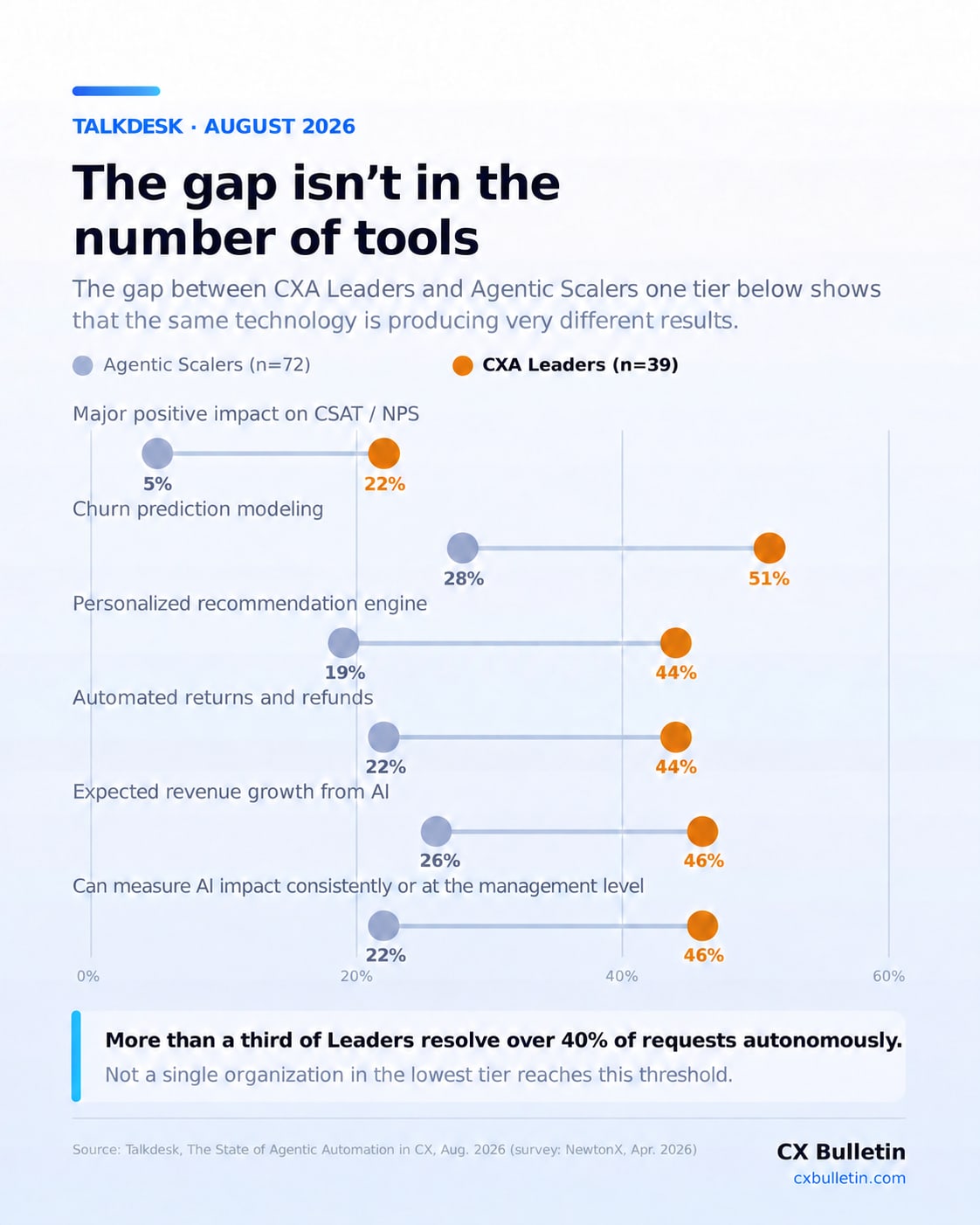
Comparison chart showing the difference between CXA Leaders and Agentic Scalers on CSAT, churn prediction and revenue metrics.
The share reporting a large positive impact on CSAT and NPS is 22% among Leaders and 5% just one tier below. In churn prediction, personalized recommendations, and automated returns and refunds, the Leaders’ numbers are close to double. More than a third of Leaders close more than 40% of customer requests without human intervention; at the lowest tier, not a single organization reaches that threshold.
Yet to my mind, the report’s most honest finding is this: only 5% of all respondents can clearly measure and report AI’s impact on business outcomes. In other words, in most of the places where autonomy is being discussed, what autonomy actually delivers still isn’t being measured. That was exactly the gap I saw most often in the submissions I reviewed as a judge: a strong technology story, weak evidence. Measurement isn’t a reporting detail; it is itself an indicator of maturity.
The model isn’t what’s holding things back
So why are so many organizations stuck? When the report ranks the barriers, not a single item at the top of the list has to do with AI’s capabilities.
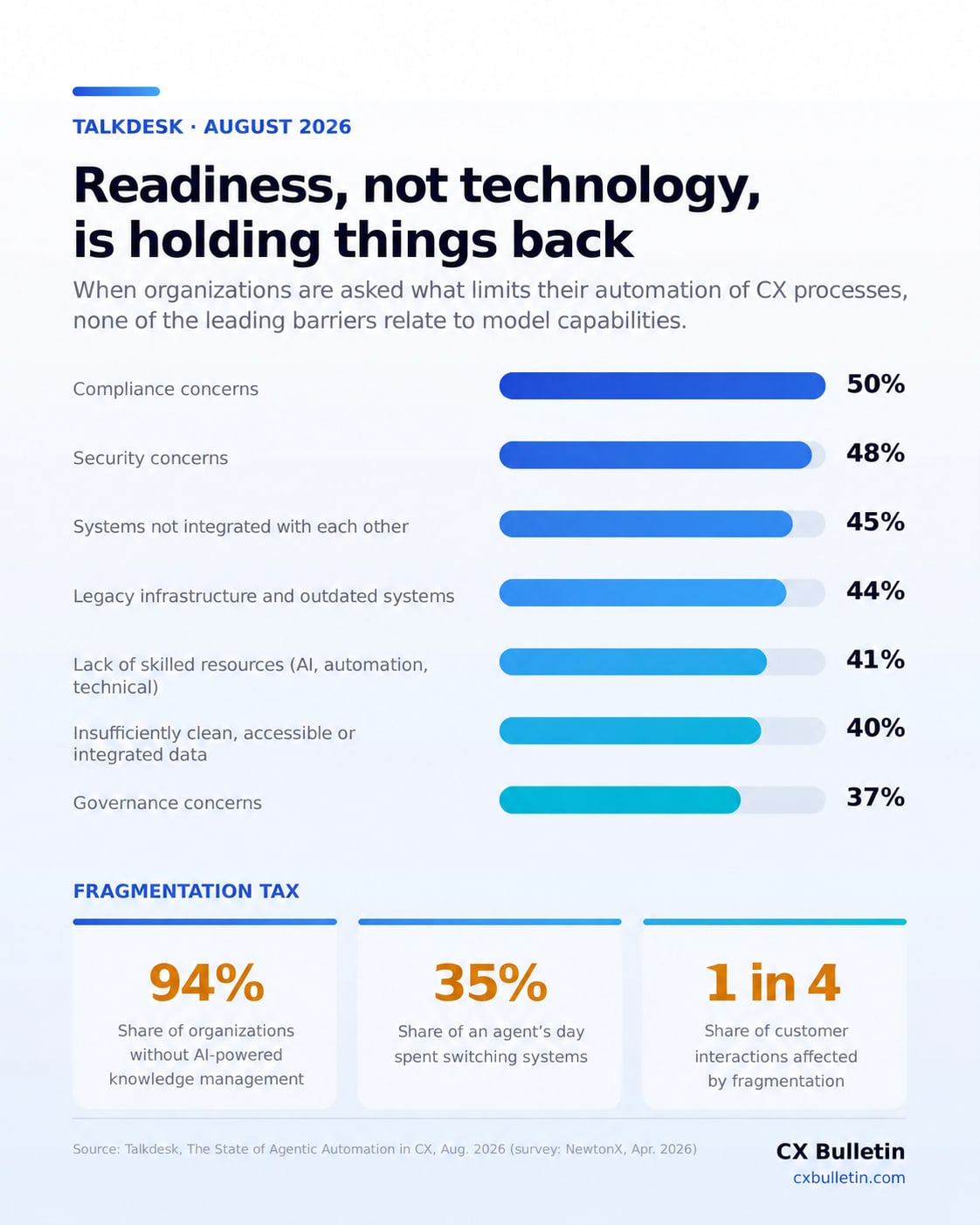
Not a single item at the top of the list has to do with the model’s capabilities. Source: Talkdesk, The State of Agentic Automation in CX, Aug. 2026 (survey: NewtonX, Apr. 2026) · Chart: CX Bulletin
Compliance, security, systems that don’t connect, legacy infrastructure, talent, data quality, governance. All of them are about organizational readiness. And what the report calls the “fragmentation tax” is the bill for that list: In the least mature organizations, human agents spend more than a third of their day navigating between systems, 94% of organizations have no AI-powered knowledge management, and roughly a quarter of customer interactions suffer from missing context and customers having to repeat themselves.
The connection here matters. When I wrote about technology fatigue at SMEs, I arrived at the same point: disconnected tools wear out employees first, and then customers feel it. In the era of agentic AI, this equation becomes less forgiving. In an environment too fragmented for a human to work efficiently, an autonomous agent can’t work safely and consistently either. The agent just gets stuck faster.
Knowledge management is a particularly quiet threat. Among Leaders, 64% have knowledge that is either embedded in the workflow or supported by AI; one tier below, the figure is 38%. If knowledge isn’t where the work gets done, whoever is resolving the request — human or agent — has to stop working to go looking for it. Every pause turns into a delay the customer feels.
The hybrid workforce is coming; trust is the price of admission
The report’s final section is the one I thought about most. Among respondents, 99% say a human-AI hybrid workforce will be beneficial. But the top concern is trust in the quality and accuracy of AI decisions (52%). In fact, 46% of CXA Leaders still mark it as their number-one concern. So even the most mature group hasn’t taken the human out of the loop.
Among organizations using AI agents, 57% say human work is shifting toward more complex tasks. Close to one in five now see agents not as technology but as a workforce. That is a threshold that will redefine many things, from headcount planning to performance management. It’s what I meant when I wrote that employee experience is the hidden root of customer experience: the structure that will carry autonomy is, in the end, one that people build.
The remaining question
Over the next two years, 83% of organizations expect their autonomous resolution rate to rise; almost no one expects it to fall. Every investment priority points the same way, too: cross-system data synchronization, proactive communication, automated quality management, churn prediction.
For CX teams in Türkiye, I’d narrow the question down like this. Will we spend the coming year adding more agents, or building the foundation those agents will run on — context, knowledge, authority limits and measurement? What sets the 15% in the report apart, after all, isn’t that they have more tools. It’s that the tools they have can talk to one another.
And I suspect the next crossroads will come right here: when the question “Which agent did you buy?” gives way to “On whose behalf can your agent act, and how much of the job can it complete?”
Update note (October 14, 2026): When this piece moved to The CX Brief, time references were updated and typos corrected. The piece’s content and views are unchanged.
This piece was first published in Turkish in CX Bulletin on August 29, 2026. English translation.