65% of experts on MIT Sloan panel: As AI grows more powerful, the real test will be preserving human judgment
On the panel of more than 50 experts assembled by MIT Sloan Management Review and Boston Consulting Group, 19% disagree with this view and 15% are undecided.
What's happening
On the AI panel MIT Sloan Management Review convened with Boston Consulting Group, 65% of experts agree that the real test of responsible AI will be preserving trustworthy human judgment in the face of capable machines. According to the magazine, the experts differ on how to define judgment but converge on the main goal: not preserving judgment for its own sake, but designing human-machine systems that keep it available when it matters most. Simply keeping a human in the loop is not enough, the magazine writes; the person giving approval needs context and evidence to make an informed decision.
Behind the number
The panel consists of more than 50 practitioners, academics, researchers and policymakers brought together by MIT Sloan Management Review and Boston Consulting Group. The percentages do not come from a representative survey; they reflect whether panel members agree with the view that the real test will be preserving human judgment.
Whose desk it lands on
The person responsible for AI in customer service. Is there a record of whether decisions in which an agent overrode or followed an AI recommendation later proved right?
Our view
The CX Brief's interpretation, not a claim made by the source.
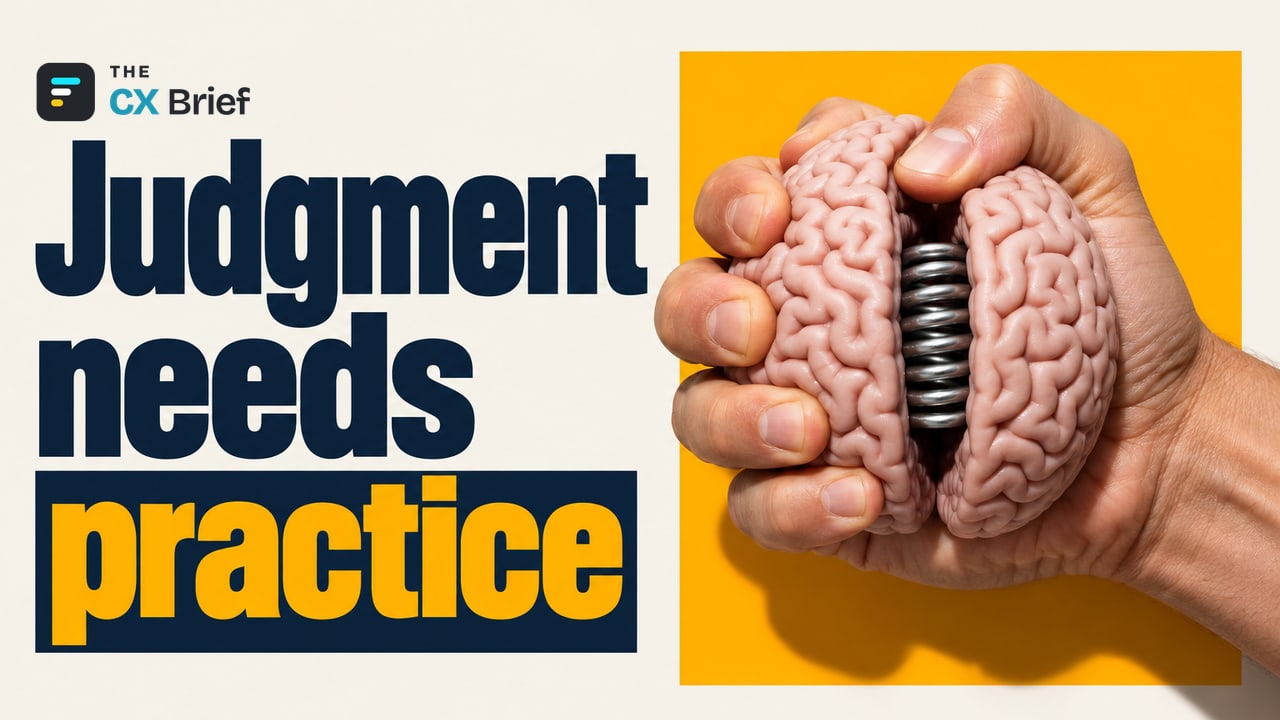
The panel's most useful finding is that judgment is a skill that atrophies when it goes unused, and that the high-stakes decisions where it matters most are too rare to provide enough practice. For customer service teams handing routine decisions to AI, this may be a hidden cost of efficiency; that is why the magazine recommends deliberately leaving some low-stakes decisions with people, as practice.
Source
Source:MIT Sloan Management Review
Reported by: MIT Sloan Management Review·October 15, 2026
Go to source →