When Money Gets Tight, Loyalty Takes Center Stage
New LoyaltyLion research based on a survey of 4,000 consumers shows why interest in joining loyalty programs grows as the economy gets tougher.
Lately, I’ve often found myself in discussions built around this question: “How do we defend our loyalty program spending when budgets are being cut?” Here’s the interesting part: the research points to exactly the opposite of cutting the budget.
A few weeks ago, LoyaltyLion published a study titled Loyalty in 2026. Working with Censuswide, they surveyed 4,000 consumers in the UK and the US who belong to at least one e-commerce loyalty program, with data collected in March 2026. The report is long — more than 150 data points — but today I want to focus on a few findings that will be genuinely useful for brands in Türkiye: we’re going through a rough patch economically, and that’s exactly why loyalty is becoming more critical.
Uncertainty turns loyalty into a refuge
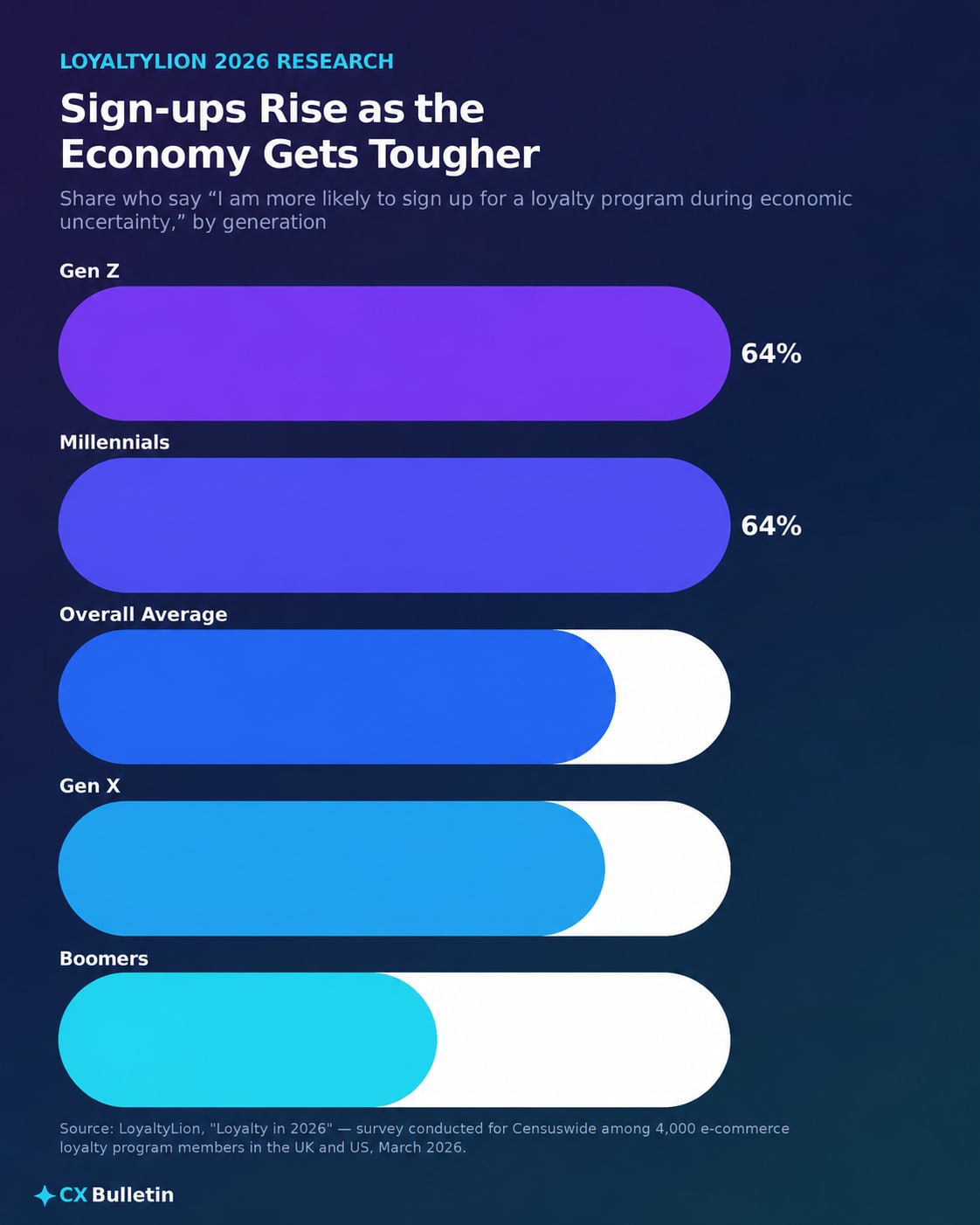
The most striking figure: 53% of respondents say they are more likely to sign up for a loyalty program when there is economic uncertainty. The share is even higher among younger generations — 64% for Gen Z and Millennials, compared with 36% for Boomers.
In my view, behavioral scientist Patrick Fagan, who provided commentary for the research, captures the heart of the matter: when uncertainty rises, people turn to brands they know and trust, and a loyalty program works like a tangible contract that embodies that trust. That also explains why consumers now belong to 3.05 programs on average (up from 2.84 last year) — even as money gets tighter, and perhaps precisely because it is, people don’t want to cut ties with the brands where they collect points.
For brands in Türkiye, cutting the loyalty budget in an inflationary environment could mean dropping consumers at the very moment they most want to hold on to the brand. Indeed, I made a similar point in my analysis of Gartner’s 2026 agenda: the customer journey no longer runs along a single line, and expectations shift quickly over time and across generations. Loyalty is no different — today’s “loyal” customer sticks around for different reasons than yesterday’s loyal customer did.
Discounts are still king, but the gap is closing fast
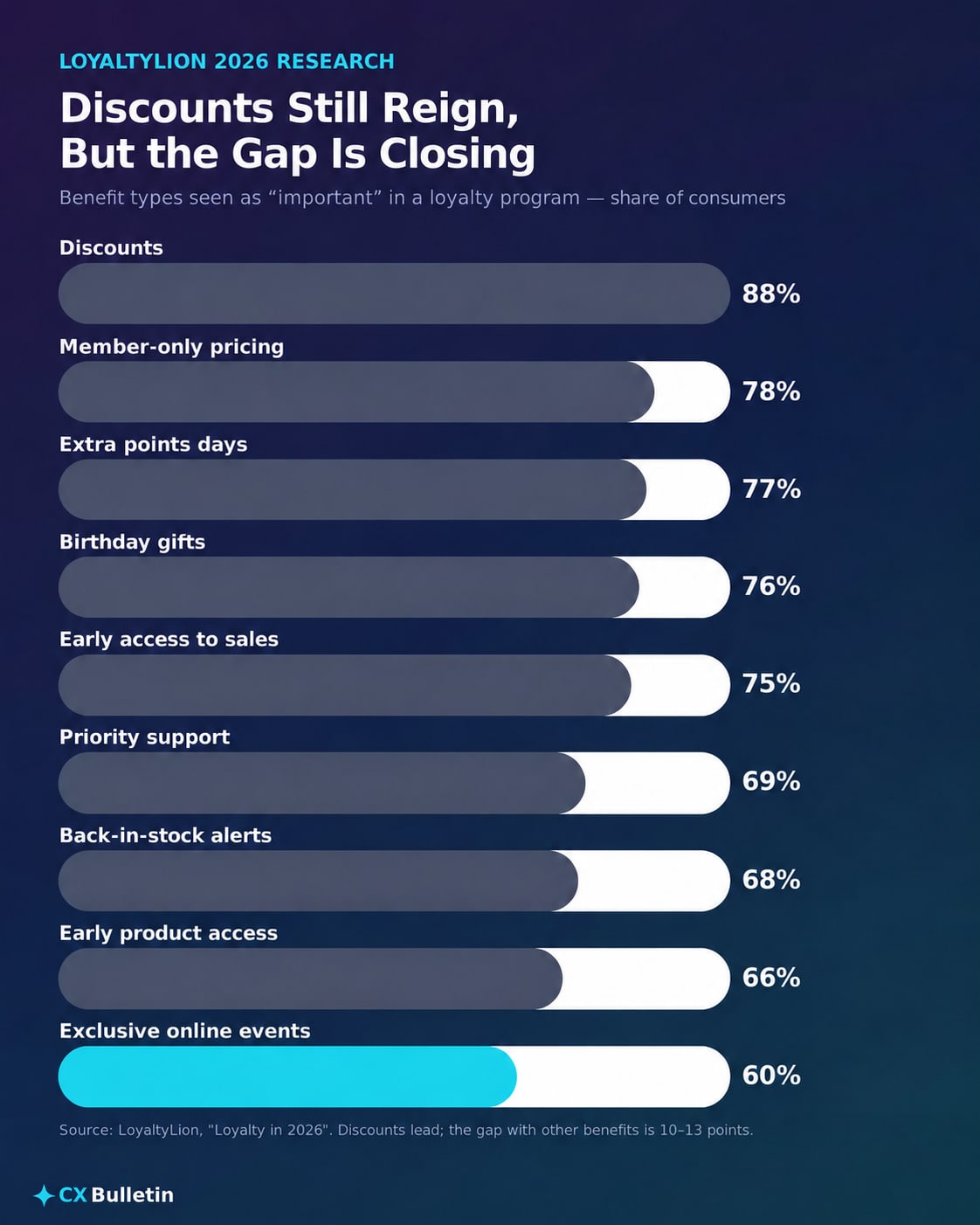
The second finding is a little more nuanced. When consumers were asked which loyalty program benefits matter to them, discounts still top the list at 88%. But close behind come member-only pricing (78%), extra-points days on select collections (77%), birthday gifts (76%) and early access to sales (75%). In other words, discounts are on top, but not alone: they lead the other benefits by 10–13 points.
Even the benefits seen as “softer” score surprisingly well: priority customer support at 69%, back-in-stock notifications at 68%, early access to new products at 66%. Even exclusive online events come in at 60%.
What really stands out here is the generational gap. Experiential benefits such as one-on-one interaction with the founder matter to 56% of Gen Z but to just 16% of Boomers — a three-and-a-half-fold difference. There is a similar gulf for personalized experiences such as styling advice. For brands in Türkiye that target young and middle-aged consumers (fashion, beauty, home goods), this means it’s time to take loyalty programs beyond a points-and-discounts mindset and redesign them around genuine experiences. At P.Louise, the British beauty brand LoyaltyLion cites as an example, the loyalty program grew to account for 30% of revenue within six months — a single figure proves nothing, but it does point the way.
Speed and trust: the silent killers of loyalty
The third finding is perhaps the most practical: 64% of consumers say they might leave a program if earning rewards takes too long. The same share, 64%, say they might give up if the rewards aren’t valuable enough, and 63% if it isn’t clear how to use them. And 58% would quit a program if they didn’t trust that their data would be used responsibly.
These three figures reminded me of the piece I wrote about automation and customer patience — a similar pattern emerged there: customers expect speed, but if speed isn’t accompanied by trust, it turns into disappointment rather than an advantage. The same equation holds for loyalty programs. However attractive the points-earning mechanism may be, if redemption is unclear or there are doubts about how their data will be handled, consumers quietly walk away.
Then there’s the localization issue, which speaks directly to Türkiye: 82% of respondents say being able to see a loyalty program in their own language is important to them, and 59% say they might drop out if the program isn’t offered in the local language. I think of this figure every time I see a loyalty program in Türkiye that runs on a global platform and still has its interface or communications in English. When it comes to personalization, AI enters the picture too — as I mentioned in my analysis of agentic AI, most organizations have yet to move autonomous personalization into production; loyalty programs have the data too, but few brands can yet turn it into a real-time, trustworthy experience.
A quick note for Türkiye
The general trend is this: as budget pressure mounts, marketing is among the first line items to be cut, but loyalty spending is often shielded from those cuts — because keeping customers is still far cheaper than acquiring new ones (as McKinsey also emphasizes, brands that plan pricing and loyalty together stand out in an uncertain economic environment). Türkiye’s economic picture is of course different from that of the UK and the US, but the behavioral logic is the same: in times of uncertainty, people take refuge in familiar brands.
The question worth asking is this: do Turkish brands still see their loyalty programs as a discount mechanism, or have they begun turning them into a relationship-building tool grounded in experience, speed and trust? The answer will become clear over the next few quarters.
This piece was first published in Turkish in CX Bulletin on July 11, 2026. English translation.