Customer Patience Lasts Three Minutes, but Automation Is Still Checking Its Watch
One in three consumers has literally yelled at automation. I looked at what Parloa's new index means for brands in Türkiye.
For years in the contact center world, we’ve been asking, “How many minutes does the average call last?” Yet the question in the customer’s head is much simpler: “How much longer is this going to hold me up?” Parloa’s Consumer Patience Index 2026, published last week, puts a number on exactly that second question. The answer isn’t very encouraging: three minutes.
The research is a survey of 1,001 consumers in North America, conducted by an independent firm. It asks where people lose patience with automated support, when they yell “connect me to an agent,” and what they do after a bad experience. Parloa’s earlier study scanning more than 10,000 enterprise systems had shown how technically broken those systems are; this new report looks at the human and commercial side — in other words, at what those “broken” systems cost. The data comes from North America, but when I looked at how Türkiye compares, I found the picture even harsher in most respects.
Source: Parloa Consumer Patience Index 2026. Infographic: CX Bulletin.
The most frustrating thing: not being understood
The report leads with its most striking finding. Asked “What’s the most frustrating experience?” respondents didn’t put long waits or endless transfers first; they put “talking to a bot that doesn’t understand me.” Top of the list: not being understood.
And people have very little tolerance for it. About 60% of respondents are willing to repeat themselves once, but not a second time. One in ten walks away without repeating a single word. Put it all together and about 70% of customers are ready to hang up before they’ve sat through two failed attempts. Two attempts. That’s it.
The odd thing is that these same people genuinely want to be understood. Asked whether “feeling understood” matters even in automated support, 86.7% say yes. So the problem isn’t automation itself; it’s automation that doesn’t understand.
It’s a familiar story in Türkiye. In MDYD, Deloitte and PRAGMA’s 2025 Customer Experience Management study, 40% of Turkish consumers name “being unable to reach a live agent” as their worst experience. The same feeling, in a different language.
The timer runs out at three minutes
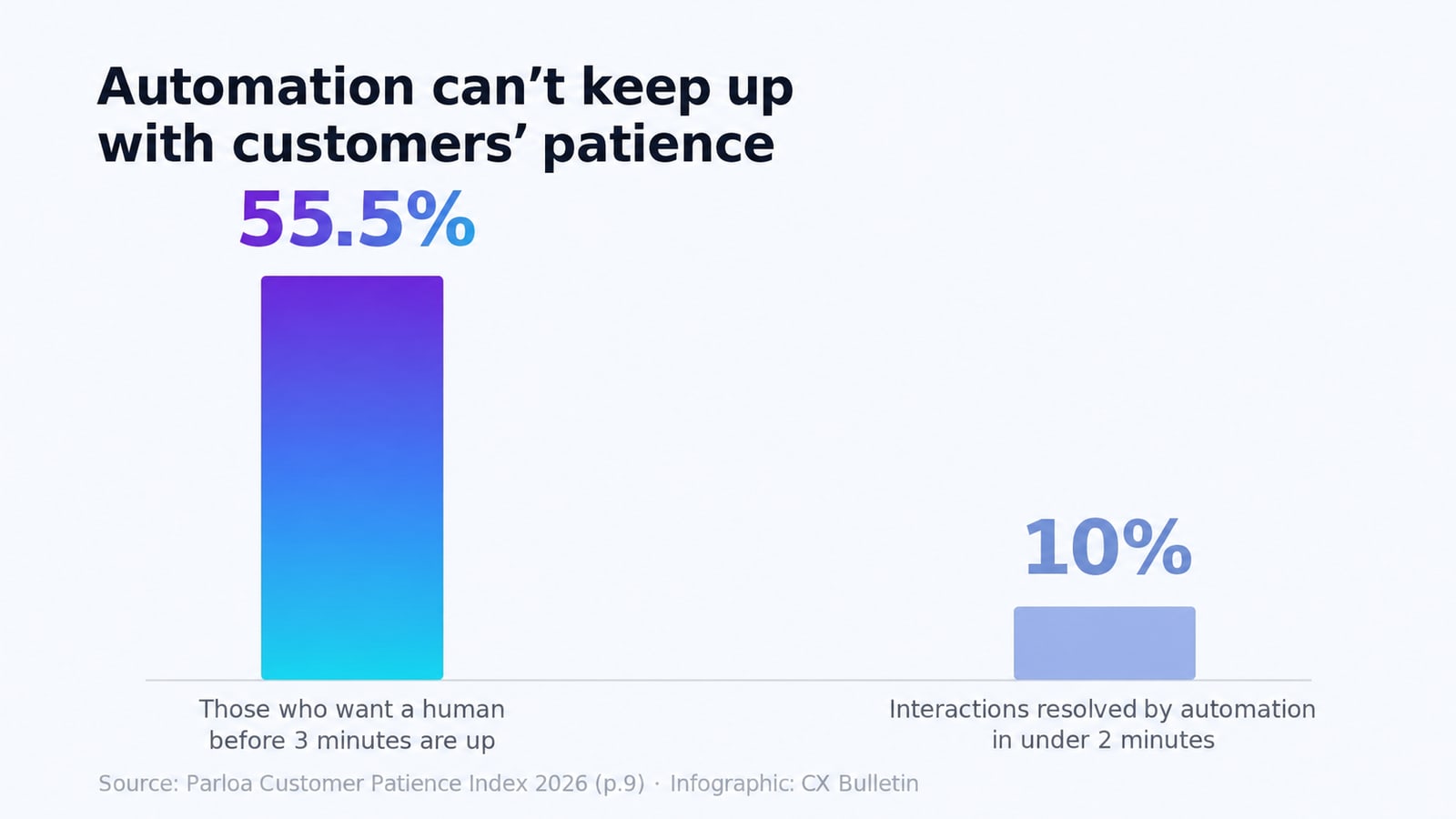
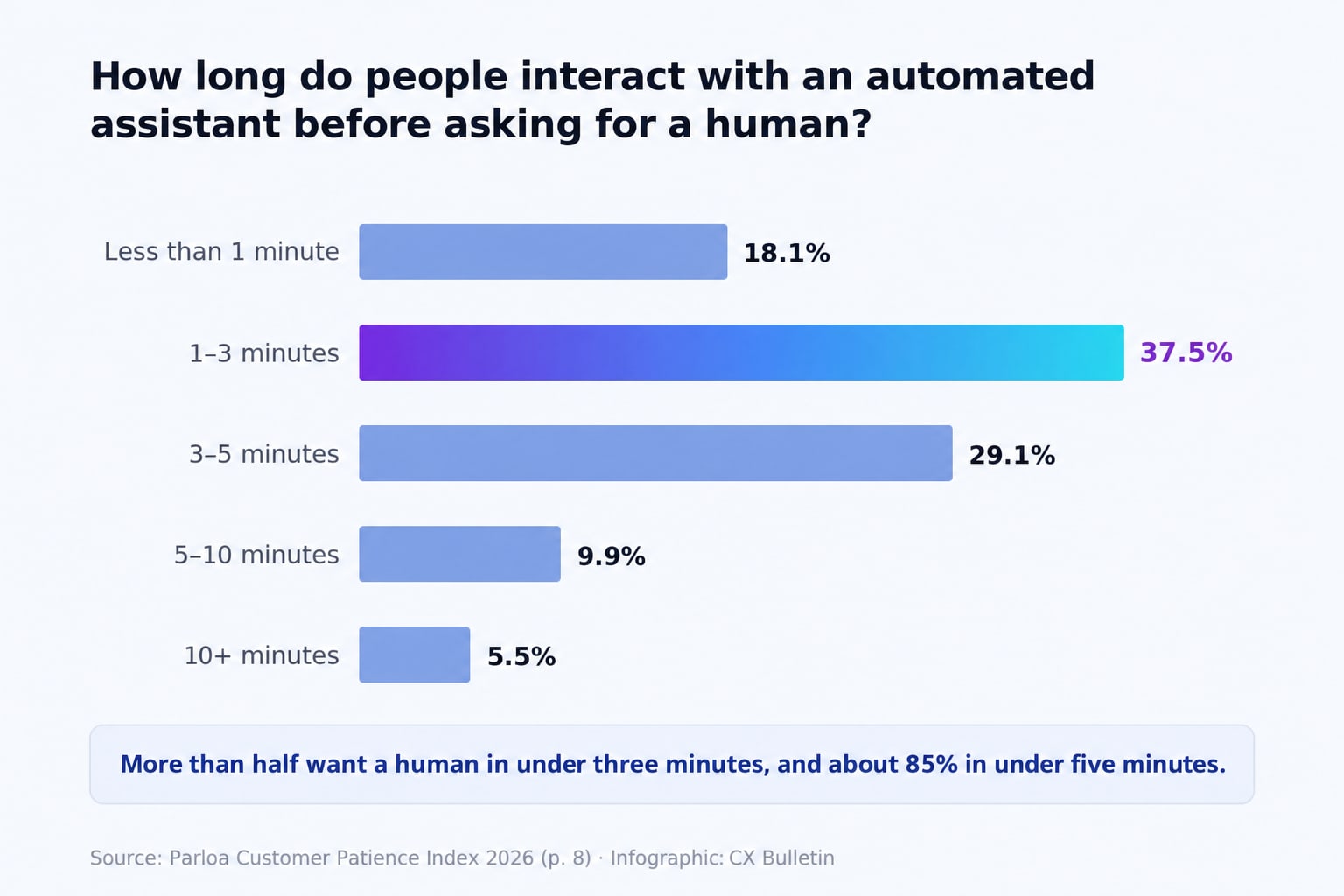
Being understood isn’t enough on its own; it also has to happen fast. More than half of consumers (55.5%) disengage from an automated system within three minutes if their problem isn’t being solved. One in five cuts that to under a minute. Our internal timer runs faster than we think.
Source: Parloa Consumer Patience Index 2026. Infographic: CX Bulletin.
What happens when the timer runs out isn’t harmless, either. More than half of respondents (53.6%) admit to trying to game the system to reach a human, from pressing zero to jamming it with nonsense answers. But the starkest figure isn’t about a tactic at all; it’s about a reflex:
“Of those who went down this route, 61.2% literally yelled at the automation to be transferred to a human.”
Yelling at a machine isn’t rational behavior, which is precisely why this data captures what bad automation does to people more honestly than any CSAT score.
The real problem is the gap between expectation and reality. While customers expect a resolution within three minutes, by their own account only 10% of their interactions are wrapped up by automation in under two minutes. The rest stretch out over 2 to 10 minutes. Automation is losing the race against the customer’s patience, and every second that ticks by in this race comes out of the brand’s coffers.
The report’s most entertaining data point sums up just how deep this impatience runs. Offered alternatives to waiting, 29.9% of consumers would be willing to switch brands entirely, 21.1% to get up at five in the morning, and 12% to text an ex. If someone would sooner risk rekindling an old flame than wait, it’s worth taking another look at those “average call duration” reports.
The channel people want most lets them down most
Despite all the new channels, the phone is still number one. When a problem comes up, people’s first step is most often to “call” (38.9%); the website and FAQ, in second place, account for only 13.8%. What’s more, even when asked which kind of automation they would rather deal with, people put voice on top (31.7%), ahead of both text chatbots (28.5%) and “none, I want a human” (27.2%).
In Türkiye the gap is even wider. The same MDYD study says 61% of Turkish consumers still choose the phone. For brands that have spent years steering customers to the app, to chat and to self-service, this should serve as a small warning: the place where loyalty is won or lost is, more often than not, still the phone line.
And yet the channel people want most is also the one that disappoints most. Only 7% say the voice response system “consistently” solves their problem. For the remaining 93%, the experience ranges from partial success to outright failure. In all, 24.6% are at least slightly satisfied with IVR. The place that most needs investment is, at most brands, the place that gets the least attention.
There’s no technical reason it has to be this way. Not long ago I wrote about FIFA entrusting its World Cup operation to Salesforce; large organizations are already gearing up to deploy AI agents at scale. Voice, too, can work at scale when it’s built right. The problem isn’t technology; it’s design. Brands that design voice interactions as conversations are in the minority; the majority are still stuck in keypad-menu thinking.
The bill for a bad experience arrives after the call ends
People never forget how you made them feel, as the saying goes. And that feeling turns directly into decisions. After a bad experience, 44.1% of respondents say they canceled their subscription immediately, and 34.9% say they switched brands. Asked whether customer experience affects how they see a brand, 83.2% say “yes, it directly determines my loyalty”; for 18.2%, a single bad experience is enough to send them to a competitor.
Nor does that anger stay confined to a single incident. Of those who get poor support, 48.9% tell the people close to them, and 27% share it on social media. In other words, a bad experience doesn’t just drive away the customer you have; it also shuts the door on prospective customers the brand hasn’t even met yet, before they’ve so much as knocked. The report is candid, too: 55.4% of consumers admit that a frustrating bot or phone menu has made them cry, yell at a loved one, punch a wall or throw their phone. These are reactions that never show up in satisfaction surveys but leave their mark on the brand’s reputation.
It’s worth remembering the economic backdrop, too. I’ve written before that in an endurance economy, customers look first for fairness, certainty and control. In an environment where household budgets are stretched thin and switching brands feels almost free, a single bad automation experience is far more likely to push a customer toward a competitor. In Türkiye, the “loyal customer” is a more fragile concept with each passing day, and that fragility is tested most on the support line.
Customers haven’t given up on AI; they want proof
All this fatigue has a consequence: customers assume from the outset that automation will fail. Only 7.8% are “extremely confident” that automated systems will do their job correctly. Half of respondents (50.7%) believe their problem is “too complex” for automation before they even try. And there’s this: when a system transfers a customer to a human and the human asks everything all over again, 85.4% of customers don’t get angry at the agent, because they had already accepted from the start that the automation would break down. They aren’t hopeful about the future, either. Only 10.3% believe automation will make customer service “much better.”
What makes the picture truly interesting is the other side of the coin. These people haven’t closed the door. If an automated system instantly solved their problems nine times out of ten, 84.9% say they would use it rather than wait for a human. Interest in AI assistants that offer personalized service stands at 68.2%, and 75.2% say they would prefer a system that anticipates their needs and acts proactively. The share who believe AI will one day resolve complex requests better than humans climbs as high as 69.6%, and 43% expect end-to-end AI-powered service to arrive within one to three years. On one condition: two-thirds of customers (66.6%) won’t trade accuracy for speed. Reliability is non-negotiable.
This picture lines up exactly with the situation I wrote about last week, drawing on Forrester’s 2026 report. On one side, three-quarters of organizations are chasing agentic AI, yet very few have managed to put it into production; on the other, customers have long been ready and are simply waiting for consistent proof. Both sides are staring at the same gap: sky-high expectations, rock-bottom delivery.
This is exactly where both the opportunity and the risk lie for Türkiye. In a 2022 forecast, Gartner predicted that conversational AI would reduce agent labor costs in contact centers by $80 billion in 2026; according to MDYD data, Turkish companies’ AI investment stands at 40% today and is expected to rise to 45% in 2027. The money is coming. But the point Parloa’s index underlines is a different one: the bar isn’t innovation; it’s reliability.
Patience is not a constraint but a report card
After reading these figures, it’s easy to treat “customer patience” as an engineering problem: you look for ways to extend the timer or shorten the menu. That three-minute window looks like a matter of patience; in reality, it’s a matter of trust. In those three minutes, the customer isn’t gauging whether the automation understands them, but whether the brand values them.
An even tougher test is on the horizon. Parloa’s earlier study showed that only 1% of organizations are ready for a setup in which a customer’s own AI assistant talks directly to the brand’s AI agent. So the question brands will soon face is this: will an AI calling on the customer’s behalf be received by the system on the other end as part of the customer relationship, or as a security threat?
Brands that can answer that question clearly before the three minutes are up will turn the support line from a cost item into the place where loyalty is built. The rest will be left watching the customer’s internal timer run out.
This piece was first published in Turkish in CX Bulletin on June 24, 2026. English translation.