There Are Now Two Travelers on the Customer Journey
On Gartner's 2026 agenda, the customer journey splits in two: one traveler is human, the other is AI. Here I unpack its three priorities for Türkiye.

I recently read the first-quarter 2026 issue of CMO Quarterly, which Gartner publishes every three months. Its cover addresses marketing leaders, but as I turned the pages, I realized I was actually reading a customer experience document. Since a significant share of CX teams in Türkiye already work under the marketing umbrella, the line between these two worlds has always been thin here; this report makes it thinner still. Read it alongside the assessment Gartner published on CMO priorities for 2026, and the picture becomes even clearer.
The report sets out three priorities for 2026: building an AI-powered marketing organization, adapting to the new rules of customer engagement, and taking on a future-facing leadership role. At first glance, the headings may seem familiar. What really stopped me was the data woven through its pages and a concept placed squarely at its center: the dual customer journey.
As the era of incremental change comes to a close
Gartner’s opening thesis is bold: the era of progress in small steps is over. And it backs that up with data, not slogans. According to the report, 82% of business leaders think company identity must evolve to keep pace with AI’s impact on markets; 65% of CMOs, meanwhile, expect AI to fundamentally change their roles within two years. When two-thirds of a profession say “soon my job won’t be what it is today,” that is not the kind of humility we often come across in corporate surveys.
The trajectory the report charts for AI is also worth noting. Today, in most organizations, AI is a tool: it boosts productivity but doesn’t transform outcomes. In the second stage, it becomes an agent: it makes semi-autonomous decisions under human oversight and runs processes end to end. In the third stage, expected within three to five years, it turns into an influencer, an actor that shapes decisions independently and is embedded in social norms. According to Gartner, most marketing leaders are currently piloting the agent stage, but even advanced users are struggling to achieve meaningful business results. The diagnosis is clear: they start with the technology, not the process.
This picture felt very familiar, because in my piece examining Forrester’s agentic AI report, I had written almost the same sentence: many adopt it, few put it into production. When two research firms independently point to the same gap, it also holds up a mirror to projects in Türkiye stuck in “PoC limbo.” Here, pilots usually start on the technology team’s agenda and end without ever touching the business unit’s process map. That is exactly why Gartner’s recommendation is valuable — first redesign the workflow, the decision points and the goals, and only then let the technology do the talking.
The courage to build the channel plan from scratch
Under its second priority, the report recommends a zero-based approach to channel strategy: every channel investment must re-earn its budget based on its projected contribution in an AI-mediated world. The supporting data is striking: according to Gartner’s analysis based on Similarweb data, ChatGPT usage grew 608% in one year. Familiar channels such as search advertising, display and social are either being embedded inside AI interfaces or no longer reach the same audience they once did.
For executives in Türkiye, the idea of zero-based budgeting isn’t new; the inflationary environment has taught them for years to re-justify every line item. Every CX and marketing leader who sits down to negotiate a budget with Finance knows this discipline. The difference is this: Gartner recommends it not as a cost-cutting exercise but because the channels themselves are changing. Customers now ask a chat interface before they ever come to your brand’s site; in the near future, they will hand part of the purchase decision over to an agent working on their behalf. As I noted when writing about FIFA entrusting its World Cup operation to Salesforce, once agents cross over to the customer’s side, most of the assumptions in a channel plan turn into historical data. For Türkiye’s e-commerce ecosystem, which leans so heavily on performance marketing, this is a reckoning that grows more expensive the longer it is put off.
When personalization goes too far
One of the findings in the report that gave me the most pause concerns personalization. According to Gartner’s research, consumers and B2B buyers who encounter personalized messaging during a purchase decision are 1.7 times more likely to put off the decision and 3.2 times more likely to regret their purchase. It is one of the few strong data points showing that the prescription we as an industry have long summed up as “more personalization” drives customers away when the dose is wrong.
In Türkiye, I think this finding carries even more weight. Any brand that measures how many times a day promotional texts, app notifications and emails reach the same customer will probably be uneasy reading these numbers. In my piece on Parloa’s patience index, we saw that more than half of customers give automation three minutes at most; now add to that the finding that a “just for you” message arriving at the wrong moment actually sabotages the decision process. As AI makes it easier to scale these messages, the risk of multiplying an ineffective approach through automation grows. In Gartner’s words, the reflex to floor the accelerator can blow up the experience itself.
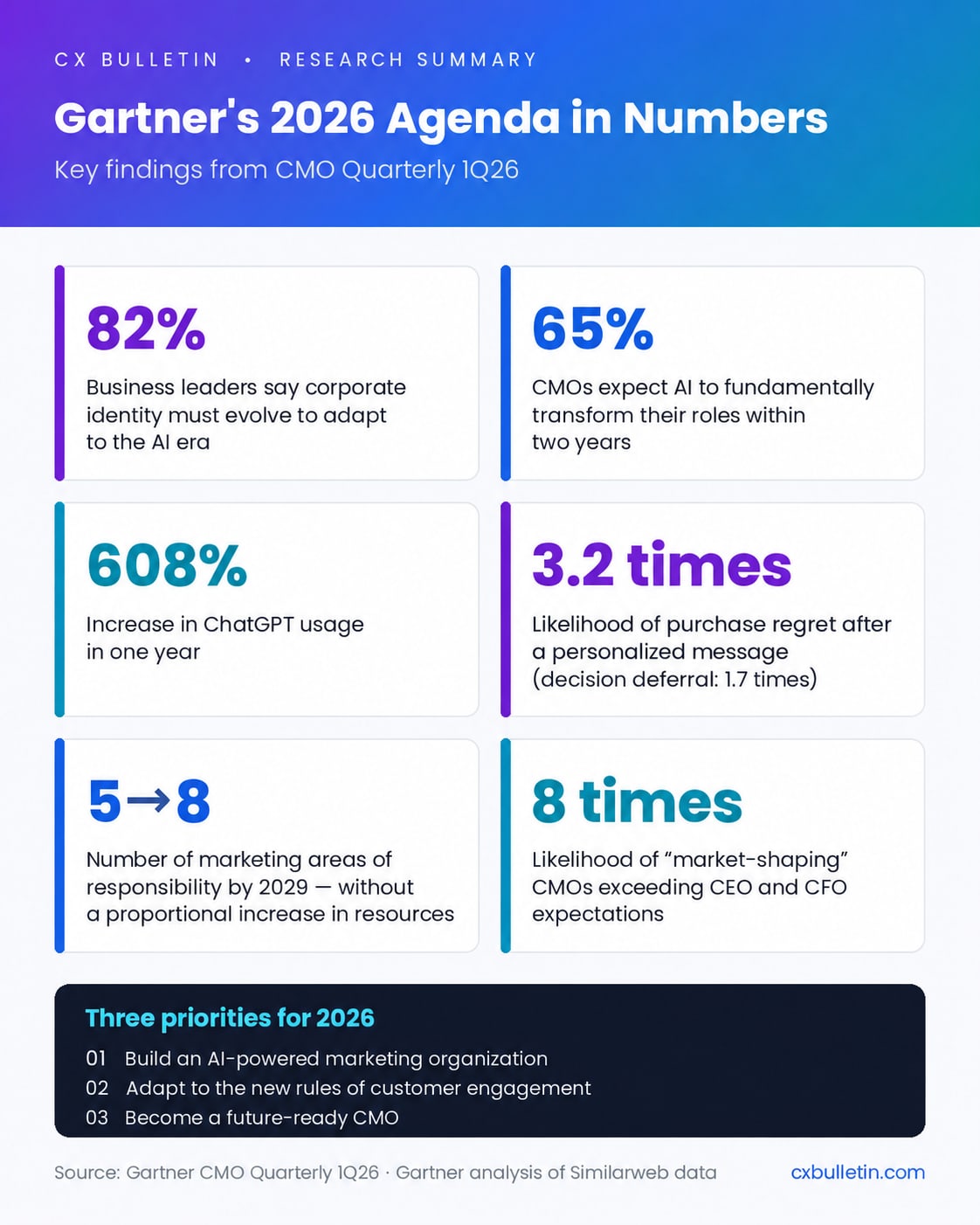
The report’s key data. (Source: Gartner CMO Quarterly 1Q26; visualization: CX Bulletin)
A new persona on the map: AI
The heart of the report, to my mind, is the dual customer journey map. Gartner now recommends designing two separate journeys: one for the AI tools and agents that scan information and evaluate options, and another for the people who evaluate those tools’ output. The two personas’ lists of needs look nothing alike. The AI persona has tasks, questions and information needs; it has no emotions. In the human persona’s journey, emotions sit right at the center. Let me sum up the report’s warning in this section in my own words: trust in machines rests on the robustness of the data and the model, while trust in people rests on emotion — and managing both at once will take serious discipline.
The good news for CX professionals is that journey mapping is already our craft. What’s changing is the number of personas at the table. There are two practical implications. First, structure your educational content so that generative AI platforms can consume it; the first answer a customer sees is now determined not by your homepage but by a language model. Second, deliberately strengthen the emotional bond at the dwindling number of human touchpoints.
In Türkiye specifically, I see a notable gap on the first point. In Nord CX projects, I frequently run into the same situation: knowledge bases are written not for the customer but for the contact center agent’s screen. Now this content has a third reader — machines. Given that Turkish content is relatively sparse in large language models, I believe brands that move early to make their corporate knowledge easy for machines to read will gain disproportionate visibility over the next few years. This isn’t a new discipline replacing SEO; it’s work that sits on top of it and doesn’t yet have an owner.
The role grows while resources stand still
The report’s final section turns directly to the leadership role. CEOs and CFOs plan to expand marketing’s areas of responsibility from an average of five today to eight by 2029 — and, in all likelihood, without a proportional increase in resources. The same executives are also clear about their preferences: they value strategic insight more than operational effectiveness. “Market-shaping” leaders, as Gartner defines them, are eight times more successful at exceeding CEO and CFO expectations than “enterprise operators” who keep things running smoothly.
CX leaders in Türkiye know this equation all too well. In the past few years, digital channels, self-service and even revenue targets have been added to experience teams’ job descriptions; headcount has stayed the same. The way out that Gartner proposes isn’t doing more work faster — it’s being the person who brings customer and market insight to the table before anyone else. AI is increasingly capable of sifting data and finding patterns; what will make the difference is the human judgment that can interpret those patterns in the organization’s own context.
Does your map have that row?
As I write this, the summer season in Türkiye is in full swing; these are the peak months for human touchpoints in tourism, airlines and retail. It would be hard to find a livelier laboratory for testing Gartner’s advice to “strengthen the emotional bond as human touchpoints dwindle.” Three minutes at the front desk, a single sentence of empathy on a call — that is exactly where trust accumulates, the kind machines can imitate but cannot earn.
High on the list of issues that need debating in the period ahead is one question: does your customer journey map have a row set aside for AI? If it doesn’t, by the end of 2026 human eyes won’t be the only ones reading that map — and it’s the map that will be caught unprepared.
This piece was first published in Turkish in CX Bulletin on July 5, 2026. English translation.