A Premium Product Is Not a Premium Experience: Starbucks' "$9" Lesson
The reality behind Niccol's "$9 premium experience" remark: the difference between a premium product and a premium experience, and a pricing lesson for Turkish brands in a time of inflation.
Brian Niccol may have unwittingly launched the biggest “Voice of the Customer” program in Starbucks history.
The Starbucks CEO’s ears have been burning for more than a week now, ever since an interview with the Wall Street Journal. The reason: Niccol described a Starbucks visit costing roughly $9 as, in some cases, “an affordable premium experience.”
But let me rewind the tape a little. To understand why this one remark stayed in the headlines for days, you first need to know who said it and exactly what was said.
Who is Brian Niccol?
Niccol is the executive who brought the fast-food chain Chipotle back from the brink — the name that springs to mind whenever talk turns to operational turnarounds. In September 2024, as Starbucks struggled with consecutive sales declines, lengthening lines, criticism that it had “lost its soul” and a battered brand reputation, it lured Niccol away with one of the largest pay packages Wall Street had ever seen — an offer that, with stock and bonuses, could exceed $110 million. The mission could be summed up in a single sentence: turn Starbucks around.
Niccol’s prescription is called “Back to Starbucks” — a return to the brand’s core. The idea was simple but radical: in recent years the company had turned the coffee shop from a “third place” into something close to an order-fulfillment factory. Niccol is reversing that shift: putting seating back in stores, reopening the condiment bars, giving baristas time to create a “human moment” with customers. In short, Niccol is leading one of the most visible CX transformations in the world. That is why every word out of Niccol’s mouth makes news; whenever the Starbucks chief speaks, the industry listens.
The irony is that in the same week as that ill-fated interview, Niccol also announced the strong quarterly results investors had been awaiting for more than two years. So while Wall Street was applauding, social media was booing.
What exactly did Niccol say, and why did it blow up?
Before judging a CEO’s remark, you have to look at how the conversation led up to it. The question, asked on WSJ’s “What’s News” podcast, was about the widening gap between higher- and lower-income groups. Niccol was reminded that consumers are under economic pressure and asked whether this was hurting Starbucks sales. The intent was clear: to put Niccol on the defensive.
Niccol first pushed back, saying business was going well across every income group, especially among Gen Z and millennials. Then came the remark: people want a special experience; whatever their income, spending $9 feels to some like “treating themselves” and to others like buying “a real premium experience for under $10.” And Niccol added this: we have to make it feel worth it.
That was where the fuse was lit. At a time when the cost of living is squeezing wallets, the head of the world’s largest coffee chain calling a $9 coffee visit “affordable” was read by large swaths of the public as a blatant case of being “out of touch with reality.” Comments along the lines of “doesn’t get what people are going through” and “try living on the median income first” were shared thousands of times.
I’m less interested in the fight itself than in what the fight skipped over. The answer Niccol gave while cornered — a reflexive reply, not a manifesto read from a podium — actually contained two separate arguments, and both deserved a hearing.
First: what counts as a “luxury” is entirely relative to income. Second — and this is the real point — offering a fully premium experience makes customers willing to invest in a higher-priced product. That second point is the foundation of almost every argument for investing in CX. Niccol put it clumsily but said nothing wrong.
Avoiding one trap, recalling another
A few weeks ago in these pages, I wrote about the “Back to Starbucks” transformation’s employee bonus system and the insidious trap of tying customer scores to incentives. As I said in that piece, the transformation Niccol is leading is a coherent whole with interlocking parts. Bringing back seating, freeing up baristas’ time, running the store as a place where people connect rather than a “production line”… The $9 remark fits into that whole as well. The problem isn’t that the remark was wrong; it’s that the words came in the wrong order.
And that wrong order overshadowed the most fundamental distinction in CX.
A premium product is not a premium experience
This is the crux of the matter. A nine-dollar caramel drink with an extra shot and cold foam is a premium product. Going to Starbucks — the atmosphere, the armchair, the greeting you get as you walk through the door, that brief human contact with the barista — is a premium experience. Niccol’s mistake was collapsing the two into a single sentence and setting up the equation “$9 product = premium experience.” The truth is this: the $9 product is a premium product consumed within a premium experience. The experience is the frame that justifies the price; the product is the painting inside that frame.
This distinction may sound like wordplay; it isn’t. What determines a customer’s willingness to pay is not the cost of the product but the perceived value the experience creates. When a customer asks, “Why does this coffee cost $9?” you can’t walk them through your input costs. All you can do is give them an experience that answers the question “Was it worth it?”
Mapping this equation onto a matrix cuts through the confusion I’ve seen in the industry for years:
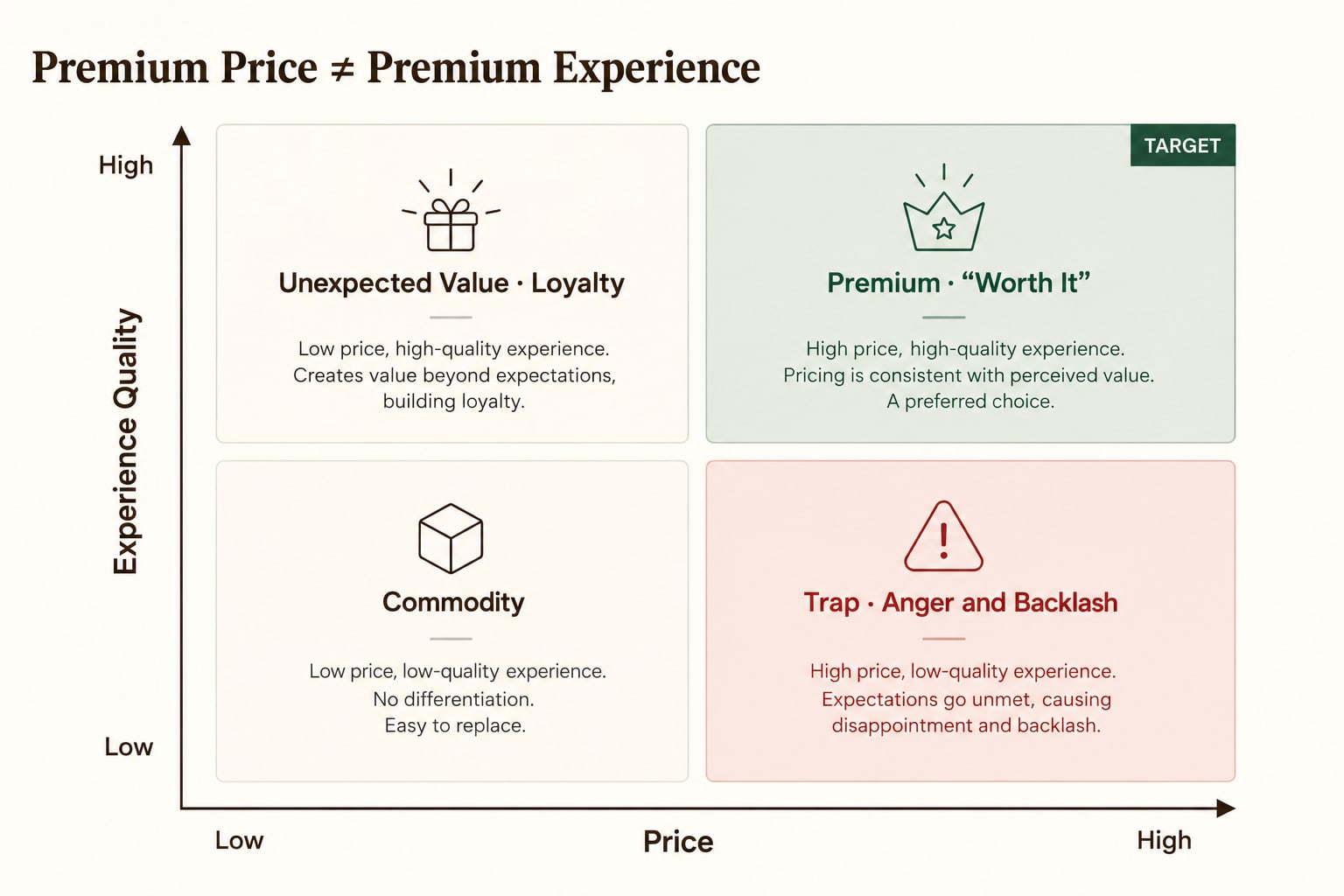
The Value Perception Matrix. Original infographic, CX Bulletin.
Niccol wants to place Starbucks in the upper-right corner, the “Premium: worth it” zone. Consumer anger, meanwhile, feeds on the threat that the brand will be pushed into the lower-right corner — the trap of “high price but a lackluster experience.” That corner is the most dangerous zone in the CX world: the moment you charge a premium price without delivering a premium experience, customers feel cheated and the anger goes viral. That is exactly what happened to Niccol: those words landed the Starbucks chief in that corner, however undeservedly.
The smartest line was the least quoted
Paradoxically, the smartest thing in the interview was the least shared: Niccol saying “we have to make it feel worth it.” The idea: rather than playing the discount game, build an experience where the customer says, “Yes, that was worth it.”
Good CX leadership knows the bar isn’t something you raise once and then leave alone; it has to keep rising. Niccol’s team has backed away from turning many stores into “pickup” stations, put the seating back and brought back the condiment bars — all of which makes me think they really have raised that bar. They look like small touches, but these are exactly the details that “make the experience premium.” It was the same point I underlined in the piece where we discussed the power of the human touch in retail: technology and efficiency only go so far; the rest comes down to that moment when one person turns their attention to another.
Companies tell us about their flashy technology investments, their NPS charts, their automation rates. But the question that sets the successful ones apart is always the same, always that plain one: “In the end, did the customer feel it was worth it?” With that sentence, Niccol was actually asking the right exam question; it was only the answers to the exam’s other questions that fell short.
So what does this mean for brands in Türkiye?
Now let’s carry the remark into a market wrestling with inflation, because that is where the real lesson lies.
The line “what counts as luxury is relative to income” hits harder in Türkiye than anywhere else. Consumers whose wallets get a little tighter every month are extremely price-sensitive; they now ask “Is it worth it?” about every decision, even the smallest purchase. And the trap Turkish brands fall into here is exactly the lower-right corner Niccol was pushed into.
In an inflationary environment, raising prices is often unavoidable. But most brands defend their increases in the language of product and cost: “input costs went up,” “the exchange rate,” “raw materials”… Customers don’t buy that explanation, because customers live the experience, not your cost sheet. The only thing that justifies a price increase is a simultaneous increase in perceived value. A brand that raises its price to premium levels while leaving the experience where it was — or even letting it grow a little duller through staff cuts and pressure for speed in the name of “efficiency” — slides straight into the “Anger and Backlash” corner.
While I was working on this piece, I also came across a story about a cafe in Alanya charging a 20 TL surcharge for a drink without ice on the grounds that it “uses more product.” If you haven’t seen it, I’d say don’t bother 🙃 but if you’re really curious, the story is here.
Here is the defensible side of Niccol’s position: the Starbucks CEO says there will be no discount game and wants to play the value game not by “making it cheaper” but by “making it worth it.” This lines up exactly with what we discussed about the end of the era of holding on to departing customers with last-minute discount offers: the new rule of competition is not to lure customers back with discounts but to get them to say “that was worth it” from the very first moment.
What was the last premium-priced product or service you bought that made you say it was worth it?
This piece was first published in Turkish in CX Bulletin on June 6, 2026. English translation.