Customer Experience in the Endurance Economy: Fairness First, Then Sparkle
In the endurance economy, customers look first for fairness, certainty and control; status and enjoyment come later. Here's my take on what Ipsos Canada's approach means for brands in Türkiye.
As you may know, I live in Ottawa, Canada, and in recent months I’ve developed a small ritual at the grocery store: I check the unit price of the package in my hand. The number on the label looks familiar, but has the net weight quietly gone down? And yes, food inflation in particular is unfortunately running high here, too. I don’t do it out of professional habit as a customer experience specialist; I do it with an ordinary consumer’s unease. And I realized that this momentary pause actually sums up an entire economic era.
Ipsos Canada’s April 2026 point of view, Customer Experience in an Endurance Economy, puts a name to exactly this pause. The report says that an assumption we’ve built on for years is cracking: we have always designed customer experience around the trio of “grab attention, differentiate, build an emotional bond.” Moments of sparkle, flawless journeys, personalization, “delight”… These worked for a long time — because customers had the capacity to notice them. But in this new era, which Ipsos calls the “endurance economy,” persistent, structural financial and psychological constraints are reshaping decisions before customer experience even gets a chance to play its traditional role.
In my previous piece, I looked at how AI is redrawing the customer service workforce — in other words, the “brand” side of the equation. This time I’m turning the lens the other way, toward the customer — or, more precisely, toward customers facing constraints. What is changing on that side requires us to reorder all of our CX investment priorities.
From growth logic to endurance logic
Let me frame it the way Ipsos does: in a growth environment, the job of customer experience is relatively clear. Once a customer decides to engage with a brand, experience becomes the lever that reinforces preference: it makes engagement easier, creates moments of enjoyment and builds an emotional bond. In this context, differentiation happens early; experience is what lifts a brand above its competitors.
But the environment has changed. Customers now ask far more basic questions first: Can I afford this? Is it predictable? Will it work the way I expect? Only once these questions are settled do the other layers of experience come into play. Ipsos describes this as experience moving from a “growth model” to an “endurance model” — and stresses that these are not temporary adjustments. Over time, these behaviors harden into expectations; they reset what customers consider acceptable, fair and trustworthy.
Here’s the crux: the components of experience haven’t changed. What has changed is the order in which they matter. In a growth context, experience wins preference through differentiation and enjoyment. In an endurance context, experience must first earn “consideration” through fairness, certainty and control; differentiation through status, belonging and enjoyment comes after that.
A quick reminder of the six core human needs Ipsos calls the “Forces of CX”: fair treatment, certainty, control, status, belonging and enjoyment. In the growth economy, the first three were usually taken for granted, and brands really shone through the last three. In the endurance economy, by contrast, the first three are now the floor of a “minimum viable experience” — that is, where the decision gets made; the last three are an upper layer that makes a difference only if that floor is solid. The best way to explain this reordering is with a single visual — which is why I built this piece’s original infographic around that logic.
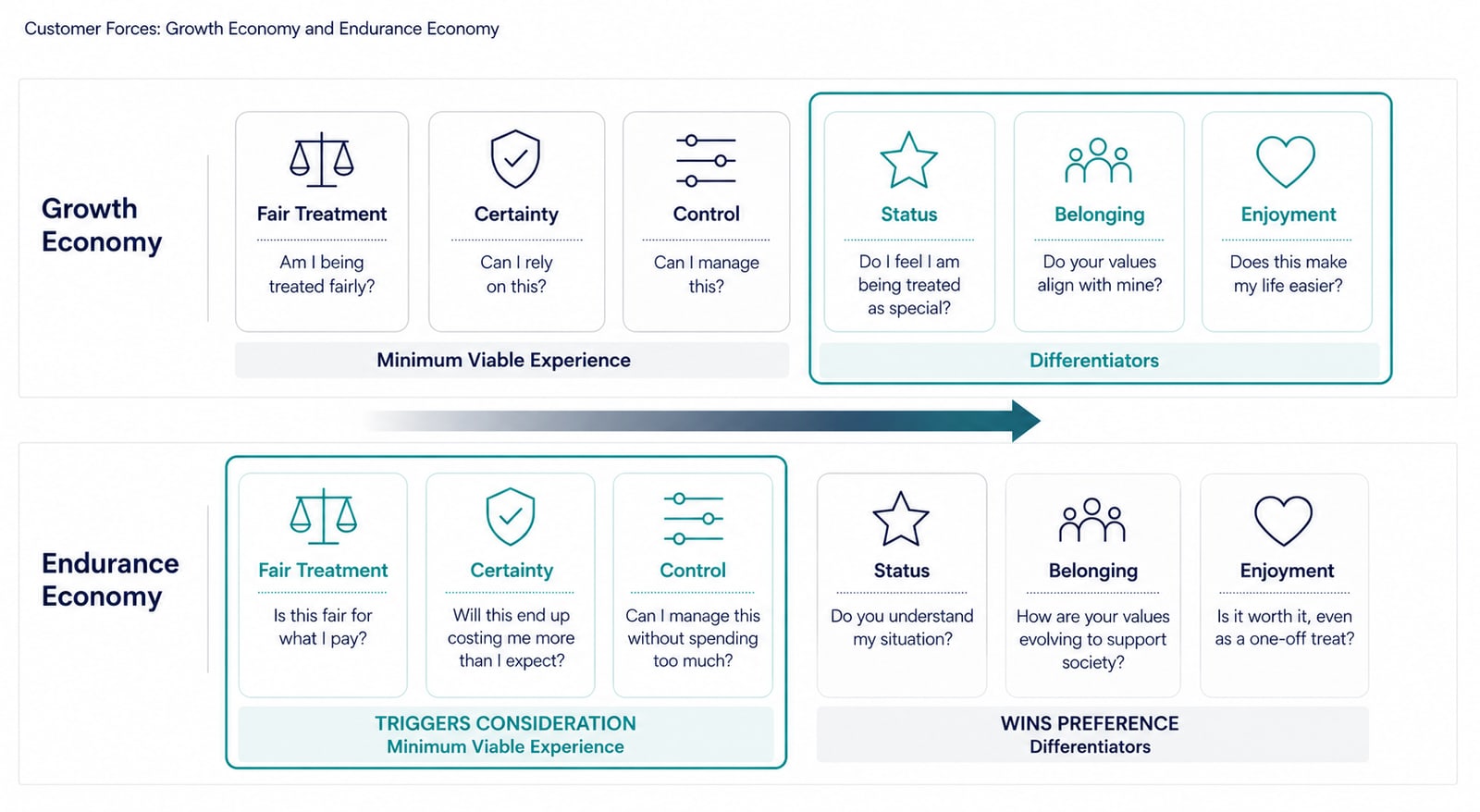
The order of the Forces of CX has changed: in the endurance economy, fairness, certainty and control earn “consideration” first. Source: Produced by CX Bulletin, adapted from the Ipsos Canada (April 2026) framework.
When the fundamentals call the shots
According to Ipsos, this reordering isn’t a theoretical forecast; it’s already visible on the ground. The report’s three sector examples show this clearly. And it is most striking in the earliest moments of the experience — the very moments we used to file under “nice to have.”
In telecom, recent reporting points to a sharp rise in complaints related to billing and issue resolution. According to data from CCTS, Canada’s telecom and television complaints agency, complaints rose 17% between August 1, 2024, and July 31, 2025, reaching one of the highest levels on record, with a significant share stemming from billing inconsistencies, unexpected charges and contract misunderstandings. In the endurance economy, what used to count as a simple “service issue” is now read as a matter of fairness; customers are less tolerant of uncertainty and far more inclined to end the relationship when their expectations of cost and clarity go unmet. (Ipsos’s separate assessment of Canadian telcos sums this up as “fairness, not sparkle” — I borrowed my headline from it.)
In insurance, the emphasis has shifted to the claims experience. Customers judge not only the outcome but how that outcome was reached. (I wonder why I still haven’t written about my insurance experience after my car was damaged in an accident in Canada! It just came to mind, and it’s now in my notes 😃) Transparency, explanation and predictability matter at least as much as speed. In the endurance economy, the claims process becomes the brand’s real “trust engine”: How was the decision made, how was the amount calculated, was the process fair? This shifts competition away from price alone and toward end-to-end clarity and consistency.
And the most visible arena: the grocery store. Customers are recalibrating their behavior in real time; above all, the debate over shrinkflation (raising prices by shrinking package sizes) has sent sensitivity to perceived fairness through the roof. When the net weight drops while the price stays the same, it directly raises questions of transparency and value; at the same time, households are shopping more cautiously, switching to private labels and chasing promotions. Customers are no longer asking “what am I buying?” but “is this priced fairly and transparently?”
I don’t think I need to look at Türkiye separately here, because the picture back home is starker than in Canada. In Canada, this debate is the legacy of a few years of inflation; in Türkiye, as TÜİK/TCMB data has shown for years, it’s an ingrained reflex. Turkish consumers have long since made a habit of checking the “unit price” and going over their basket one more time before heading to the checkout. In other words, the behavior Ipsos describes as the “new normal” is our everyday reality. Reading the Canada report, I thought of my own time in the grocery line, and even of the Istanbul grocery stories my mother tells me over the phone; both end with the same line: “I never used to look this closely.”
The common pattern the report identifies across sectors fits in a single sentence: experience is now judged not by how it feels at its peak, but by how it performs under pressure.
Not a loss, but a redistribution
What Ipsos has shown for years hasn’t changed: strong customer relationships still rest on those six core needs. What has changed is their relative weight. In today’s environment, fairness and certainty have become non-negotiable; control has become a critical tool for building trust; belonging is expressed through empathy under constraint and a sense of “you understand me”; status and enjoyment are still there, but in far more measured, far more deliberate doses.
In Ipsos’s words, this isn’t a loss of experiential richness; it’s a redistribution. What we used to regard as “the floor that should be there anyway” is now the threshold where the decision is made. And what used to be the star of differentiation now plays a supporting role.
I’ve seen the same shift in CX awards over the last few cycles: the highlights of submissions used to be surprise moments that made you say “wow.” Now the ones that stand out are programs that make a claims process transparent, simplify a bill and give customers the right to “know in advance what will happen.” Not thrilling, perhaps — but these are the ones that win, and the ones that keep customers. As I wrote earlier when discussing the AI–data–trust triangle for SMBs: technology creates value only when it translates into trust. The endurance economy extends that idea to every sector.
So where should investment shift?
For leaders, the question isn’t “should I invest in customer experience?” but “where should I shift that investment?” Ipsos suggests three areas of focus as a pragmatic starting point; I’ve added my own observations alongside them.
First, make sure the fundamentals hold up under pressure. Pricing, policies and processes need to be transparent, consistent and defensible. If customers feel surprised or misled, the experience breaks down before it has even begun. In Türkiye, the most concrete test of this is billing and price communication: a process that can’t give a clear answer to a single “Why did it cost so much?” overshadows even the flashiest loyalty program.
Second, design for control as much as for ease. Ease of use still matters, but customers increasingly value the ability to “understand, manage and predict the outcome.” Control lowers anxiety and builds trust. In the endurance economy, any design that lets customers see their usage, their spending and where a process stands is a direct investment in trust.
Third, bring in differentiation after trust has been established. Moments of enjoyment and emotional connection are still valuable — but their impact depends on a foundation of fairness and reliability. Without that foundation, differentiation easily goes unnoticed. This is also where I see a common mistake in Türkiye: brands often invest in the upper floors while the foundation is cracked — more campaigns, more tools, more “wow” moments. Yet we’ve already discussed how having more tools doesn’t mean a richer experience. In the endurance economy, competitive advantage comes not from doing more, but from focusing on what matters most.
From experience to endurance
As Ipsos also emphasizes, the endurance economy isn’t a short-term cycle. It reflects a broader shift in how customers define value, progress and trust. Customers still want meaningful experiences — but what they now find meaningful isn’t flash or novelty; it’s what stays consistently fair, predictable and manageable, even under pressure.
That’s why the winning brands won’t be the ones that impress the most. They’ll be the ones that pass the customer’s test of fairness, predictability and control day after day, under pressure, without letting up. For more Ipsos data, take a look at Ipsos Canada’s Endurance Economy Hub.
I’ll leave you with this question: What on your brand’s experience map is still “taken for granted” today? Because this is exactly where the endurance economy shows its ruthless side: the customer’s decision is made at the very “basic” moment you put the least effort into — before you ever get the chance to rescue that lovely moment at the peak.
This piece was first published in Turkish in CX Bulletin on June 6, 2026. English translation.