Will Half of All Customer Service Jobs Be Gone by 2030?
Forrester says 49% of customer service jobs will disappear because of AI. But the real issue isn't how many people will go; it's what the rest will do.

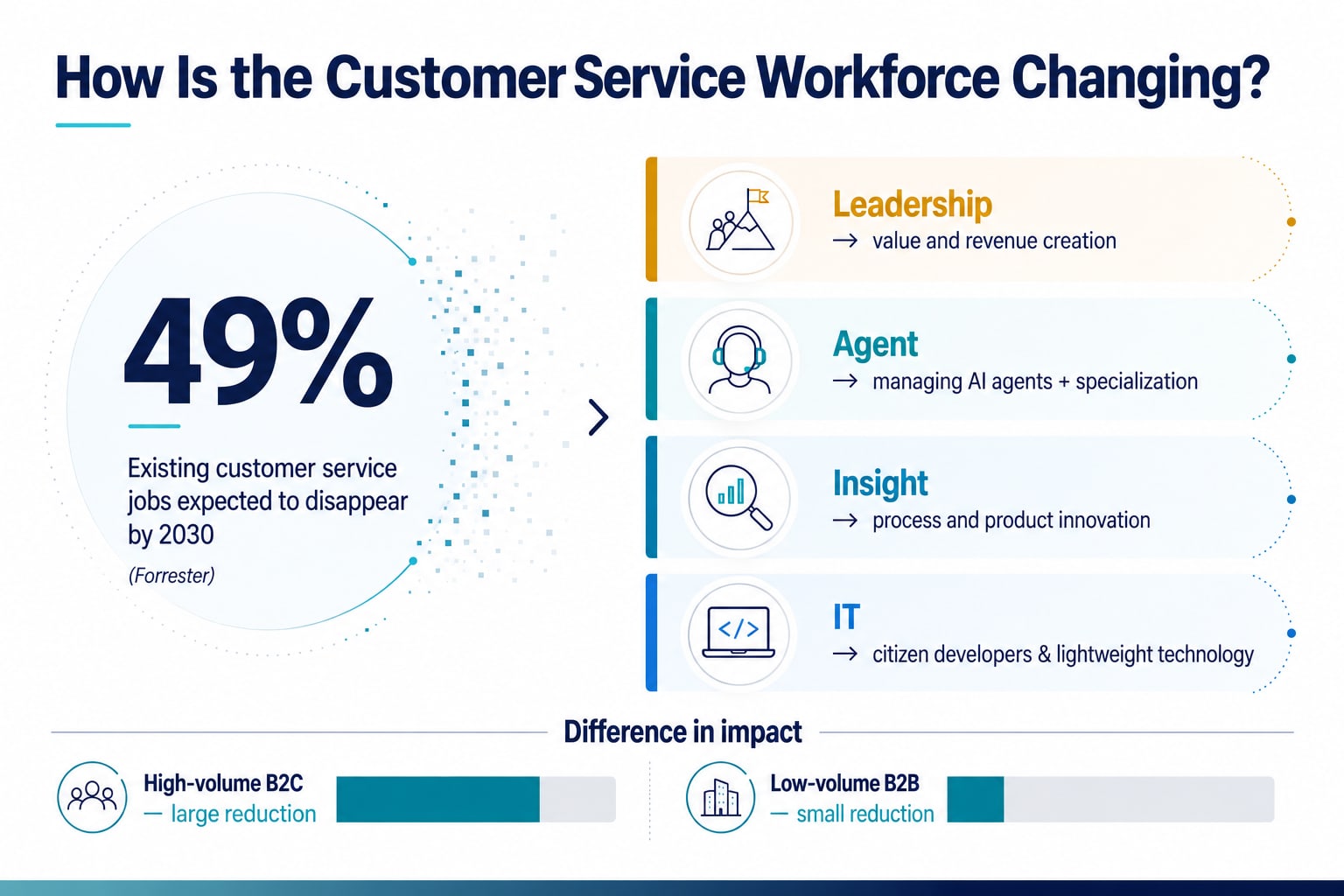
Ever since AI took center stage and shook everyone up, most workers’ fear of losing their jobs has grown by the day. In the customer experience world, we feel that cold wind most in the contact center. Most contact center managers are asking the same question: “If most of my team won’t be here down the line, what exactly will the rest of them do?” It isn’t an easy question to ask out loud, because part of the answer has to do with the workforce and part of it with the manager’s own job. Forrester’s recently published report AI Agents Reshape The Customer Service Workforce In Dramatic Ways (by Kate Leggett and Laura Ramos, May 2026) tackles exactly this uncomfortable question — and the figure it offers is the kind the industry will be talking about for a long time: by 2030, roughly half of today’s customer service jobs are projected to disappear.
In the previous piece, looking at Forrester’s 10 emerging technologies for 2026, we talked about how AI has moved beyond the chat window and settled into every layer of the customer journey. This report takes that picture one step further: once the technology is in place, what happens to the human workforce that runs it?
The real story behind the 49% figure
The headline figure may grab attention, but on its own it’s misleading. The sentence “half the jobs will go” gives the impression that one morning an entire team will wake up to find itself shown the door; what Forrester describes is far more gradual and far more interesting. In fact, the transformation has already begun. Many contact centers are flattening their org charts and cutting the number of team leaders; traditional middle-tier work such as coaching and shift scheduling is giving way to software. In other words, the downsizing often starts not at the top or the bottom but in the middle.
At its core, the report’s real thesis isn’t a number but a shift in roles: the core task of the human workforce is shifting from dealing with customers directly to managing the AI that deals with customers. That sentence is worth reading a few times, because it captures what the next five years hold for the industry. Today an agent’s success is measured by how many calls they handle. Tomorrow, the same person’s success will be measured by how accurately and cost-effectively the AI agents they’re responsible for perform, and how much satisfaction those agents create. The desk stays the same, but the nature of the work is being rewritten from scratch.
Four job families, reshaped
Forrester frames the transformation in terms of “jobs to be done” and maps out four main areas. It’s more accurate to see them not as prophecies but as trends already starting to take root in Türkiye’s large contact centers.
First, customer service leadership. This tier is moving toward using AI not just for operational excellence but to create customer value and revenue directly. Service is shifting from a cost center to a function that contributes to the top line. It’s no coincidence that in Salesforce’s sixth State of Service report, from 2024, 85% of decision-makers said they “expect service to contribute more to revenue this year.” For brands that still position customer service as “the department that closes out complaints,” this is an uncomfortable but inevitable paradigm shift.
Second, the agent. Instead of resolving requests one by one, junior agents are starting to manage a team of AI agents, stepping in to “unblock” an agent when it needs a human decision, and giving feedback to improve the system’s output. Senior agents, meanwhile, are specializing: some become technical subject-matter experts or policy experts, while others focus on relationship management. In other words, the agent role is no longer a single, uniform job; it is branching into specialized tracks.
Third, operations and insight teams. Insights drawn from conversation data and conversation intelligence are turning customer service into an engine for process and product innovation. Insight teams now run forensic-level analyses that go all the way down to the full cost of automating a single intent. That is a very different, far more strategic job than “how many calls came in” reporting.
Fourth, IT. Low-code tools are putting AI agent configuration within reach of “citizen developers,” and new “tech-lite” jobs are emerging for people who build agents and check the quality of their output. Traditional integration work, meanwhile, isn’t going away; if anything, it’s holding its ground.
New titles: automation supervisor and process architect
The most concrete sign of this transformation is that titles that didn’t exist until very recently are appearing on org charts. As CX Dive reported, two roles Forrester points to stand out in particular. One is the “automation supervisor”: the person who analyzes performance gaps, fills knowledge gaps and adapts workflows to align the AI’s output with business goals. The other is the “process architect”: a role that embeds expertise into agentic workflows, working shoulder to shoulder with machine learning engineers and subject-matter experts.
One interesting detail: the human task of “unblocking the AI where it gets stuck” isn’t permanent. As the system learns from cases resolved through human intervention, this role is expected to shrink naturally. In other words, some of the new jobs we’re creating today have their own obsolescence built in before they’re even born. I see the first signs of this in the projects I’ve followed over the last two years as a judge in international CX competitions: solutions presented a year ago as “AI that supports humans” are arriving this year framed as “humans who oversee AI.” The narrative has flipped.
Not everyone will be affected equally
Perhaps the most actionable part of the report is that instead of offering a single prediction, it builds two separate scenario models: staffing projections over two-year and five-year horizons. The distinction that emerges is critical for Türkiye. High-volume contact centers whose monthly demand is measured in the hundreds of thousands — typically on the B2C side — will see the largest proportional staff reductions. In B2B organizations with lower volumes and longer, exception-laden workflows, the share resolved by AI at first contact will stay lower.
This distinction maps directly onto Türkiye’s customer service employment landscape. Sectors with massive call volumes, such as banking, telecom and e-commerce, fit exactly the profile Forrester says will “shrink fastest.” In a field that employs tens of thousands of people, the question isn’t whether automation will come; it’s whether the normal rate of attrition will outpace leadership’s capacity to reskill. If people leave faster than management can prepare them for new roles, the transformation becomes not a planned transition but an uncontrolled exodus. The difference determines whether a brand comes out of this process with its reputation intact.
Forrester also offers leaders a concrete method: simulation exercises. That means modeling future staffing levels by holding interaction volume constant and gradually raising AI’s resolution rate; factoring in the impact of human interaction on satisfaction, retention and revenue; and adding salary projections to calculate AI’s true return. One warning is worth repeating here: if what we’re measuring is wrong, then no matter how sophisticated a model we build, we’ll end up running in the wrong direction.
The Türkiye lens: between cost pressure and loyalty
I’m writing this piece in Ottawa, but my eyes are on Istanbul this week. The theme of AloTech CX Summit 2026, to be held on June 8, is precisely “The Future of Customer Experience with Agentic AI” — in other words, the Turkish counterpart of Forrester’s report will be debated on the Paribu Art stage at almost the same time. This timing is no coincidence; the industry is riding the same wave, just in different time zones.
Türkiye faces a balancing act all its own. On one hand, the cost-cutting pressure created by stubborn inflation makes automation extremely attractive; the promise of “the same work for less” is an offer no CFO could turn down. On the other hand, protecting customer loyalty in the midst of economic uncertainty is harder, and more valuable, than ever. And that is where the danger lies: brands that lean on AI to cut costs and inadvertently erode the human bond with their customers may save in the short term and lose loyalty in the long term. The idea Forrester underlines, “service’s contribution to revenue,” is especially vital for SMEs; indeed, we’ve talked before about why growing SMEs put customer experience ahead of new customer acquisition. Big or small, the equation is the same: automation is a tool, not a goal.
When I taught customer experience courses at Istanbul Kültür University, I always told my students: as technology gets cheaper, the human touch gets more expensive. Today that holds truer than ever. As AI takes over the routine, the human interaction that remains — the difficult, emotional, exceptional moment — is becoming the brand’s most valuable and most visible touchpoint. Developing the people who will handle that moment isn’t a cost item; it’s a direct investment.
The real race
Forrester’s 49% is a figure for planning, not for panic. The real question isn’t “how many people will go?” but “can we turn those who remain into a workforce that manages AI, oversees it and demands better from it?” This isn’t a technology project; it’s a matter of change management and organizational design — and that is the hardest part of the job.
Over the next five years, which brands will manage to reposition their people before letting them go? Because the winners of this race won’t be the ones with the most advanced AI, but the ones with the fastest-learning human teams. AI reaches everyone at the same time; the difference lies in who does a better job of preparing the people who will manage it.
This piece was first published in Turkish in CX Bulletin on June 5, 2026. English translation.