The New Rule of SMB Growth: Customer Experience First
Salesforce’s SMB Trends report shows why growing SMBs put customer experience ahead of winning new customers.

For small and medium-sized businesses, growth is often treated as a synonym for winning new customers. More ads, more campaigns, more leads, more sales pressure… But Salesforce’s Small & Medium Business Trends, 6th Edition report shows that reality looks a little different.
Here’s the most valuable thing about the report: growing SMBs and SMBs that are stalling or shrinking don’t prioritize the same thing. Companies with rising revenue focus on customer experience first. Struggling companies’ first instinct, by contrast, is to go looking for new customers.
This seemingly small distinction actually reflects a major strategic difference. One side sees growth as the result of experience; the other tries to make up for gaps in experience with a steady flow of new customers.
Salesforce’s 2024 survey of 3,350 leaders at businesses with 200 or fewer employees across 26 countries makes exactly this point: in the SMB world, customer experience is no longer something you can put off with “we’ll look at it once we grow.” It has moved to the very center of growth decisions.
Why do growing SMBs think differently?
The report defines growing companies as businesses whose revenue rose by more than 5% over the past 12 months. This group’s top priority is improving customer experience. Among stalling and declining companies, by contrast, winning new customers comes first.
To me, this is the report’s most critical finding.
After all, continually pouring new customers into a poor experience is like trying to fill a leaky bucket. The sales team brings customers in, operations create friction, the support team falls behind, data stays scattered, and the customer doesn’t buy again or recommend you. Then the company has to spend on advertising all over again.
Good customer experience reverses this cycle. Customers buy more easily, struggle less, get support faster, trust the brand more and are more likely to come back. As we also saw in the previous piece on customer experience metrics, loyalty and word of mouth usually grow not out of a single campaign but out of consistent experiences, repeated over time.
For SMBs, this difference matters even more. Large companies may have brand power, distribution power or advertising muscle. An SMB’s advantage, by contrast, is often that it is closer to the customer. The report reflects this confidence, too: a significant share of SMB leaders believe they offer customers more distinctive value and build stronger customer relationships than large companies do.
But this advantage isn’t automatically preserved once growth begins. You can keep track of your first 100 customers in your head. With your first 10,000 customers, though, that closeness has to be backed up by systems, data and good processes.
More technology doesn’t always mean a better experience
According to the report, 76% of SMBs are spending more on technology than they did last year. On its own, that’s a positive sign. But the same report also points to another truth: the average SMB uses seven different business applications, and that can create serious complexity.
Many leaders say they run into data inconsistencies between tools, feel overwhelmed by too many tools and can’t find enough time to master all the technologies they use.
Customers don’t think of this as “tool sprawl” or “an integration problem.” They experience it far more simply:
“You don’t know me.”
Customers give the sales team one set of information, and the support team pulls up a different record. Email history sits in one place, payment information in another system, support notes in yet another tool. When customers have to explain the same thing all over again, the experience can get worse even as technology investment goes up.
That’s why investing in technology and investing in customer experience are not the same thing. Technology adds value to CX only when the pieces work together.
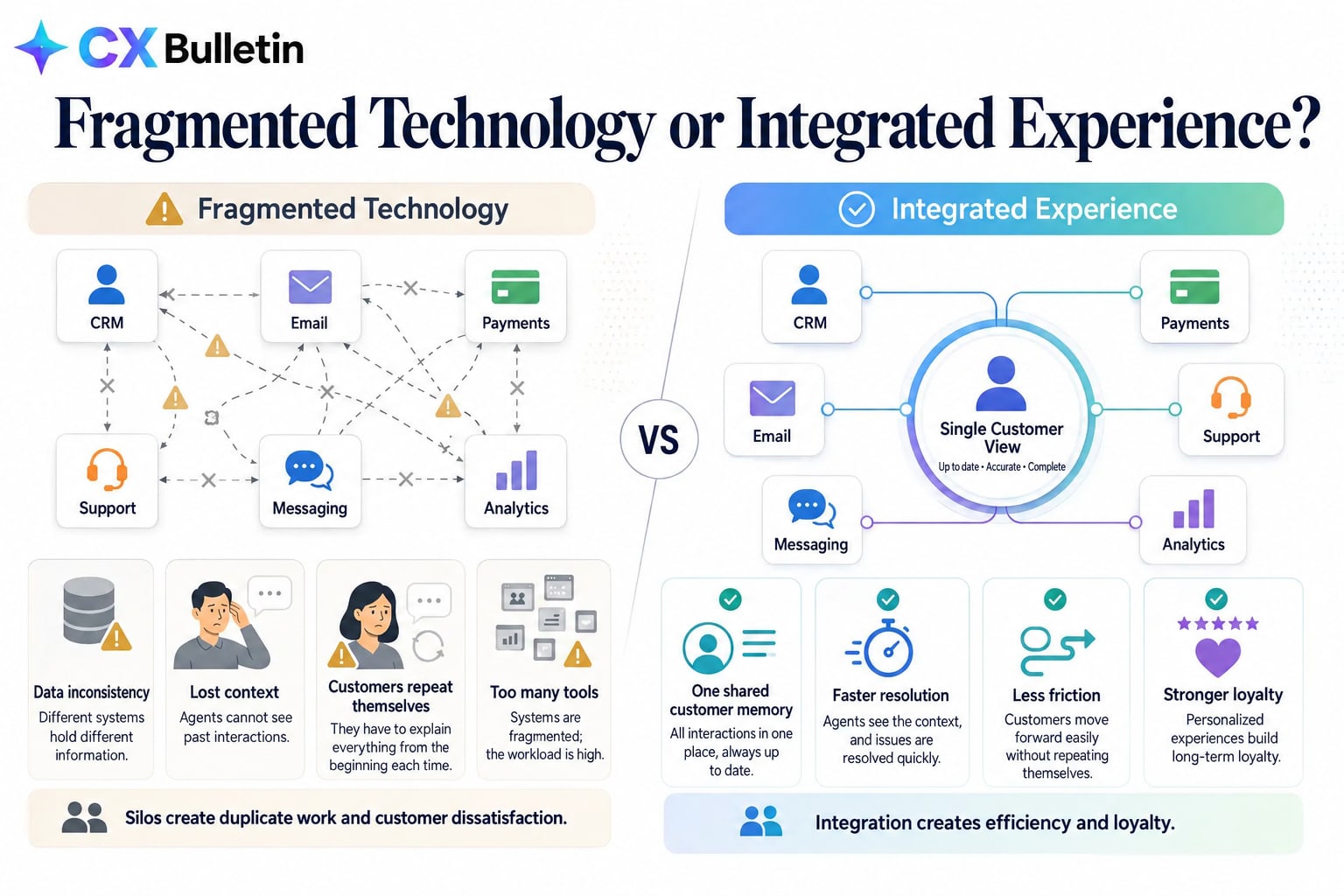
The problem isn’t too much technology; it’s technology that doesn’t work together.
AI’s real value begins beyond efficiency
AI is another strong theme in the report. According to Salesforce data, SMBs aren’t just eyeing AI with curiosity; they are actively investing in it. And most SMBs that use AI say their operations have become more efficient.
That matters, but in my view it isn’t enough on its own.
The real question is this: Is AI only speeding up the company’s work, or is it genuinely improving the customer’s experience too?
An SMB can use AI to produce content faster, send automated messages or speed up internal operations. All of these are useful. But from a customer experience standpoint, the real leap comes when AI responds to customers faster, makes more accurate recommendations, cuts down on how often customers have to explain the same thing over and over, and gives employees richer context.
That’s why seeing AI purely as an efficiency tool falls short. The real value emerges when it makes the experience more personal and smoother, with less friction. For anyone who wants to look at this topic through a somewhat wider lens, my piece on AI platforms’ customer experience report card may be a good complement.
One more point matters here: however powerful AI may be, it will struggle to create long-term value if it leaves trust and transparency out of the picture. That’s why organizations need to assess AI not only for capability but also for trustworthiness. Indeed, the NIST AI Risk Management Framework lays out clearly why trust, governance and risk awareness are critical in the use of AI.
Data quality: the invisible backbone of CX
Another of the report’s most valuable findings concerns data. The vast majority of SMB leaders believe that improving data quality will have a positive effect on revenue and efficiency. What’s more, a significant share of companies plan to invest more in data management going forward.
This is critical, because bad data produces bad experiences.
Incomplete customer history produces the wrong recommendations. Outdated records lead to slow support. Information scattered across channels forces customers to explain themselves again. Inconsistent data makes the brand behave differently at different touchpoints.
In fact, this also makes clear what the whole technology and AI debate rests on: without solid data, it’s hard to scale good CX. Without good data, AI often doesn’t deliver as much benefit as expected. State of Data and Analytics, a separate Salesforce study, supports this link in a broader context: for AI to really work, it needs trustworthy, accessible data.
On the customer experience side, we can put it more simply:
The more clearly a company sees its customers, the better it can treat them.
5 CX lessons for SMBs
From a customer experience perspective, Salesforce’s report offers five clear lessons:
-
CX isn’t something to deal with after you grow.
Growing SMBs put customer experience ahead of winning new customers. -
More technology doesn’t automatically mean a better experience.
If the tools aren’t connected, the experience becomes fragmented too. -
AI’s value lies not just in efficiency but in experience.
The real difference shows up in speed, personalization and friction reduction. -
Data quality is the invisible infrastructure of CX.
Bad data means bad recommendations, bad support and low trust. -
Trust and scalability matter as much as price when choosing technology.
As you grow, stopgap fixes turn into experience debt.
That’s exactly why, for SMBs, CX is no longer a “corporate concept” borrowed from large companies. Built correctly, it is an operational system that feeds growth, loyalty and advocacy all at once.
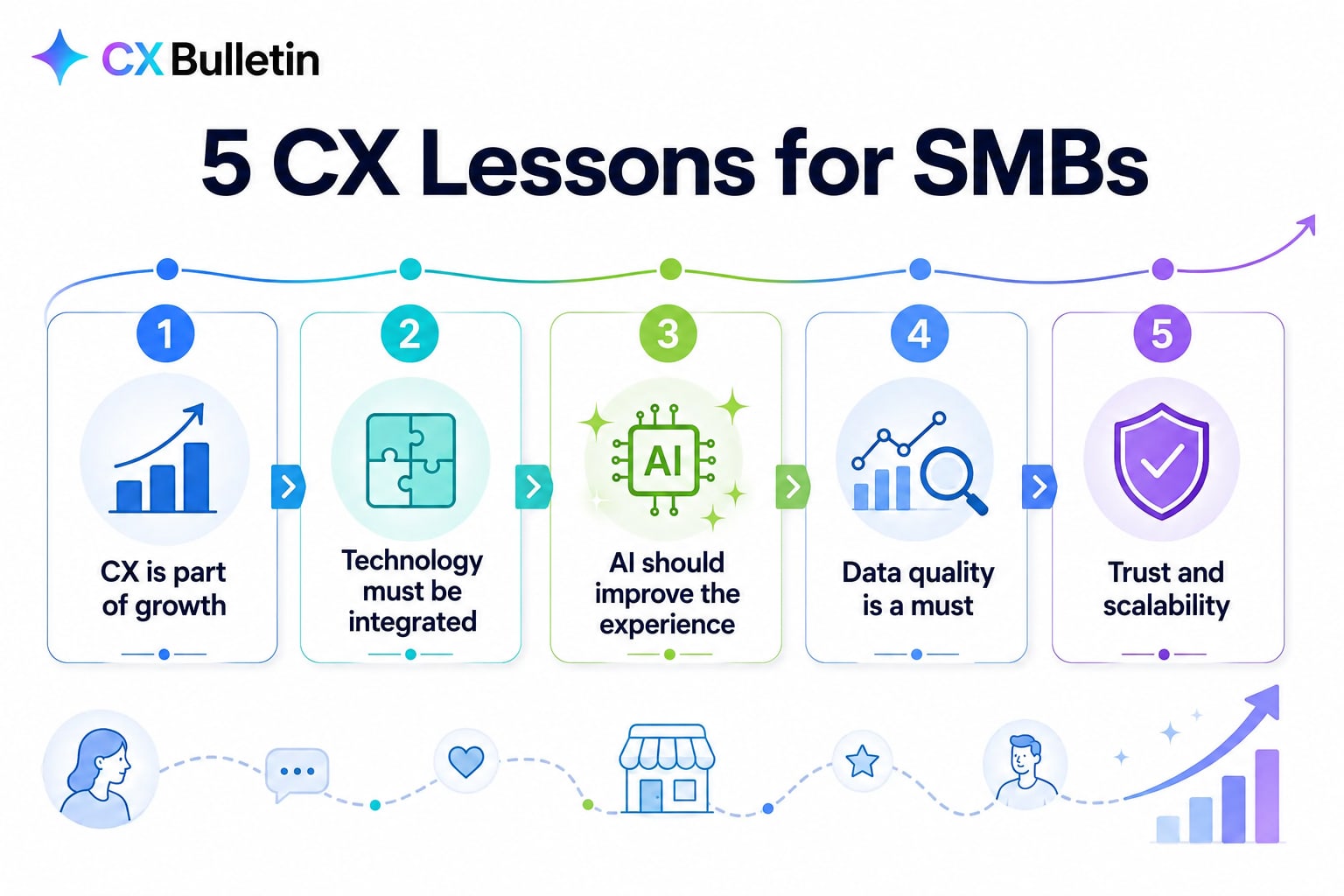
Growing SMBs put customer experience at the center not of their campaigns, but of their growth.
Why are trust and scalability now a CX issue?
To me, the final part of the report is less about choosing technology than about choosing what kind of customer relationship to build. That’s because as SMBs grow, stopgap fixes start to pile up. The cheap tool that looks practical today can leave your data disconnected tomorrow. The system you describe today as “doing the job for now” may no longer be able to hold everything you know about your customers a year from now.
That’s why trustworthy, scalable technology stops being a technical investment decision and becomes a customer experience decision.
Trust matters in particular, because customer experience isn’t only about speed; it also involves consistency, security and transparency. I made a similar point in the piece where I discussed how trust is put to the test in insurance: how customers see a brand is often shaped most at the moments when they feel the most friction.
It’s no different for SMBs. When the experience is going well, everyone gets by. The real difference lies in whether the experience holds up as the system grows.
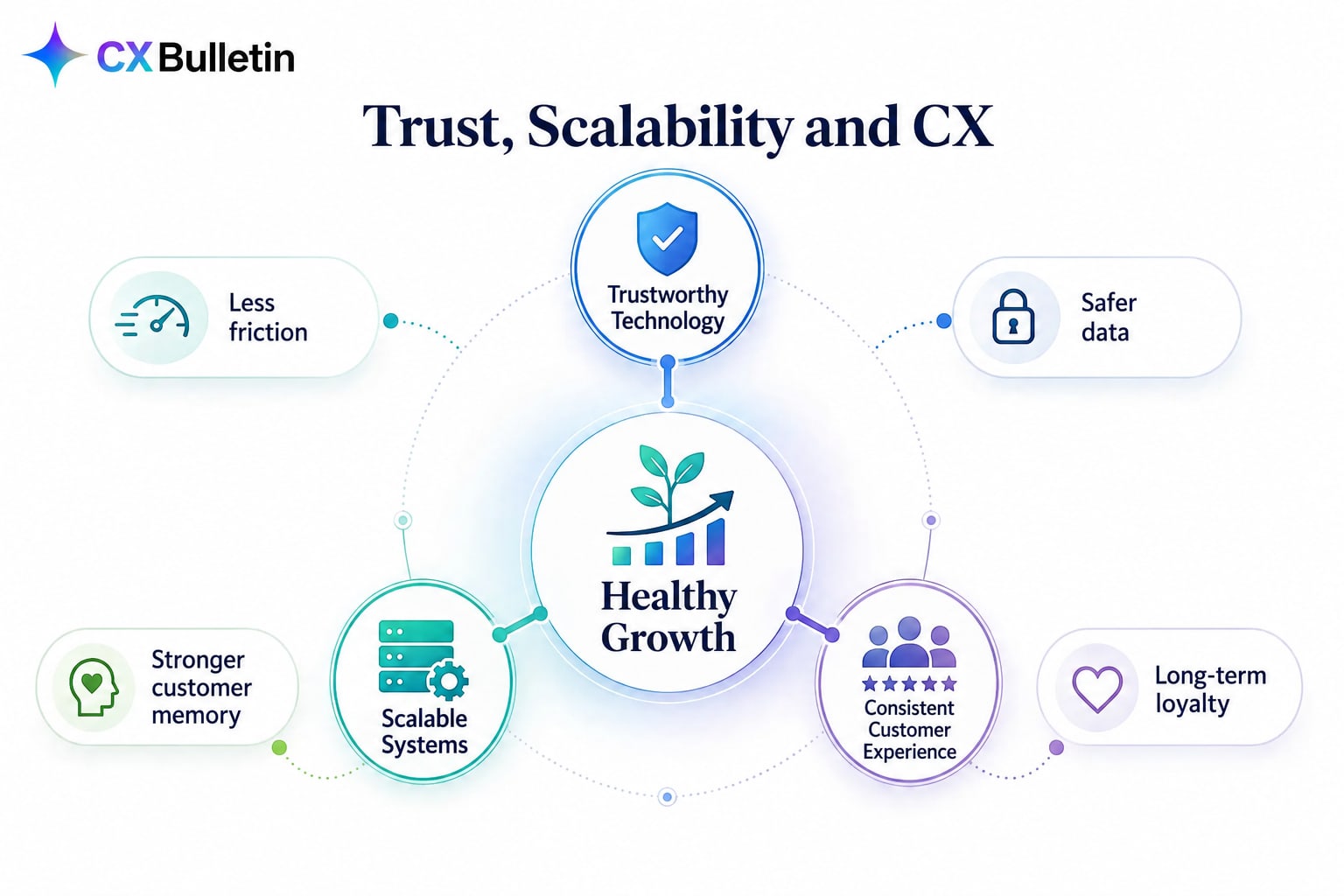
As an SMB grows, choosing technology effectively becomes a choice about the customer relationship.
Conclusion
The clearest conclusion from this report is this: for SMBs, customer experience is no longer a decorative extra to think about after the sale. Built correctly, it becomes the system that growth itself runs on.
Growing SMBs see this more clearly. First they improve the experience. Then they integrate their technology. They use AI not just to move faster but to improve the experience. They take data seriously. They see trust and scalability as just as strategic as price.
An SMB’s future is shaped not by how many customers it wins, but by the experience it offers them: how consistent, how fast and how reassuring it is.
This piece was first published in Turkish in CX Bulletin on May 13, 2026. English translation.