Customer Experience in Insurance: Brands Lose When They Fail to Inspire Trust at Claim Time
Insurance customers don't really judge a brand when they buy a policy; they judge it during claims, pre-authorizations and moments of uncertainty.
Insurance really is a strange product. It’s one of those rare things that, from the moment you buy it, you would rather not use. In fact, a flawless customer experience usually begins with not needing your policy at all for a long time.
But in a moment of crisis — an accident, a hospital pre-authorization, a flood, a fire, damage to your car or a complicated payment process — that invisible policy suddenly turns into a very concrete and vital question: “Is anyone there for me right now?”
QuestionPro’s customer experience benchmarking report, reflecting Q1 2026 data on the US market, makes it clear that the insurance industry still struggles to give a satisfying answer to this critical question. According to the data, the industry’s Net Promoter Score (NPS) stands at 22, its Customer Satisfaction Score (CSAT) at 74 and its Customer Effort Score (CES) at 76. What’s more, in the report’s overall assessment, banking and insurance lead the list of industries where consumers struggle most and have to put in the most effort.
The Claims Process Shows a Brand’s True Colors
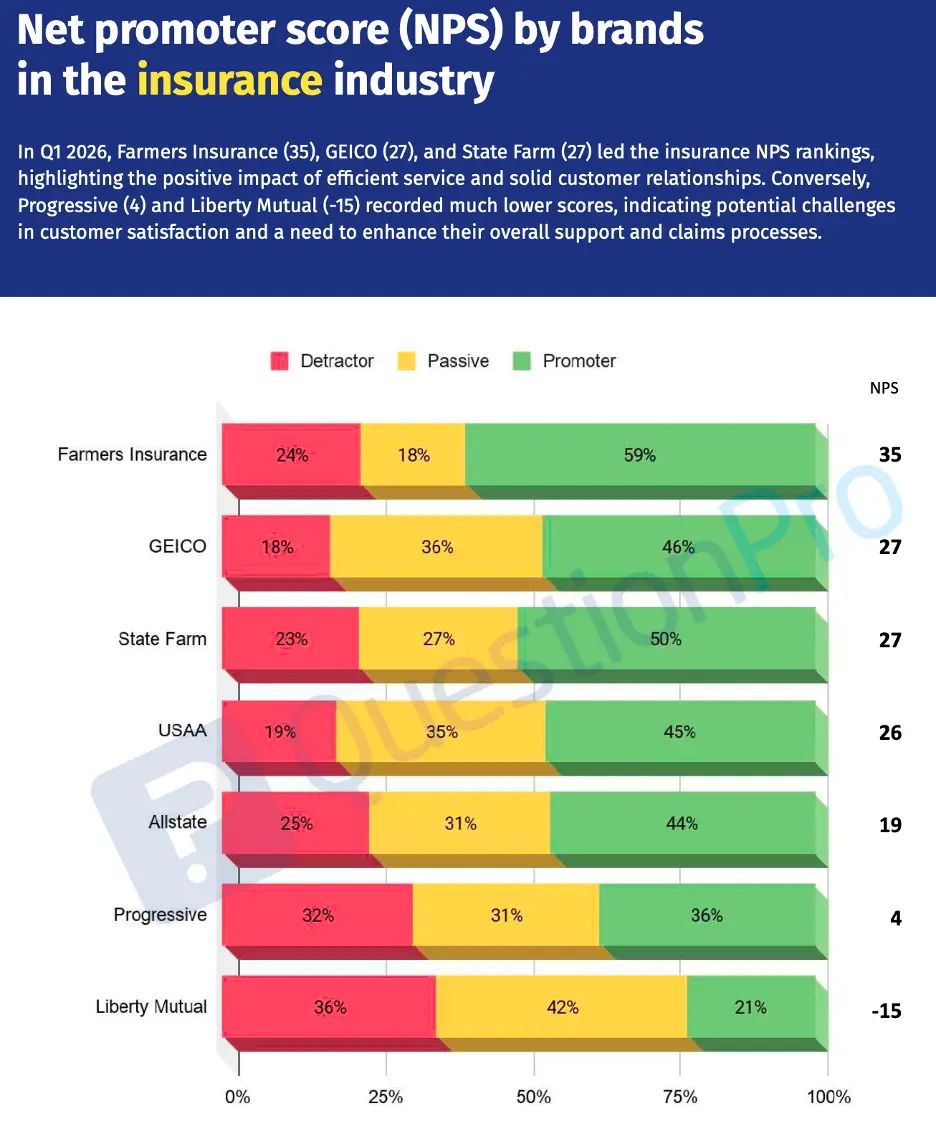
Among individual brands, Farmers Insurance leads with an NPS of 35. GEICO and State Farm are at 27. Progressive trails at 4 and Liberty Mutual at -15. The QuestionPro report notes that weak performance may be linked in particular to claims processes, price increases, friction in the digital experience, positioning problems and complaint volume.
Source: QuestionPro, Benchmarking CX Metrics by Industry and Brands in the U.S., Q1 2026
In Türkiye, this picture is all too familiar. Comprehensive auto, compulsory motor liability, supplementary health, private health, home insurance… When buying a policy, customers talk about coverage and price, but they judge the brand at claim time.
In insurance, trust is promised at the point of sale and proven at claim time.
Insurance Is Growing in Türkiye, and the Experience Gap Will Become More Visible
Türkiye’s insurance industry is growing fast. According to 2025 data from the Insurance Association of Türkiye (TSB), the industry’s total premium volume rose by about 46% in 2025 compared with the previous year. Industry news reports cite TSB data showing that total premium volume exceeded TL 1.2 trillion.
This growth matters. But growth alone doesn’t mean trust. In fact, it means more policies, more claim files, more pre-authorizations, more calls and more delicate customer interactions.
That is why customer experience in insurance is more emotional than in many other industries. When a bank transaction is delayed, the customer gets irritated. When a retail order arrives with an item missing, the customer gets angry. When an insurance process remains uncertain, the customer gets scared.
This difference needs to be clearly understood.
Why Is the Effort Score So Vital?
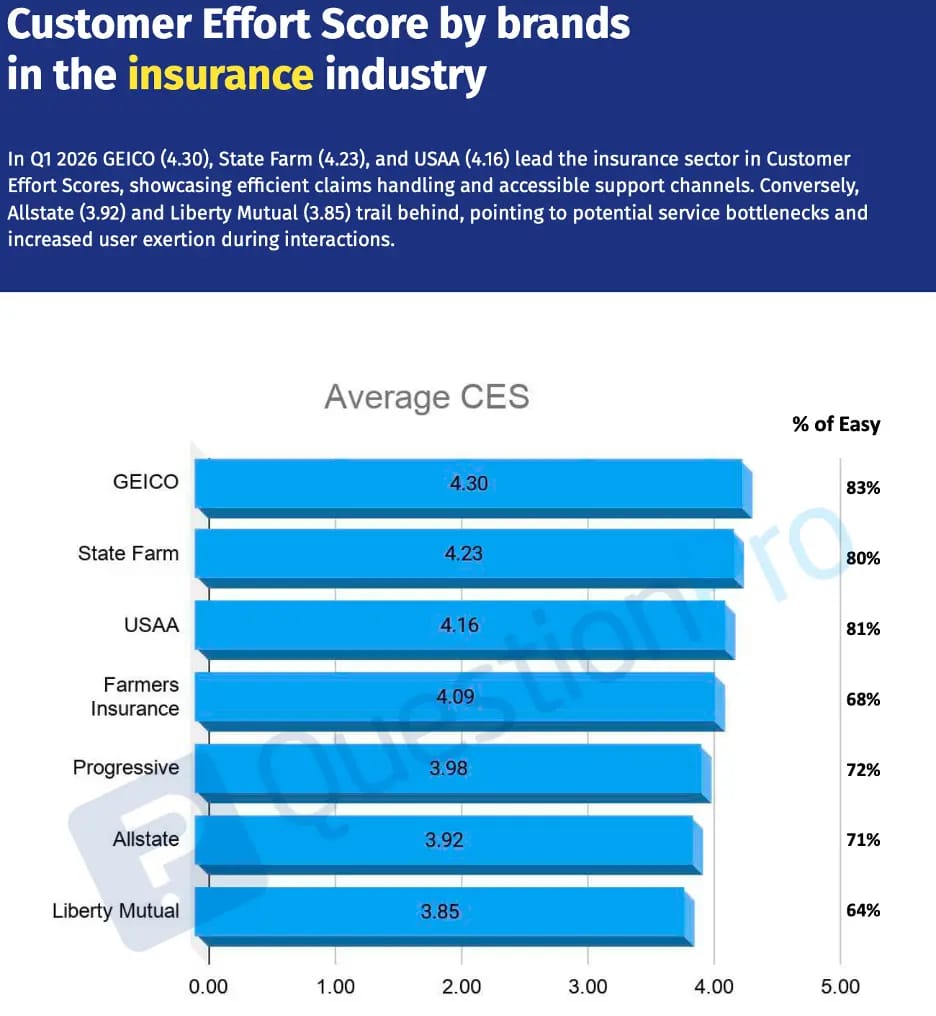
In QuestionPro’s Customer Effort Score data, GEICO stands out at 4.30, State Farm at 4.23 and USAA at 4.16, while Liberty Mutual at 3.85 and Allstate at 3.92 lag behind. The report points to increased customer effort during interactions and potential service bottlenecks at the lower-scoring brands.
Source: QuestionPro, Benchmarking CX Metrics by Industry and Brands in the U.S., Q1 2026
At this point, the AI and customer trust debate I wrote about earlier in CX Bulletin applies directly to insurance. Technology is valuable if it eases the customer’s anxiety. But if the customer is left alone with a bot at claim time, technology creates a sense of loneliness, not a solution.
Likewise, the employee-customer disconnect discussed in Why Do Employees and Customers Speak Different Languages? is critically important in insurance, too. If the agency says one thing, the call center says another and the mobile app shows yet another status, the customer feels lost in the system. That feeling of being lost is one of the things that erode loyalty fastest in insurance.
Three Make-or-Break Moments for Insurance CX in Türkiye
I see three touchpoints as especially critical for insurance companies.
The first is transparency in claims and pre-authorizations. Customers want to know where they are in the process. “Under review” is not an explanation. What stage is it at, whose desk is it on, and when will it be resolved?
The second is channel consistency. If the agency, the call center, the claims adjuster, the hospital, the mobile app and the customer service representative are not speaking the same language, trust melts away fast.
The third is human support. Insurance customers usually reach out at a stressful moment. That is why empathy is not just a nice gesture; it is part of the product.
As I said earlier when assessing AI investments in customer operations, simple tasks can be handed to automation, but in complex, emotional and high-risk moments, human support is still the insurance policy for the customer experience.
It’s Not the Policy but the Experience in Hard Times That Builds Loyalty
In insurance, customers get to know a brand not on a good day but in a moment of vulnerability. When that moment comes, they want three things:
Less uncertainty.
Someone to take ownership of the process.
Not to be left alone.
As you can see, the formula doesn’t change much from industry to industry. The right approach to customer experience is the same everywhere, and nearly every road leads to building trust. And a product like insurance, which people buy for “peace of mind,” comes into play at the most critical moment, under somewhat unfavorable circumstances. If your customer experience strategy isn’t built around this, you need to act before your customers and your competitors back you into a corner. A well-designed, well-executed customer experience strategy will never leave you with regrets…
This piece was first published in Turkish in CX Bulletin on May 5, 2026. English translation.