2026's New Rule in Customer Experience: Effortlessness, Not Loyalty, Wins
QuestionPro's Q1 2026 benchmark report shows that customers are now looking not just for loyalty but for an effortless experience.

Some reports just deliver data. Others point the way.
For me, QuestionPro’s Q1 2026 CX Benchmark report belongs in the second group. That’s because this study doesn’t just answer the question “Which sector has a high NPS?” By reading NPS, CSAT and the Customer Effort Score together, it takes a more realistic snapshot of the relationship customers have with brands. The report is based on a study of 1,200 US consumers and offers comparisons with more than 4,000 responses collected throughout 2025.
That’s why I don’t want to cover this entire report in a single long article. On CX Bulletin, I’ll break the study down sector by sector: banking, retail, technology, travel, automotive and insurance. After all, each sector’s score holds a separate lesson for brands in Türkiye.
Why does the QuestionPro report matter?
The most important thing about the report is that in 2026, the Customer Effort Score was added in place of “Likelihood of Repurchase.” This seemingly small change actually reflects a major shift in mindset.
NPS shows how likely customers are to recommend the brand, CSAT captures their satisfaction with recent experiences, and CES shows how much they struggle when doing business with the brand. In other words, NPS asks, “Would you recommend me?”; CSAT asks, “How was your last experience?”; and CES asks, “How hard did I make you work?”
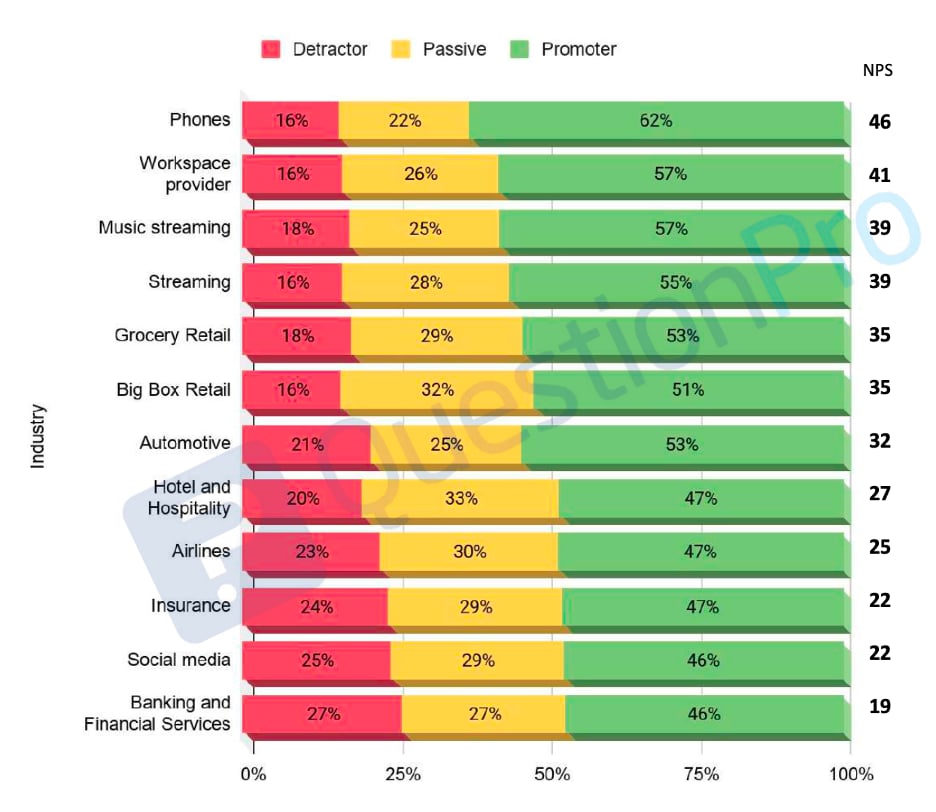
Source: QuestionPro, Benchmarking CX Metrics by Industry and Brands in the U.S., Q1 2026
NPS is strong, but no longer enough on its own
In the QuestionPro report, technology categories top the NPS rankings (46 for smartphones), while banking and financial services sit at the bottom with 19. Automotive rises from 12 in Q4 2025 to 32 in Q1 2026; banking, meanwhile, slips from 26 to 19.
This picture has me revisiting a question I explored earlier in CX Bulletin: “Is NPS a strategic compass or a statistical illusion?” NPS is still valuable. But an NPS that ignores the friction customers experience can stop being a compass that points the way and turn into a comforting vanity metric.
That’s because customers now have a relationship with brands that is too complex to be explained by the question “Would you recommend this brand?” alone. Sometimes they love the brand but struggle to get things done. Sometimes their overall satisfaction is high, but they’re left on their own when they run into a problem. Sometimes they like the app, but the whole experience falls apart once they’re routed to the contact center.
The real question for Türkiye: Are customers getting worn out?
Many brands in Türkiye still try to manage customer experience through NPS, complaint volumes and contact center performance. These matter, but they aren’t enough.
Especially in transaction-heavy sectors such as banking, insurance, telecom, e-commerce and public services, the real question should be:
Are customers getting worn out doing business with us?
As digital transaction volumes grow in Türkiye, this question becomes even more critical. According to data from the Ministry of Trade’s E-Commerce Outlook in Türkiye, e-commerce volume exceeded 3 trillion Turkish lira in 2024, and the number of transactions reached 5.91 billion. In a digital economy of this size, every small point of friction a customer experiences now spreads across millions of touchpoints. (Ministry of Trade)
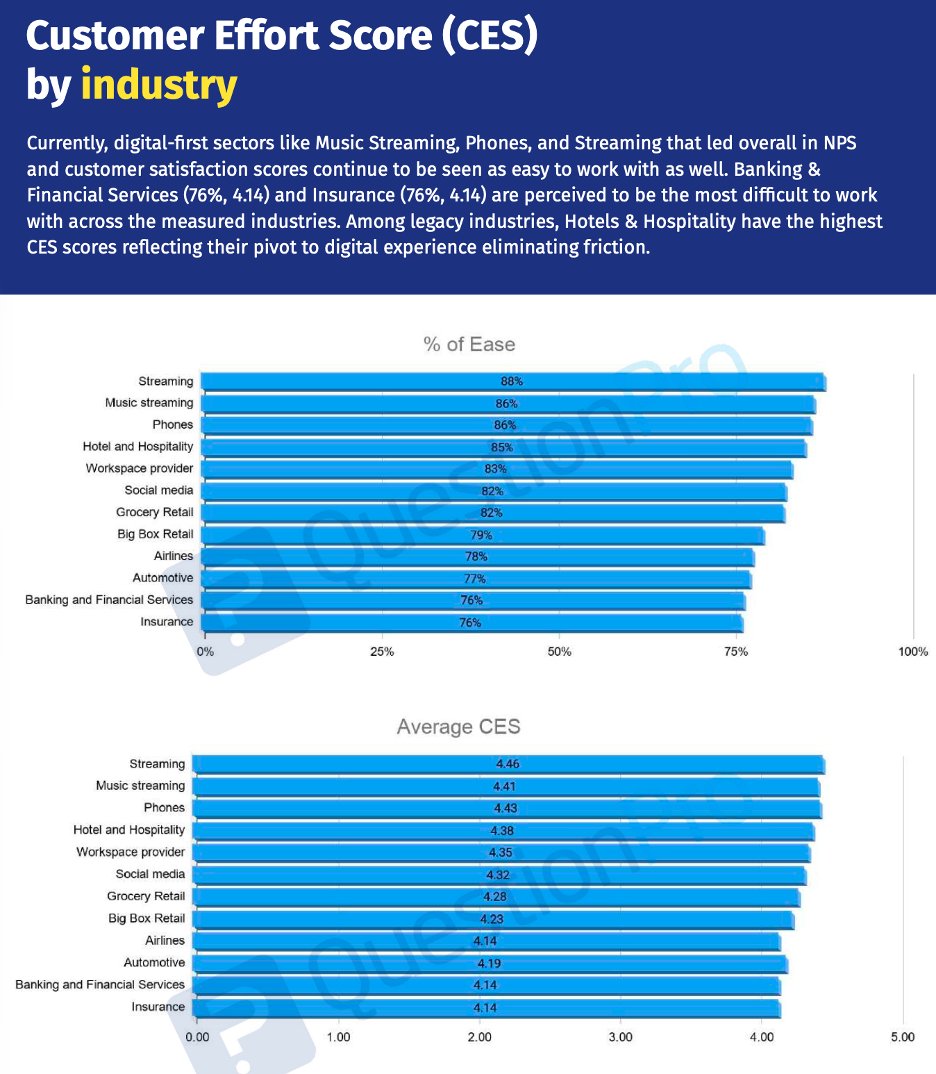
Source: QuestionPro, Benchmarking CX Metrics by Industry and Brands in the U.S., Q1 2026
In 2026, the winning brand will be the one that doesn’t wear customers out
The report’s overall findings support this as well. The technology sector leads on NPS, CSAT and CES. Banks and credit unions, by contrast, perform poorly on all three metrics. QuestionPro’s summary states clearly that customers reward reliability, speed and personalized digital touchpoints.
I came to the same conclusion when I wrote earlier about why AI investments in customer operations have not delivered the expected results. If you try to measure the new experience with old metrics, you won’t see how worn out your customers really are.
In my view, the customer experience question for 2026 is no longer:
“Do customers love us?”
The real question is:
How much effort does it take customers to do business with us?
Because loyalty is no longer won through emotional affinity alone; it’s won through the ability to make everyday life easier.
This piece was first published in Turkish in CX Bulletin on April 27, 2026. English translation.