The Customer Opens the App. What Does the Bank Say?
According to Bain's NPS Prism data, banks made the grade on experience but failed on engagement. Türkiye, with its heavy mobile traffic, faces the same question.
For years, whenever we talked about customer experience in banking, we kept coming back to the same questions: Is the app fast? How many steps does a money transfer take? Why is resetting a password such a hassle? Bain & Company’s Customer Engagement Is Banking’s New Battleground infographic, published on September 21, says these questions have largely been answered, at least in the US. As products and the digital experience have improved, it has become harder for a bank to stand out from its competitors. The clearest opening left is engagement. Bain defines it as communicating proactively with customers and showing that you genuinely care about their financial well-being.
The data comes from NPS Prism, Bain’s industry benchmarking platform, and is based on surveys conducted every year since 2021 with tens of thousands of US bank customers. It’s a short study, but every chart is rich enough to warrant an article of its own.
The one failing grade on the report card
The first chart asks customers how well their bank meets their needs in different areas. On experience and brand, the picture is quite good: 62% to 65% of customers say their needs are met, and only 7% say they aren’t. When it comes to engagement, the same customers talk as if they were describing a different bank. The share of customers whose needs are met drops to 36%, while the share saying their needs aren’t met rises to 41%.
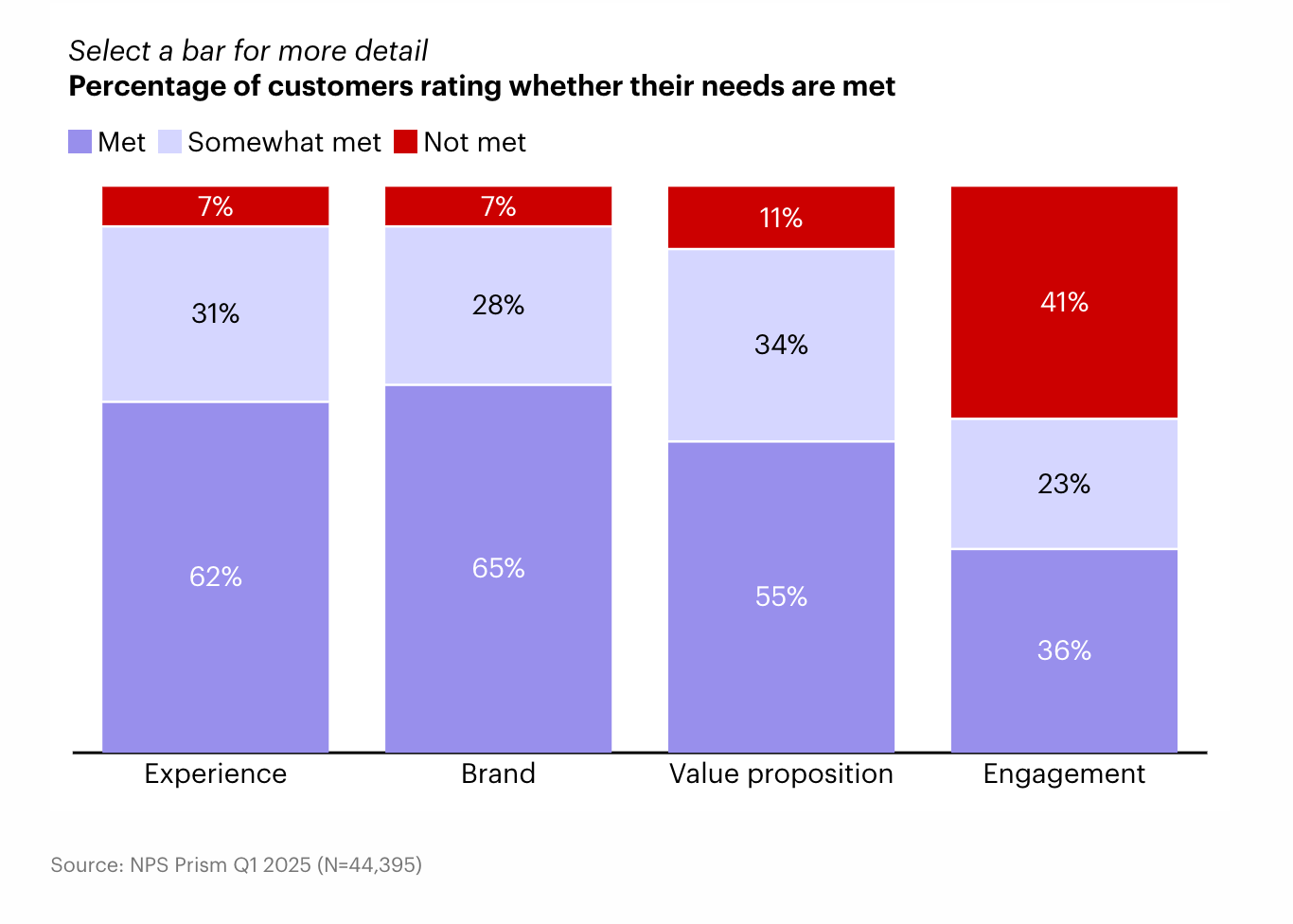
Engagement is the area where customers give their bank the lowest marks. Source: Bain & Company, NPS Prism Q1 2025 (N=44,395).
For years, banks have invested most heavily in experience, and it seems to have paid off. Yet the area where customers say “you don’t care about me” usually sits under campaign management in the budget, not under customer experience.
Frequent visitors are more loyal customers
The second chart puts 16 banks side by side. The share of customers who visit the app or website at least once a week ranges from 24% to 49%, and as that share rises, so does the engagement score. We should be careful about causality; it may be that customers who feel cared for visit more often. Whichever way it runs, the two go hand in hand.
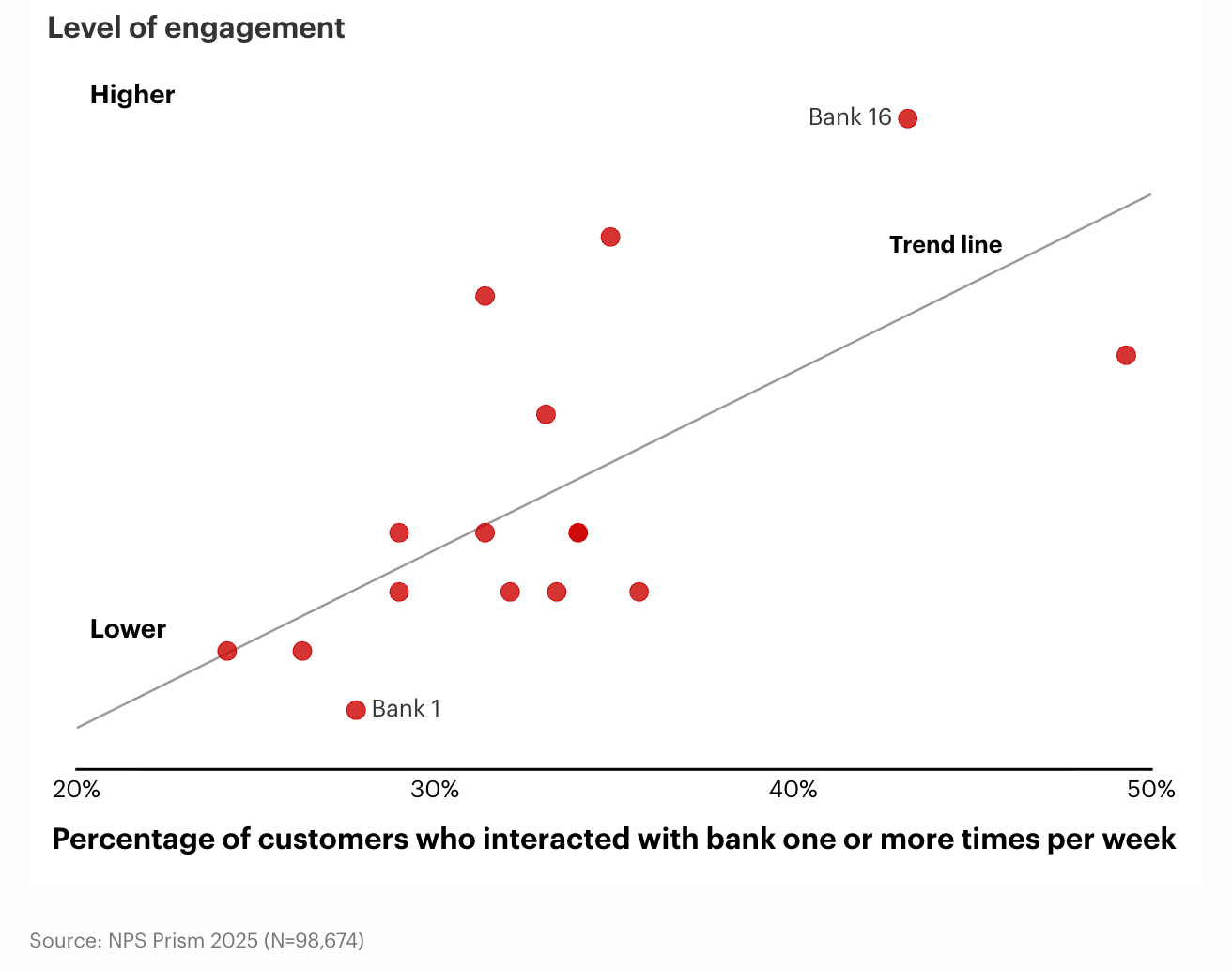
The higher the share of customers who visit at least once a week, the higher the engagement. Source: Bain & Company, NPS Prism 2025 (N=98,674).
Bills once a month, balances any time
This is the part that got me thinking the most. Bain splits engagement in two: logins to make transactions, and the browsing customers do whenever they feel like it, such as checking their balance, reviewing spending or tracking their points. Transactions have a natural ceiling; nobody pays the rent twice just to open the app more often. Browsing has no limit.
The 2025 figures make the distinction very clear. Traditional banking groups reach weekly usage of 40% to 58% for browsing but stay at 21% to 31% for transactions. Digital challengers lead on both: 83% and 37%. The gap between banks is even more striking. For transactions, usage runs from a low of 19% at one bank to a high of 41% at another. For browsing, the range stretches from 29% to 91%.
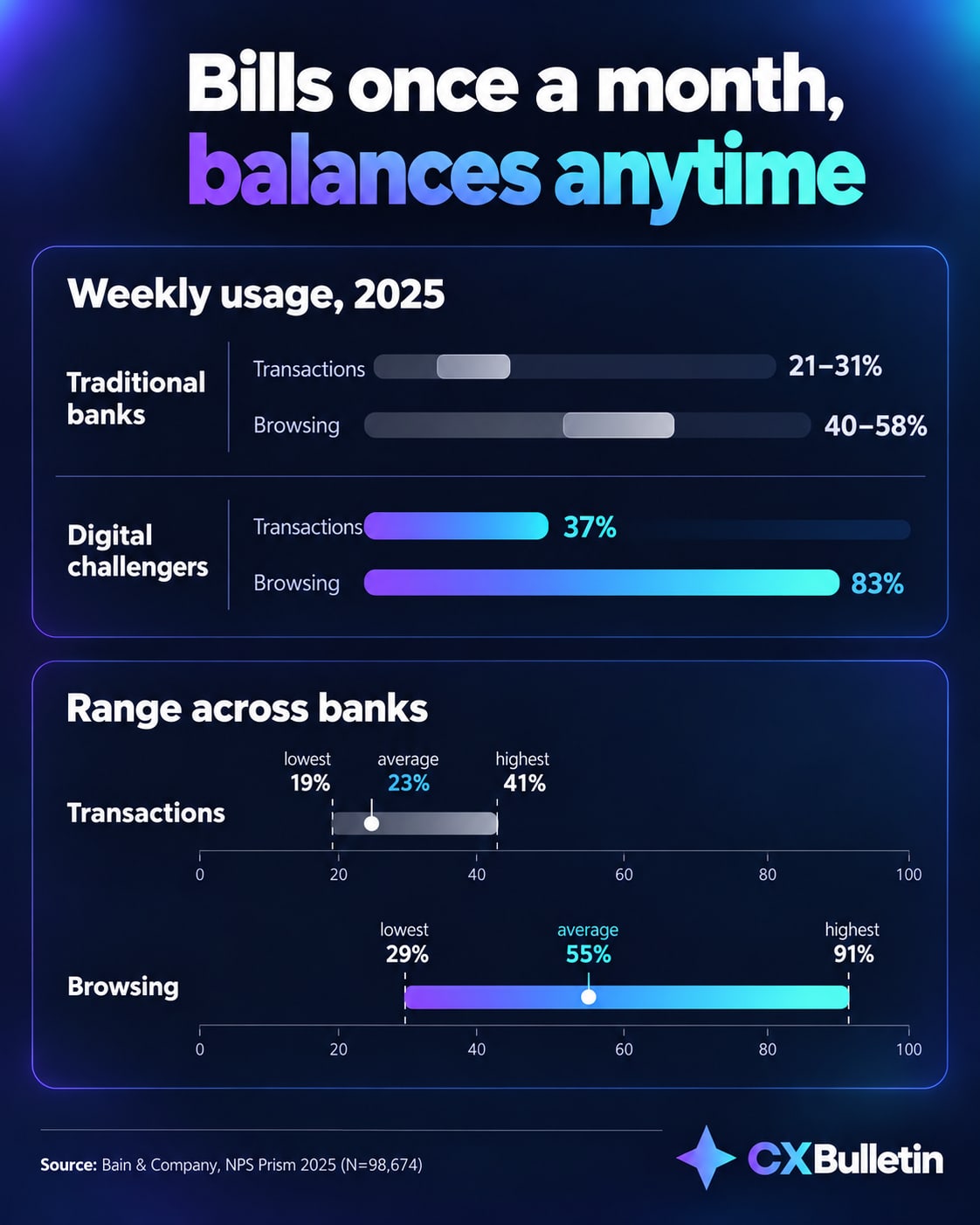
Transactions have a ceiling; browsing doesn’t. Data: Bain & Company, NPS Prism 2025 (N=98,674); visualization: CX Bulletin.
The real competition plays out in those small moments that bring customers back for no particular reason. The path Bain points to starts here, too: replacing reactive models that run on a campaign calendar with approaches that put AI at the center and deliver a message that is useful to customers at the right moment. Reading this section, I felt as if I were reading the banking version of my February piece on the habit loop and the new loyalty playbook.
In Türkiye, the traffic is there; the conversation is missing
Applying the data to Türkiye, I see an interesting reversal. The frequency Bain holds up as a target for traditional US banks is already a reality here. According to March 2026 data from the Banks Association of Türkiye, the active digital banking customer count, which tallies customers separately at each bank, has reached 129,465,000. That is why the figure exceeds the population, but it is also exactly why it’s meaningful: we are in a market where people actively use the apps of more than one bank. I have written separately before about where Turkish banks stand globally in digital banking; on that front, I have no worries.
My real question is what customers see when they open the app. Anyone who has worked in the sector can more or less guess the answer: a sizable share of the home screen is given over to loan, card and campaign offers. A notification giving cardholders who pay only the minimum an advance look at next month’s interest burden, or a short note ten days after payday reminding customers how quickly they are spending, says far more than an advertising banner at a time when inflation is felt this keenly. The headline of my banking piece in April came down to the same point: digitalization alone isn’t enough; customers are looking for trust. Sadly, didn’t hundreds of thousands feel this all the more acutely during the recent fund crisis?
Turkish banks have solved the traffic problem. In the period ahead, what sets them apart will be what they turn that traffic into. Tonight, when millions of customers open their app, will their bank show them something it wants to sell them, or something they need to know?
Update note (October 14, 2026): When this article was moved to The CX Brief, spelling corrections were made (correction type: spelling). The article’s content and views did not change.
This piece was first published in Turkish in CX Bulletin on September 26, 2026. English translation.