Forrester Names the 10 Emerging Technologies of 2026
AI is no longer confined to chat screens; it is taking new shape across customer journeys, the physical world, shopping, software development, security and invisible infrastructure.

AI moves out of the chat window and into the infrastructure of customer experience
For a long time, the AI conversation revolved around chat screens. The first big wave of excitement for companies came from employees using it to summarize reports, generate content, answer customer questions faster and find information more easily. That phase made AI visible and understandable to a broad audience. But in 2026, the debate no longer centers on chat screens alone. AI has spread across a far wider territory: from the interfaces customers see to physical operations, from shopping experiences to software development, and from security architecture to data center infrastructure.
Forrester’s analysis, “Top 10 Emerging Technologies For 2026: Beyond Chat”, points to precisely this shift. According to Forrester, AI is no longer limited to screens and digital workflows; it is expanding into robots, vehicles, shopping experiences, software development processes, security architecture and physical operations. Forrester groups these 10 technologies into three layers: Interact technologies that people will experience directly, Build technologies that will create those experiences, and Fuel technologies that power the entire transformation.
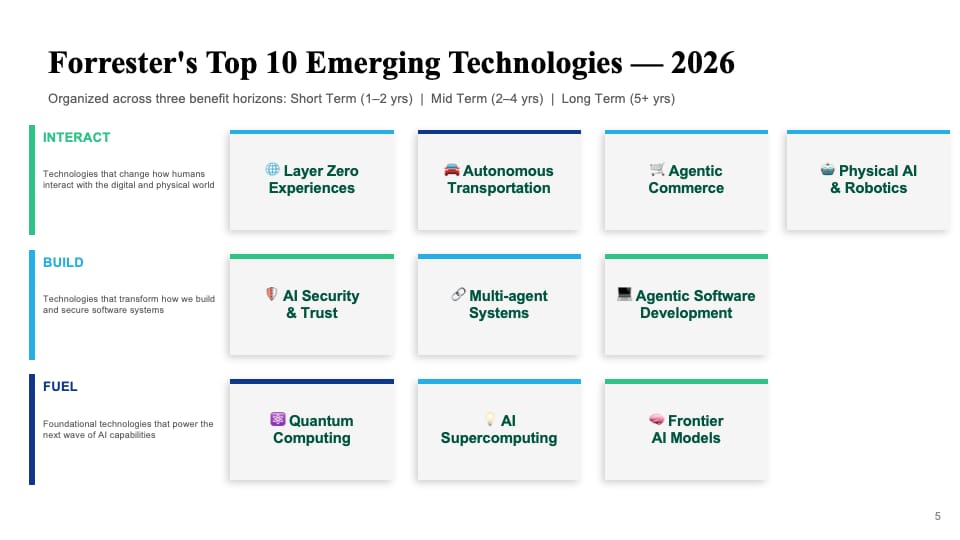
Forrester organizes 2026’s emerging technologies into three layers: Interact technologies that customers will experience directly, Build technologies that will create those experiences, and Fuel technologies that will power new AI capacity. Source: Forrester, “Top 10 Emerging Technologies For 2026: Beyond Chat.”
This is where the list starts to matter for customer experience. These are not innovations that will stay on the radar of CIOs or technology teams alone. They will change how brands appear to customers, how they serve and sell, how they earn trust and how they will be remembered.
The issue I explored earlier in CX Bulletin, why AI investments in customer operations fail to deliver the expected results, takes on renewed importance here. New technologies don’t create value on their own. Value emerges only when they reduce real customer friction, help employees make better decisions and strengthen the brand’s credibility.
1. Layer zero experiences: The era of post-app experiences
One of the most striking concepts on Forrester’s list is layer zero experiences. The term describes an AI experience layer that runs on top of today’s app-and-website model. Instead of navigating from one app to the next, users state their intent; the AI layer interprets that intent, connects different services and delivers the result as a more cohesive experience.
Forrester illustrates this with the example of planning a family vacation: an assistant that understands the dates in a group chat, pulls up flight and hotel options, builds a shared itinerary and sends it to everyone’s devices. This approach is not yet a fully mature standard, but the early signals are already visible. OpenAI’s Apps SDK lets developers build app experiences inside ChatGPT, while Google’s A2UI project puts forward the idea of agents generating interfaces that fit the context of the conversation.
In Türkiye, app loyalty could be redefined
In Türkiye, brands have long tried to draw customers into their own mobile apps. For banks, insurers, retailers, airlines, and food delivery and grocery platforms, app downloads, active users, push notification open rates and self-service usage have become key performance indicators.
As layer zero experiences mature, that picture could change. Customers may want to start a transaction through their own AI assistant, without ever opening a brand’s app. Requests such as “Find the best flight,” “Get me a cheaper alternative to the product I bought last month,” “Explain the coverage in my insurance policy in plain Turkish” or “Plan this week’s grocery shopping around my budget” may begin entirely outside the brand’s app.
The new question for customer experience then becomes: Can a brand still manage the experience properly when customers bypass its own interface? If product information, terms of service, delivery promises, return policies and pricing data are not readable, reliable and actionable for AI agents, the brand may become invisible in the customer’s new decision layer.
This topic is also closely related to the phygital revolution in experience design I wrote about earlier in CX Bulletin. Customer experience is no longer designed only in digital or physical channels; it is shaped in invisible layers that operate on top of, between and behind those channels.
2. Physical AI and robotics: AI moves into the physical world
Forrester’s second item is about AI being embedded in robots and physical machines. What we’re describing here is something different from classic automation. Whereas traditional robots mostly repeat predefined movements, physical AI refers to systems that perceive their surroundings, interpret changing conditions and act accordingly.
Developments in this area are not merely theoretical. Google DeepMind describes its Gemini Robotics models as helping robots perceive their environment, reason, use tools and interact with people. Meta’s V-JEPA 2 research, likewise, is positioned as an approach to understanding the physical world through video and supporting robot planning.
In Türkiye, the impact will first be felt in operations customers don’t see
In Türkiye, the first impact of physical AI may show up less in customers encountering robots directly than in the operations behind the experience. Logistics, warehouse management, retail inventory operations, internal hospital processes, manufacturing, after-sales service and field operations are among the areas this shift will affect first.
For customers, the result will be quite tangible: more accurate stock information, shorter delivery times, quicker access to service appointments, fewer operational errors and more predictable maintenance. Particularly in sectors such as retail and automotive, where physical operations and customer experience are intertwined, physical AI could become a CX enhancer that customers don’t see but do feel.
This ties in closely with the CX Bulletin article on after-sales customer experience in automotive. In automotive, customer loyalty is strengthened not in the showroom but through service, warranty, spare parts, maintenance and the ownership journey. Physical AI could be one of the technologies that improve precisely this unseen ownership experience.
3. Autonomous transportation: Taking the experience to city scale
Autonomous transportation is among the technologies on Forrester’s list that customers will experience directly. It shouldn’t be seen simply as a matter of driverless cars. It opens up a broader experience landscape that spans urban mobility, delivery, fleet management, insurance, maintenance, safety, regulation and customer trust.
Around the world, progress in this space is accelerating. Waymo positions itself as an autonomous ride-hailing service. Reuters also reported that Waymo and Uber launched a robotaxi service in Atlanta. These examples show that autonomous transportation is now being tested not only in R&D labs but on real customer journeys.
In Türkiye, trust will be tested first
Turning autonomous transportation into a customer experience at scale in Türkiye won’t be easy in the short term. Factors such as driving culture (!), urban infrastructure, road conditions, insurance liability, regulation and consumer trust call for serious preparation. But that doesn’t mean the topic is a distant prospect for Türkiye.
The first applications could start on campuses, at airports and ports, in organized industrial zones, in tourist areas and in enclosed logistics sites. From a customer experience standpoint, the most critical question will be not so much whether the technology works on a technical level as whether customers feel safe.
In autonomous transportation, building trust takes more than “it didn’t crash.” Customers want to understand the vehicle’s decisions, know what will happen in an emergency, see who bears insurance liability and feel confident about whom they can hand control to when needed. The brands that succeed in this area in Türkiye will be those that can design for trust rather than simply explain the technology.
4. Agentic commerce: Shopping will start with the customer’s agent
Agentic commerce means AI agents carrying out steps of the shopping process, such as research, comparison and payment, on the customer’s behalf. Instead of browsing every product page one by one, customers define their intent, budget and preferences; the AI agent narrows down the options, compares sellers and moves toward completing the transaction through secure payment infrastructure.
Payment giants are preparing for this shift. With Visa Intelligent Commerce, Visa aims to connect AI agents to secure commerce experiences. Mastercard and PayPal announced that they are developing secure payment layers for agentic commerce by integrating Mastercard Agent Pay into the PayPal wallet. Stripe also announced that, together with Visa and Mastercard, it supports a network-led agentic payment approach for agentic commerce transactions.
In Türkiye, competition could shift from search results to AI recommendations
Türkiye is a market where shopping online and getting fast delivery are deeply ingrained habits. Marketplaces, grocery apps, food delivery platforms, digital wallets and instant payment systems have already significantly reshaped customer behavior. Agentic commerce could take that shift a step further.
Instead of saying “Show me the cheapest product,” a customer might say, “Put together a basket that fits my budget this week, without settling for lower quality than last time.” Or they might use experience-based criteria such as “Buy from the seller with the most hassle-free returns.” Competition then plays out not only in search results, ad placements or campaign visibility, but in making it into the AI agent’s set of trusted recommendations.
For brands in Türkiye, preparing for this new era will start with data quality. If product descriptions, prices, stock information, delivery times, return terms, warranty coverage and customer reviews are inconsistent, the AI agent may fail to evaluate the brand accurately. In short, a new discipline will join e-commerce SEO: commerce data that is trustworthy, readable and actionable for agents.
5. Agentic software development: Software teams will adjust to a new working rhythm
One of the first items in Forrester’s “Build” layer is agentic software development. This refers not just to software development speeding up through code-completion tools, but to AI agents playing a part in multistep work such as planning, writing code, testing, fixing bugs and preparing pull requests.
Products in this space are arriving fast. OpenAI describes Codex as a cloud-based software engineering agent. GitHub is putting agentic workflows front and center in Copilot. Anthropic, for its part, says Claude Code is a system that can read a codebase, edit files, run tests and ship code.
In Türkiye, a major opportunity to clear CX backlogs
At many organizations in Türkiye, small but valuable improvements that would enhance customer experience sit waiting in the backlog. Simplifying a form, improving a self-service screen, fixing an integration, adding new information to the call center screen, streamlining the returns process or making a small change to a user flow in the mobile app can go months without being prioritized.
Used well, agentic software development could shorten that wait. Faster prototyping, faster testing, faster integration and shorter improvement cycles translate directly into a better customer experience. The critical point, however, is not that agents replace developers, but that they enable developers to work more strategically and more securely.
Security, code quality, audit trails and change management will be indispensable in Türkiye, especially in regulated sectors such as finance, insurance, telecom and public services. An AI agent can write code, but keeping the systems that improve customer experience running reliably still requires human accountability, architectural discipline and good governance.
6. Multi-agent systems: The era of agents working together, not alone
One of the most important items on Forrester’s list is multi-agent systems. A single AI agent can handle simple tasks, but real operations usually involve more than one step. A customer complaint, a loan application, a return, a technical fault or a corporate procurement request touches multiple systems, departments and approval points.
Multi-agent systems are architectures in which specialized agents work together. One agent might understand the customer’s intent, another might check the relevant policy, a third might pull inventory or payment data, and a fourth might offer recommendations to the human representative. Forrester says these systems are showing early gains in areas such as customer support resolution rates, incident triage and software delivery, but that guardrails are still needed around orchestration, governance and security.
In Türkiye, they could reduce the disconnects between departments
Many customer experience problems in Türkiye stem not from a single department performing poorly but from the disconnects between departments. Customer service sees the problem, but operations can’t act on it. Sales makes a promise, but service can’t deliver on it. Marketing sends out a campaign, but the same customer may have just had a bad experience.
Designed well, multi-agent systems could reduce these disconnects. In banking, insurance, e-commerce, telecom and public services in particular, a customer case could move faster through a set of specialist agents. But the risk is significant too: if accountability blurs while agents make decisions among themselves, customers may hear the line “the system did it” more and more often.
That is why multi-agent systems in Türkiye need more than technology investment: accountability for decisions, human approval, appeal mechanisms and record-keeping processes must also be designed in from the start. In customer experience terms, good automation is automation that makes the path to resolution visible, not automation that obscures the customer’s rights.
7. AI security and trust: Security is no longer a back-room issue for CX
Forrester positions AI security and trust as the foundational trust layer that other AI technologies need in order to work. In the more detailed section of its public blog post, it discusses the area alongside privacy and trust. Risks such as prompt injection, data leakage and model theft show that AI systems must be rigorously managed from a security perspective, not just a productivity one.
These risks are on the security community’s agenda as well. OWASP’s Top 10 risk list for LLM applications highlights threats such as prompt injection and sensitive information disclosure. In its Generative AI Profile document, NIST recommends an approach aligned with the AI Risk Management Framework so that organizations can manage generative AI risks throughout the life cycle. In the European Union, the AI Act implementation timeline shows that organizations need to prepare for the rules on high-risk AI systems and transparency.
In Türkiye, trust will move from the tech team to the customer front line
AI security in Türkiye is often seen as a matter for IT and cybersecurity teams. Yet in customer experience terms, security is a direct part of the brand relationship. If an AI assistant gives incorrect information, exposes a customer’s personal data, carries out an unauthorized transaction or points the customer in the wrong direction, the impact goes beyond a technical incident. Customers begin to question whether they can trust the brand.
That is why banks, insurers, e-commerce platforms, healthcare providers, educational institutions and public services should now treat AI security as part of their CX strategy. The question “How secure, auditable and explainable is the AI, and how readily can its decisions be challenged?” will matter as much as “How fast does the AI respond?”
In Türkiye, where KVKK, sector regulations and customer trust all come into play, secure AI design could become a competitive advantage. Customers like a brand that answers them quickly, but they trust a brand that protects their data and can correct its mistakes.
8. Frontier models: The most powerful model may not always be the right one
One of the items in Forrester’s “Fuel” layer is frontier models. These are the AI models offering the most advanced capabilities in areas such as language, images, audio, video, code, reasoning and tool use. For customer experience, however, the point is not always to use the biggest or most powerful model.
In CX, the right model is one that understands the customer’s intent, draws accurately on the company’s own knowledge, reduces the risk of error, can run at a sustainable cost and hands off properly to a human agent when needed. In other words, how the model handles context matters as much as its technical capacity.
In Türkiye, it’s less about a powerful model than the right context
The question “Which model is better?” comes up often in AI projects in Türkiye. It’s a natural question, but for customer experience it falls short. If Turkish-language performance, local expressions, industry jargon, regulation, brand voice and customer expectations aren’t handled properly, even the most powerful model can produce a poor experience.
In customer service, for example, Turkish isn’t used only in its standard written form. Regional expressions, anger, irony, incomplete explanations, sentences that mix English and Turkish, and industry abbreviations are all common. If a model can’t grasp that context, being technically advanced may not be enough from the customer’s point of view.
For frontier models to translate into CX value in Türkiye, organizations will need to clean up their own knowledge bases, processes, product descriptions and service policies, because AI can only deliver an experience as good as the context it is fed.
9. AI supercomputing: The invisible capacity race behind the experience
AI supercomputing is one of the infrastructure layers that customers don’t see directly but that determine the quality of the experience. More advanced models, longer context windows, real-time agents, multimodality and physical AI applications all require greater computing capacity. As a result, data centers, GPU infrastructure, energy, cooling and network capacity are becoming invisible components of customer experience.
Global investment in this area is accelerating. Reuters reported on OpenAI, Oracle and SoftBank’s large-scale plans to invest in AI data centers under the Stargate project. Investments like these show that AI is a race not just in software but in infrastructure.
In Türkiye, infrastructure will set the limits of the AI experience
AI supercomputing may not be an area where every company in Türkiye invests directly, but everyone will feel its effects. Model access costs, response latency, data center location, data sovereignty, energy costs and regulatory compliance will determine how far AI-powered customer experience projects can scale.
The question “Where does the AI run?” will become more important, especially for finance, telecom, the public sector, healthcare and large e-commerce platforms. Where in the world customer data is processed, which systems store it and how quickly responses are generated can all directly affect CX quality.
Building strong local capacity in this area in Türkiye would be valuable not only for technological independence but also for customer experience, because delivering a fast, reliable and uninterrupted AI experience requires strong infrastructure behind the scenes.
10. Quantum computing: Not today’s experience, but tomorrow’s test of trust
The technology with the longest horizon on Forrester’s list is quantum computing. For most companies, it may not be a direct customer experience project in the near term. Forrester also stresses that, for many firms, the technology will take longer to generate broad commercial value, but that preparation for the encryption-breaking risk known as Q-day should start now.
The call to prepare is more than a theoretical warning. In 2024, NIST published its first three post-quantum encryption standards. NIST’s post-quantum cryptography page also states that organizations should begin planning their transition to quantum-resistant cryptography.
In Türkiye, a long-term trust issue to start thinking about today
Quantum computing may not be on the agenda of most CX teams in Türkiye today. But when it comes to customer data, payment information, health records, insurance files, identity information and sensitive data stored for long periods, the issue bears directly on trust.
The possibility that some of today’s seemingly secure encryption methods could become breakable in the future poses a risk, especially for organizations that retain data over the long term. For banks, payment institutions, telecom operators, public institutions, healthcare organizations and brands holding large volumes of customer data, quantum readiness should be part of the trust strategy, not just a matter for technology departments.
For customers, the visible effects may not show up right away. But customer trust will be shaped not only by fast service today but also by a brand’s ability to keep data protected well into the future.
The big picture for Türkiye: The opportunity is large, but value won’t come automatically
Forrester’s 2026 list shows that AI should no longer be seen merely as a tool that generates content or answers questions. AI is building new interfaces on top of apps, entering physical operations, transforming software development teams, redesigning commerce, changing security architecture and accelerating the infrastructure race.
For Türkiye, this landscape presents a significant opportunity. A young customer base with strong digital habits, mature e-commerce adoption, a fast-growing fintech ecosystem, manufacturing capacity and software talent together lay the groundwork for capturing value from these technologies. TÜBİTAK’s 1711 Artificial Intelligence Ecosystem Call, which supports areas such as smart manufacturing, financial technologies, smart agriculture, sustainability and smart education technologies, is another sign that Türkiye’s AI ecosystem is trying to align more closely with enterprise needs.
From a customer experience perspective, however, the critical caveat remains the same: technology by itself doesn’t improve customer experience. A technology creates value once it is clear what friction it reduces for customers, how it empowers employees, how it protects trust and how it connects to business outcomes. Otherwise, even the most dazzling technology remains little more than a good demo.
Conclusion: In 2026, customer experience moves beyond the screen
Forrester’s list of emerging technologies for 2026 sends a clear message to the customer experience world: in the period ahead, AI won’t be squeezed into a chat box. Customer experience will extend to invisible interfaces running on top of apps, robots in the physical world, autonomous vehicles, shopping agents, systems that build software, security platforms and unseen computing infrastructure.
Brands in Türkiye that read this transformation correctly could gain a significant advantage. Customer experience is no longer limited to a better call center, a better mobile app or faster response times. It will be defined by how well a brand understands its customers, how well it preserves context, how well it manages trust and how wisely it uses technology to make customers’ lives easier.
That is why the most important question of 2026 is not “Which technology should we invest in?” The better question is this: What friction in the customer’s life do we want to remove, and which of these 10 technologies truly addresses it?
This piece was first published in Turkish in CX Bulletin on May 8, 2026. English translation.