In Automotive, CX Is Won After the Sale, Not During It
Vehicle delivery isn't the end of the relationship; it's day one for service, warranty, software, spare parts and dealer consistency.
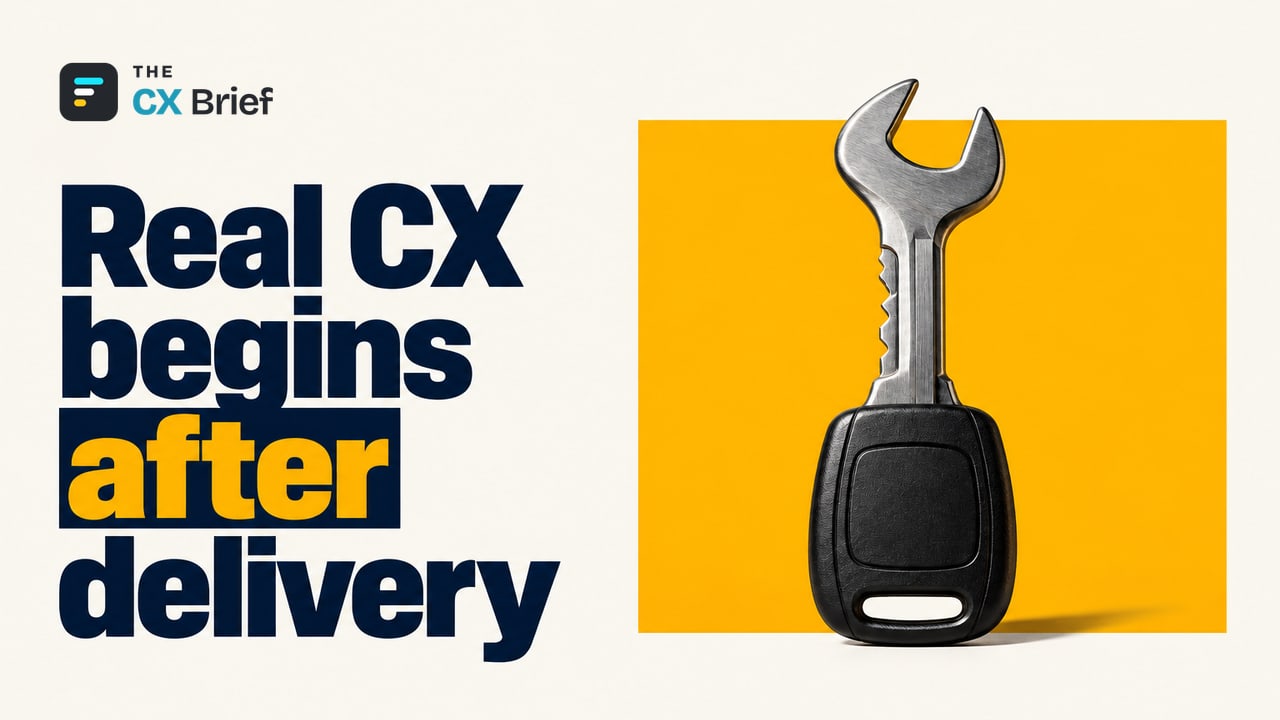
The moment you buy a car is a glamorous one: the showroom lights, the test drive, the delivery photo, the key being set down on the table…
But in automotive, the real customer experience usually begins later. At the first service appointment. In a dispute over warranty coverage. While waiting for spare parts. When a software update is needed. While tracking whether the car holds its value.
QuestionPro’s Q1 2026 CX Benchmark report, which measures the US market, paints a highly instructive picture of the auto industry. Industry NPS jumps from 12 in Q4 2025 to 32 in Q1 2026 (QuestionPro notes that this quarter it also raised the limit on how long a vehicle had been used or owned). Among brands, GMC and BMW stand out with an NPS of 61, and Toyota with 55. By contrast, Volkswagen sits at 4 and Hyundai at 0. The report notes that strong brands set themselves apart through reliability, a premium service experience and the ability to resolve maintenance problems.
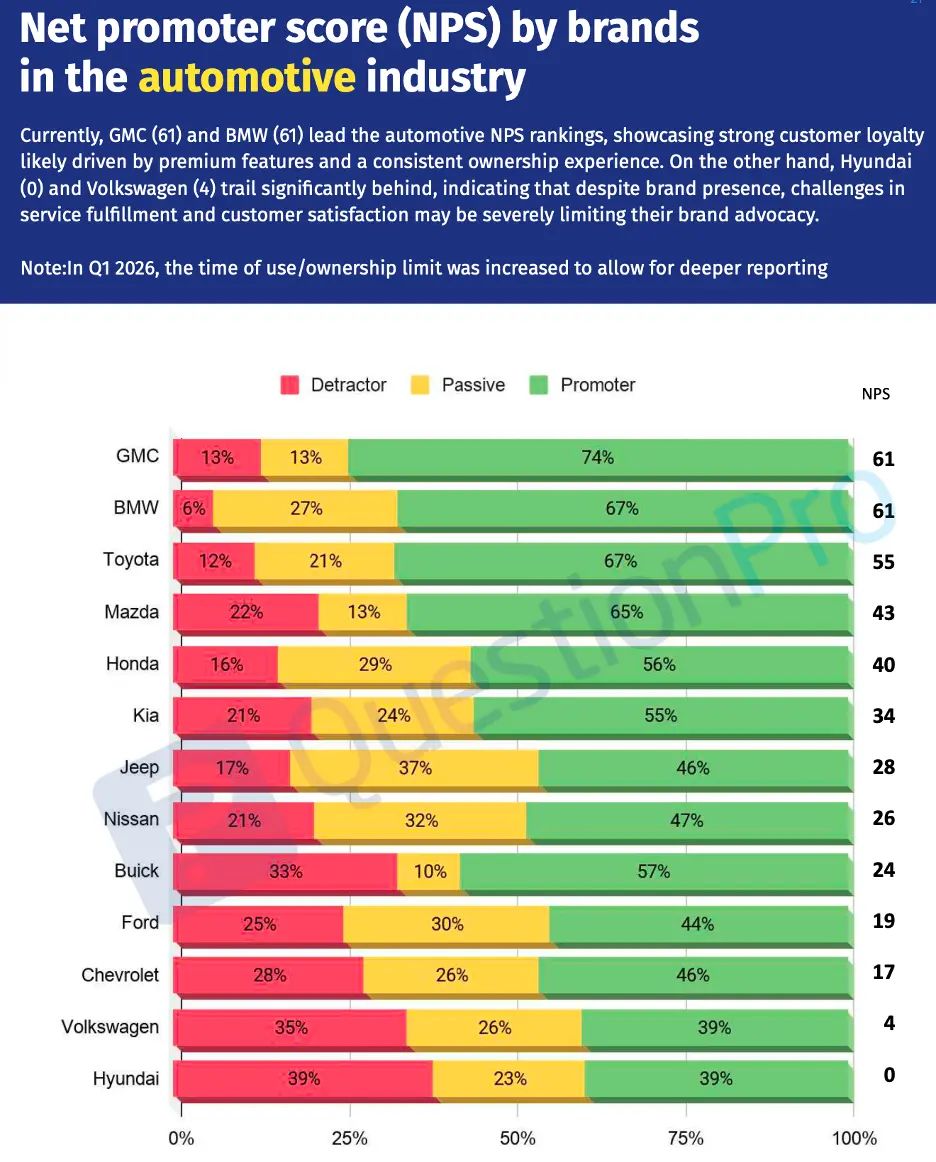
Source: QuestionPro, Benchmarking CX Metrics by Industry and Brands in the U.S., Q1 2026
Türkiye’s Auto Market Is Growing, and the Ownership Experience Is Becoming Even More Critical
Türkiye’s automotive market now stands out not just for its volume but for the speed of its transformation. According to a Reuters report based on ODMD data, car and light commercial vehicle sales rose 10.5% in 2025 to 1.37 million units; fully electric car sales climbed to around 190,000 units, taking a 17% share of the passenger car market. Anadolu Agency also reported that electric vehicle sales in Türkiye reached 191,960 units in 2025, with a market share of 17.7%.
All of this makes CX an enormous responsibility for Türkiye. A car is no longer just a mechanical product; it is a living ecosystem of software, connected services, battery health, the charging experience, the mobile app, the warranty and resale value.
Buying the car does not end the customer’s relationship with the brand. Quite the opposite: that relationship is only just beginning.
The Service Counter Reveals More About a Brand Than the Showroom
In QuestionPro’s Customer Effort Score results, Toyota leads at 4.44, followed by BMW at 4.39 and Mazda at 4.30. Volkswagen ranks lowest at 3.78. The report notes that Toyota excels at low-friction interactions, while for Volkswagen it points to a need to simplify the overall consumer experience.
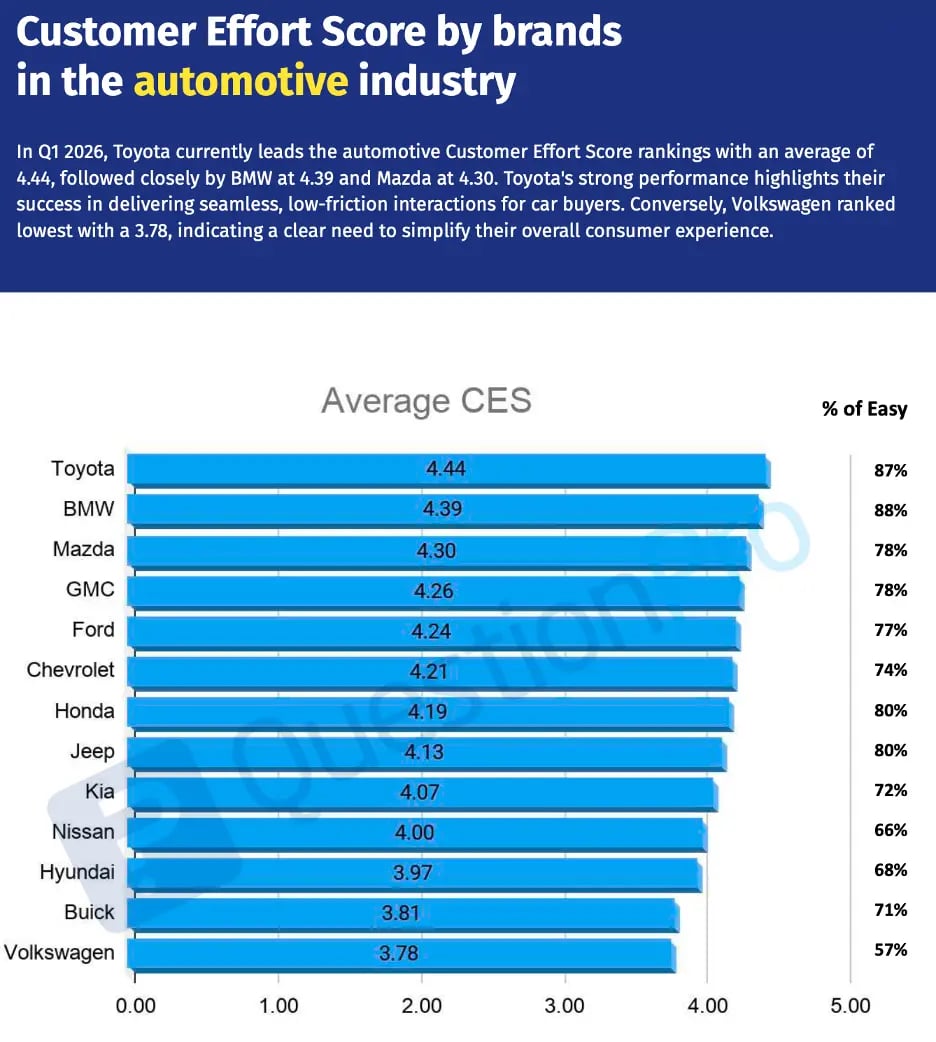
Source: QuestionPro, Benchmarking CX Metrics by Industry and Brands in the U.S., Q1 2026
When I think about the automotive experience in Türkiye, the same scene always comes to mind: a customer leaving the service center and being told, “You’ll get a survey — please give us a perfect score.” This is not just a Türkiye problem; it is a chronic CX problem for the auto industry in many markets around the world. When I wrote earlier about why tying customer experience metrics to employee bonuses is risky, I specifically touched on this “survey coaching” trap in automotive. Measurement exists to shed light on reality; once it forces frontline employees to chase scores, it starts to mask the real experience.
The EV Era Makes CX More Complex
The rise of electric vehicles in Türkiye makes automotive CX even more critical. The EV buyer’s journey differs from that of a conventional car buyer. EV buyers don’t just look at motor performance; they ask new questions about charging access, battery guarantees, software updates, the mobile app, range information, service expertise and resale value.
That is why, for automotive brands, “after-sales” no longer means just maintenance and scheduled servicing. It means the customer’s entire digital and physical relationship with their car.
When I wrote earlier about Levi’s Wear Longer initiative, I stressed that the experience does not end at the moment of purchase. In the Levi’s example, the brand was equipping customers with the skills to use the product for longer. A similar logic applies in automotive: a brand should not just sell cars; it should enable customers to use their cars with more confidence, for longer and with less stress.
Four Critical Areas for Türkiye
I see four areas as especially critical for automotive brands in Türkiye.
The first is ease and consistency of service appointments (unfortunately). If customers have to struggle to reach the service center, brand loyalty starts to erode.
The second is transparency on spare parts and repairs. “We’re waiting for parts” is not an explanation on its own. Customers want to know the timeline, where things stand and what their alternatives are.
The third is warranty communication. If warranty coverage is not explained in language customers can understand, it breeds stress, not trust.
The fourth is consistency between the dealership and the service center. If the promise made at the sale is not kept at the service center, customers blame the system, not the brand.
This is where the logic of the article on calculating ROI on customer experience investments also comes into play. Good CX in automotive cannot be defended simply on the grounds that “customers loved us”; it has to be weighed alongside the service retention rate, warranty costs, referral behavior, second-car purchases and dealer profitability.
In Automotive, Loyalty Starts Not with the Key but with Leaving the Dealership
In automotive, the moment of sale is emotional, but loyalty is tested after the sale, and on rational grounds.
The customer asks:
“Was the service center a hassle?”
“Did the warranty really have my back?”
“Did the dealer and the brand speak the same language?”
“Am I the owner of this car, or have I just been saddled with its problems?”
For automotive brands in Türkiye, the real competition is playing out — and will keep playing out — not in the showroom but along the ownership journey. After all, customers choose a brand the day they buy the car; they champion it the day they leave the service center satisfied. By turning a customer we worked so hard to win into a brand ambassador, we both keep a loyal customer on our books and bring in new customers on the strength of a powerful referral. The formula really is that simple; what matters is executing it well…
This piece was first published in Turkish in CX Bulletin on May 4, 2026. English translation.