Duolingo Chose a Better Experience to Drive Growth
In its 2026 growth strategy, Duolingo chose to improve the free user experience rather than step up ad and subscription pressure.
Most of us know Duolingo for its cute owl, its endless notifications, its streak tracking and its gamified learning experience. I, for one, remember it for Junior shrieking “papaaa papaaaa” while I was trying to learn French; to this day, I can’t decide whether that tone is annoying or funny. 🙂 What the company laid out in its latest quarterly announcements is more than a product update from an education app. I think there’s a much bigger customer experience lesson here.
Duolingo says plainly that its 2026 strategy will focus on a better free experience rather than more pressure on users, a heavier ad load or more aggressive subscription pushes. And this isn’t coming from a small startup. It’s coming from a company that, as of Q1 2026, had reached 56.5 million daily active users, 12.5 million paid subscribers and $292 million in revenue for the quarter. Daily active users and paid subscribers grew 21% year over year, and revenue rose 27%.
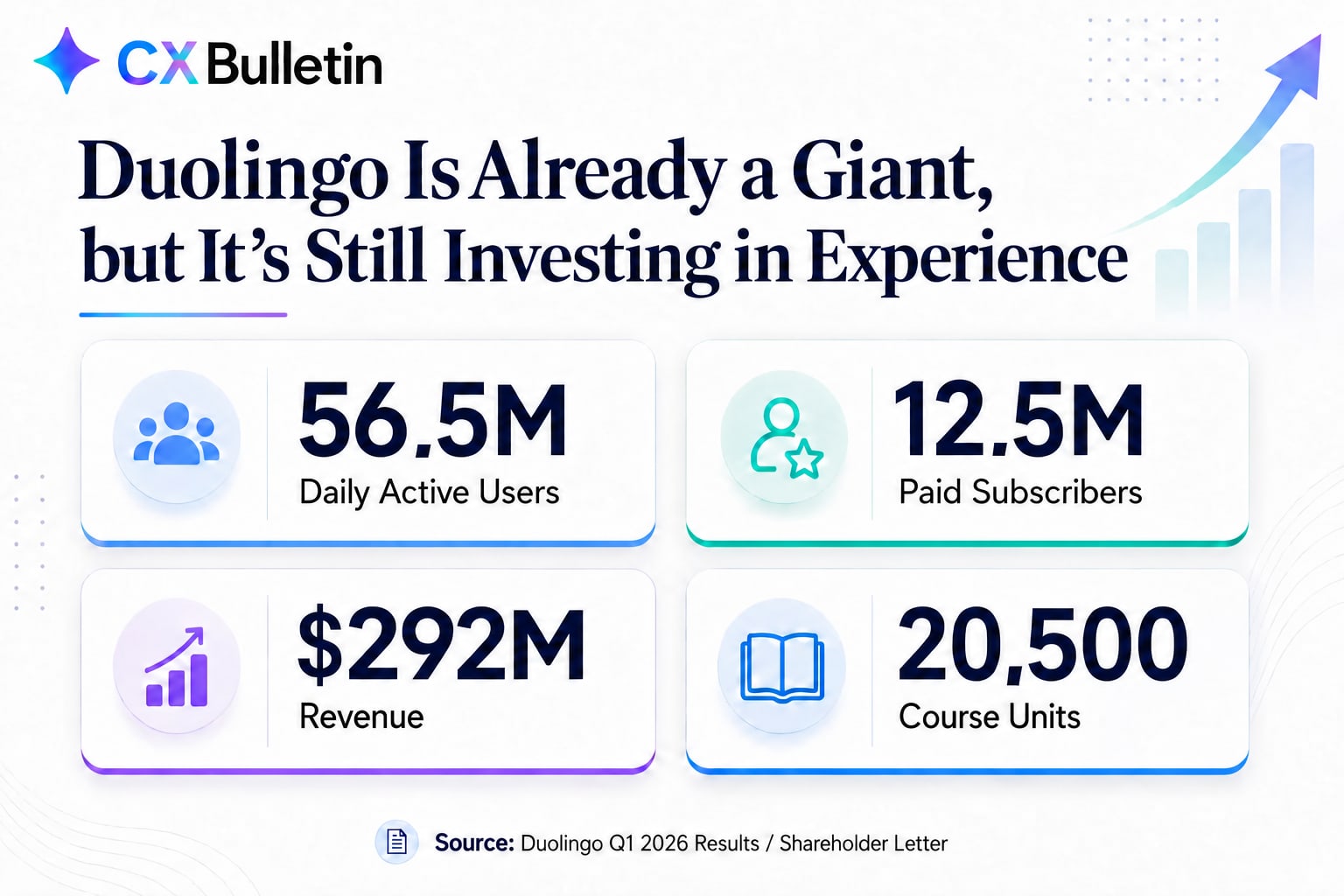
Duolingo’s new growth approach shows that a better user experience, rather than more ad pressure, can deliver stronger results over the long term.
That’s why the Duolingo case shows so clearly that CX still can’t be boxed into categories like “customer service,” “complaint management” or “NPS report.” Designed the right way, experience can be the growth strategy itself.
What did Duolingo realize?
Duolingo’s most striking self-criticism actually comes in its Q4/FY 2025 investor letter. The company acknowledges that it leaned more heavily on ads and subscription prompts to increase bookings per user, but that these small frictions may have slowed daily active user growth. That’s why it says it will put user growth ahead of monetization in 2026.
More important, Duolingo doesn’t frame this choice as simply “let’s make the product a bit nicer.” The company sees giving up more than $50 million in potential bookings as an investment in the free user experience and in word-of-mouth growth.
From a CX standpoint, that’s a very powerful statement.
Here, the company is deliberately walking away from certain sources of friction that could bring in revenue in the short term. It could show more ads, put up more paywalls and push subscriptions harder. But Duolingo is asking: If these tactics lift revenue today while weakening tomorrow’s user growth and the power of recommendations, is that really a good strategy?
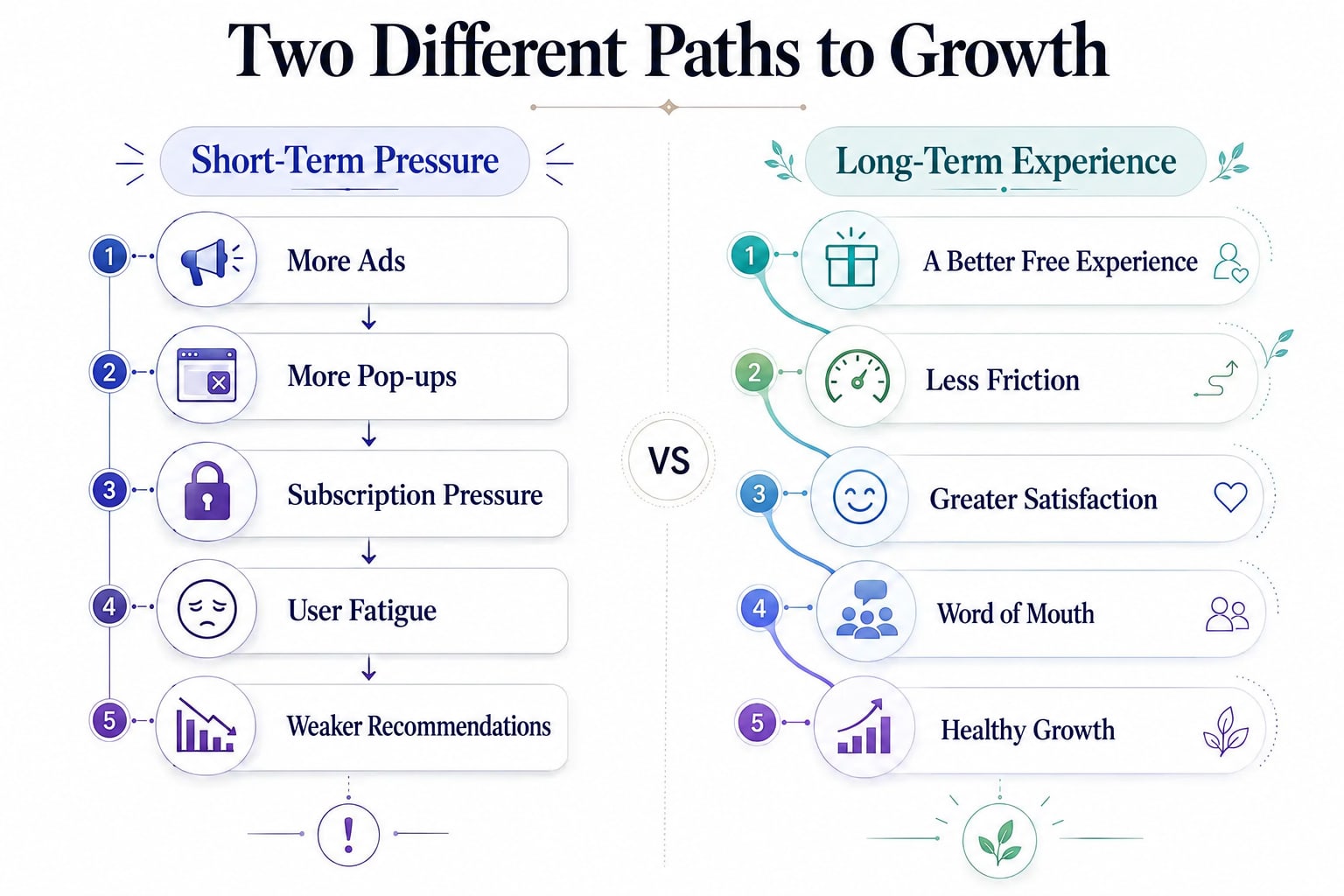
Short-term monetization pressure can lift some metrics, but a better experience can generate stronger referrals and healthier growth.
This question goes to the very heart of ROI on customer experience investments, a topic I’ve covered before in CX Bulletin. The return on experience won’t always show up in that month’s income statement. But friction removed in the right place pays off in higher loyalty, stronger referrals, lower acquisition costs and longer customer lifetimes.
Free users are customers too
Many companies still have this reflex: Give limited value to users who don’t pay, and keep the really good experience behind the paywall.
Duolingo is saying the exact opposite. Strengthening the free experience isn’t just “goodwill”; it’s a growth strategy. The company’s own strategy page explains that the freemium model is critical to both its mission and its business model, that more users create a cycle of more data and a better product, and that better learning in turn supports word-of-mouth growth.
A CX Dive story based on the Q1 call makes a similar point: Over the past two months, Duolingo improved its free tier and opened up more features to free users, and it expects this to contribute to both daily active user growth and word-of-mouth referrals. CEO Luis von Ahn says most users come to Duolingo through word of mouth.
The lesson here is clear: A free user is not “someone who hasn’t paid yet.” Sometimes they’re the brand’s most powerful distribution channel.
They’re the ones recommending the app to a friend, sharing screenshots on social media, telling their kids, their spouse or a coworker, “Try this.” A poor free experience doesn’t just drag down the conversion rate; it also makes people less likely to talk about the brand.
It’s no accident that Nielsen’s global research on trust in advertising shows that people trust recommendations from people they know above all else. Word of mouth is still one of the most powerful marketing channels, but it’s also the hardest one to buy.
Recommendations are earned through experience, not campaigns
This naturally brings us to NPS. After all, the core NPS question is “Would you recommend us?” Fred Reichheld’s classic article in Harvard Business Review treated the willingness to recommend as a central indicator of growth.
But the Duolingo case is a reminder: You don’t create recommendations by sending customers surveys. Recommendations happen when customers have an experience that’s genuinely worth talking about.
In McKinsey’s analysis of word-of-mouth marketing, too, what matters isn’t just the volume of conversation but the impact and credibility of the recommendation. So for brands, the point isn’t to “get people talking about us more”; it’s for the right people, in the right context, to describe a genuinely trustworthy experience.
That’s why Duolingo’s investment in the free experience is strategic. As the user experience improves, recommendations become more organic. And as recommendations become more organic, growth gets healthier.
What does improving the experience actually mean?
The nice thing about Duolingo is that it doesn’t just say “we’ll improve the customer experience” and leave it in the abstract. The company goes straight to the heart of the learning journey.
In Q1 2026, speaking practice became a more central part of the product. With “spoken tokens,” free and paid users can answer out loud in most exercises instead of tapping words. Flashcards support quick recall. And “Speaking Adventures” prepares users for realistic conversation scenarios. On the paid side, Duolingo continues to develop the Video Call feature while extending access to Super subscribers.
Taken one by one, these may look like product features. But seen through a CX lens, there’s a bigger picture: Duolingo is helping users do what they actually came to do, and do it better. What a language learner needs isn’t just to keep a streak going in the app. It’s to be able to speak. (Especially when learning French! 😆) To remember. To put sentences together in real life. To express themselves more comfortably.
In other words, Duolingo’s improvements aren’t cosmetic; they’re built around the outcome the customer wants to achieve. That’s exactly where good CX begins.
Sometimes friction brings in revenue; sometimes it chokes growth
One of the most valuable lessons in Duolingo’s disclosures is the tension between monetization and experience.
The company says tactics like more ads and subscription prompts can boost bookings in the short term but can conflict with daily active user growth. So in 2026 it’s looking for more user-friendly ways to monetize. The CX Dive story highlights longer free trials, upgrade paths users feel good about, and monetization models that don’t clash with DAU growth.
It’s a familiar dilemma that nearly every digital product faces.
Should we show more pop-ups?
Should we ask people to sign up earlier?
Should we add more ads?
Should we squeeze free users a little harder?
Should we add one more step to the checkout flow?
Some of these tactics can make short-term metrics look better. But every bit of friction that wears users out, breaks their flow, erodes trust and chips away at goodwill toward the brand can choke growth over the long run.
The core lesson of the Harvard Business Review article “Stop Trying to Delight Your Customers” is similar: Before you try to wow customers, make things easier for them. Experience usually improves not through grand gestures but by reducing unnecessary effort.
That’s exactly what Duolingo is doing. Instead of squeezing users harder, it’s trying to make the learning journey smoother, more useful and more worth talking about.
AI: Not to cut costs, but to elevate the experience
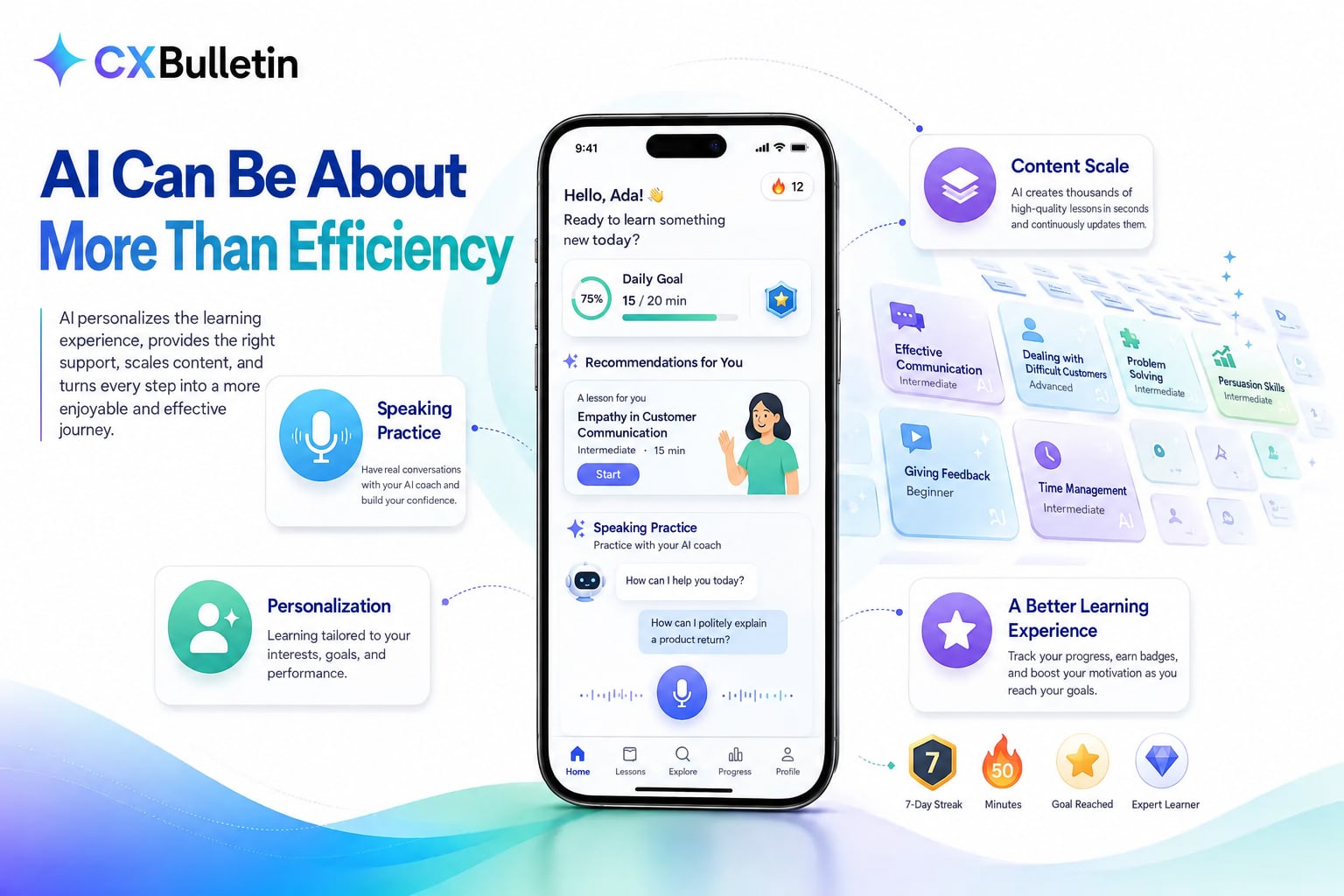
The Duolingo case shows that AI can be used not only to cut costs but also to deliver a better experience and better learning.
AI also plays an important role in the Duolingo story. But what stands out here is that AI isn’t presented merely as a tool for efficiency or cost reduction.
The company says AI tools enabled it to release 20,500 course units in Q1 2026. That figure stood at 7,100 per quarter in 2025 and 1,800 in 2024. Content in the 9 most-studied languages has also been expanded up to Duolingo Score 129, which corresponds to CEFR B2.
That’s more than “we produced content faster with AI.” It means more content, more advanced learning, better speaking practice and a more personalized learning experience.
I reached the same conclusion earlier when I wrote in CX Bulletin about why AI investments in customer operations haven’t delivered the expected results: Technology alone doesn’t create value. Value emerges only when technology reduces real friction that customers experience.
That’s the strength of Duolingo’s use of AI. AI isn’t being used just to lower content production costs, but to teach better, get learners practicing more, strengthen personalization and bring users back to the product more often.
This approach also fits the bigger shift I discussed in my piece on Forrester’s 2026 emerging technologies. AI is no longer just a tool that answers questions on a screen; it’s becoming a layer embedded in the infrastructure of the experience, shaping the touchpoints customers see and the ones they don’t.
If the “free” experience is weak, brand memory weakens too
Duolingo’s move holds a lesson not just for freemium apps but for nearly every industry.
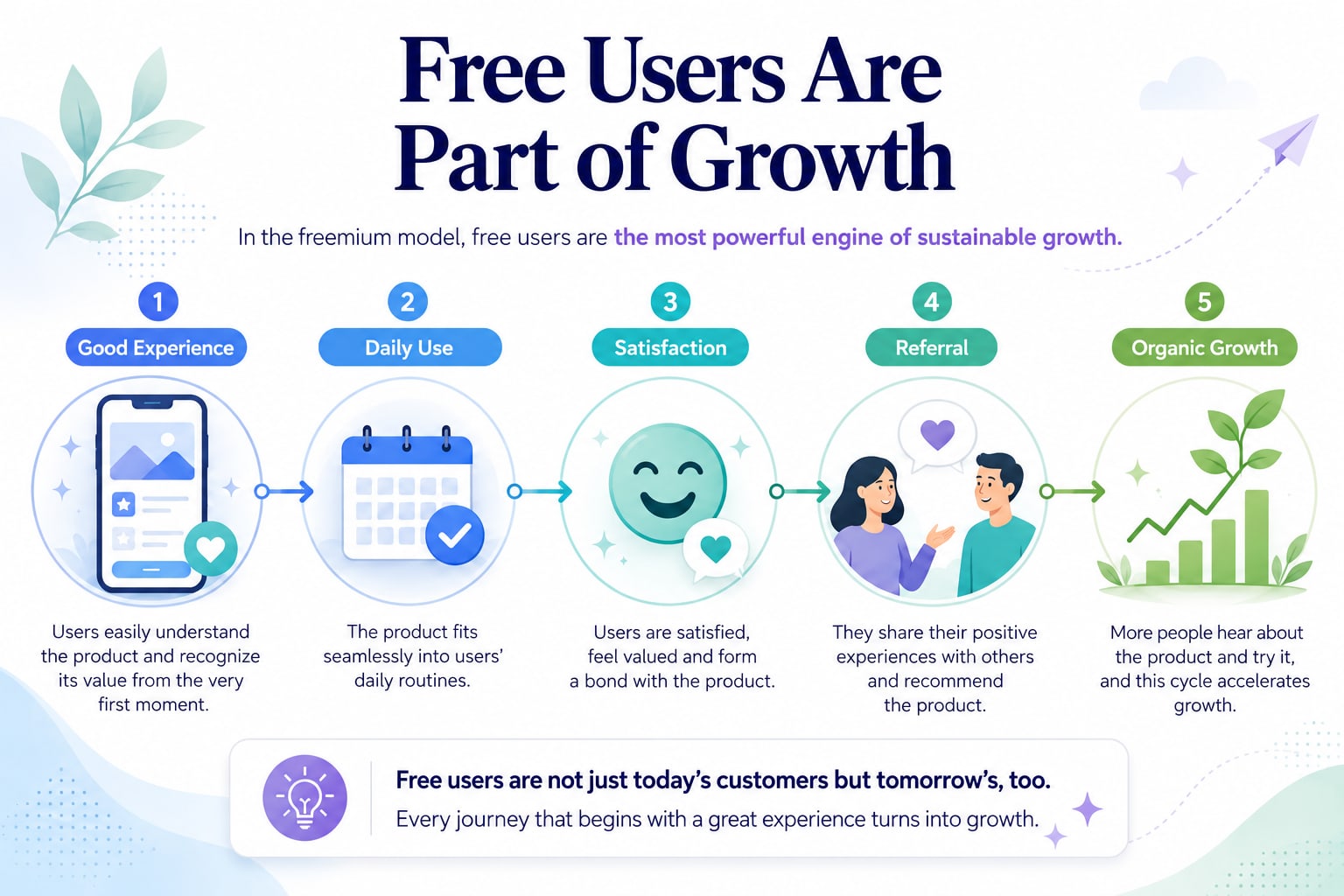
In freemium models, a free user isn’t just someone who hasn’t paid yet; they’re the user who recommends, builds habits and fuels growth.
In banking, we might think a mobile app has no free users, but there are low-balance customers. In insurance, there’s the customer who has just bought a policy but hasn’t experienced a loss yet. In automotive, there’s the customer who has bought a car but hasn’t come in for service yet. In retail, there’s the customer who has made a first purchase but hasn’t joined the loyalty program.
Each of these customers may hold future value for the brand. Yet brands often try to reserve the best experience for the “high-value customer” segment. Growth, however, sometimes comes from the opposite direction: from improving the experience at first contact, in the free tier, for the low-income segment or at the early stages of the journey.
That’s why the idea of CRM becoming the memory behind customer experience matters here too. Companies that can see customers not only through today’s revenue but also through their journey, behavior, potential and the friction they encounter make better decisions.
Duolingo sees free users not as an “audience that can’t be monetized” but as part of the growth engine. To me, that’s the perspective many brands miss.
Experience starts before growth, not after the sale

The Duolingo case shows that CX can be more than satisfaction; it can be a growth strategy in its own right.
This lesson isn’t limited to digital products. I made a similar point in my piece on after-sales customer experience in automotive: The customer relationship doesn’t end at the moment of sale; more often than not, that’s where it really begins.
Duolingo follows a similar logic. Getting people to download the app is just the beginning. What really matters is whether users come back the next day, keep going a week later, practice speaking, feel they’ve improved and tell someone else about it.
Constantly pouring more people into the top of the growth funnel may seem easy. But if there’s friction inside the product, if users don’t feel they’re learning much, if the free experience wears users out, that funnel leaks from the bottom.
That’s why Duolingo’s decision matters: The company sees growth not just as a matter of acquisition but as a matter of experience.
The market’s reaction is one thing; the CX lesson is another
According to a Reuters report, although Duolingo reported better-than-expected revenue for Q1 2026, investors responded cautiously to the company’s more measured growth path and its emphasis on user experience over short-term monetization; the stock fell in extended trading.
The reaction isn’t surprising. Markets often focus on short-term growth. CX, by contrast, demands a longer-term discipline. And that’s what makes Duolingo’s strategy interesting. The company is deliberately moving away from tactics that could make some financial metrics look better in the short term, because it believes a larger user base, stronger loyalty and a healthier referral cycle will create a more valuable company over the long term.
It’s not a decision every brand can make easily. But that’s precisely where CX becomes strategic.
What’s the lesson for us?
If even a company like Duolingo, which has already reached enormous scale, is building its growth strategy on customer experience, it makes no sense at all for smaller brands to put CX off.
After all, customers no longer just buy a product. They live the experience, talk about it, recommend it or quietly walk away.
Sometimes growing doesn’t take a bigger ad budget. It takes a better first experience.
Sometimes it takes less friction, not more sales pressure.
Sometimes it takes not a new campaign but a product with enough value to get existing users to say, “You should try this.”
Duolingo’s latest move is a reminder of exactly this: Customer experience isn’t window dressing for growth; it can be growth itself.
And perhaps the simplest question this piece raises is this:
If even Duolingo is choosing to improve the experience in order to grow further, why are we still leaving CX for later?
This piece was first published in Turkish in CX Bulletin on May 11, 2026. English translation.