The Right to Talk to a Human: The Cost of Giving Chatbots Responsibility Without Authority
The UK's most established advice organization has sounded the alarm on chatbots. The system may be ready, but what about the customers who aren't ready for it?

Britain declared war on Germany on September 3, 1939. The next day, 200 small advice bureaus opened their doors across the country. Volunteers ran the bureaus out of public buildings, sometimes out of their own living rooms, and people came to them about lost ration books, bombed homes and relatives they had heard nothing from. That is how the Citizens Advice story began.
Today, 87 years later, the organization is a broad network of local charities across England and Wales, giving free, impartial advice on everything from debt and housing to employment and consumer rights. Last year it gave one-on-one support to more than 2.7 million people — incredible, isn’t it? Its influence reaches beyond the advice desk, too: the rules protecting tenants’ deposits that became law in 2004 were the product of a ten-year campaign the organization ran using evidence gathered from its clients. It’s hard to find an exact equivalent in Türkiye; the closest comparison would be the accessibility of consumer arbitration committees combined with the on-the-ground credibility of a civil society organization, under one roof. In short, it is one of the institutions that best understand the people who fall through the cracks of the system.
In September, this organization issued an unusually blunt call to energy, banking, phone and internet companies: stop leaning so heavily on chatbots in customer service, and guarantee customers’ right to talk to a human. The Guardian reported the story on September 21.
A customer who gives up looks like a closed request
According to the organization’s findings, about half of those who had to use a chatbot found it useless. Some say they felt the bot had been set up to make them give up. In a separate survey carried out for Citizens Advice in July, only 20% of British adults named a chatbot as their preferred way of getting in touch; phone, email and instant messaging all rank ahead of it.
The most striking findings concern people who struggled to reach a human to fix a problem with an essential service. Among them, 49% experienced stress or anger, 44% faced delays and 27% felt helpless. And 14% gave up trying to resolve the problem altogether.
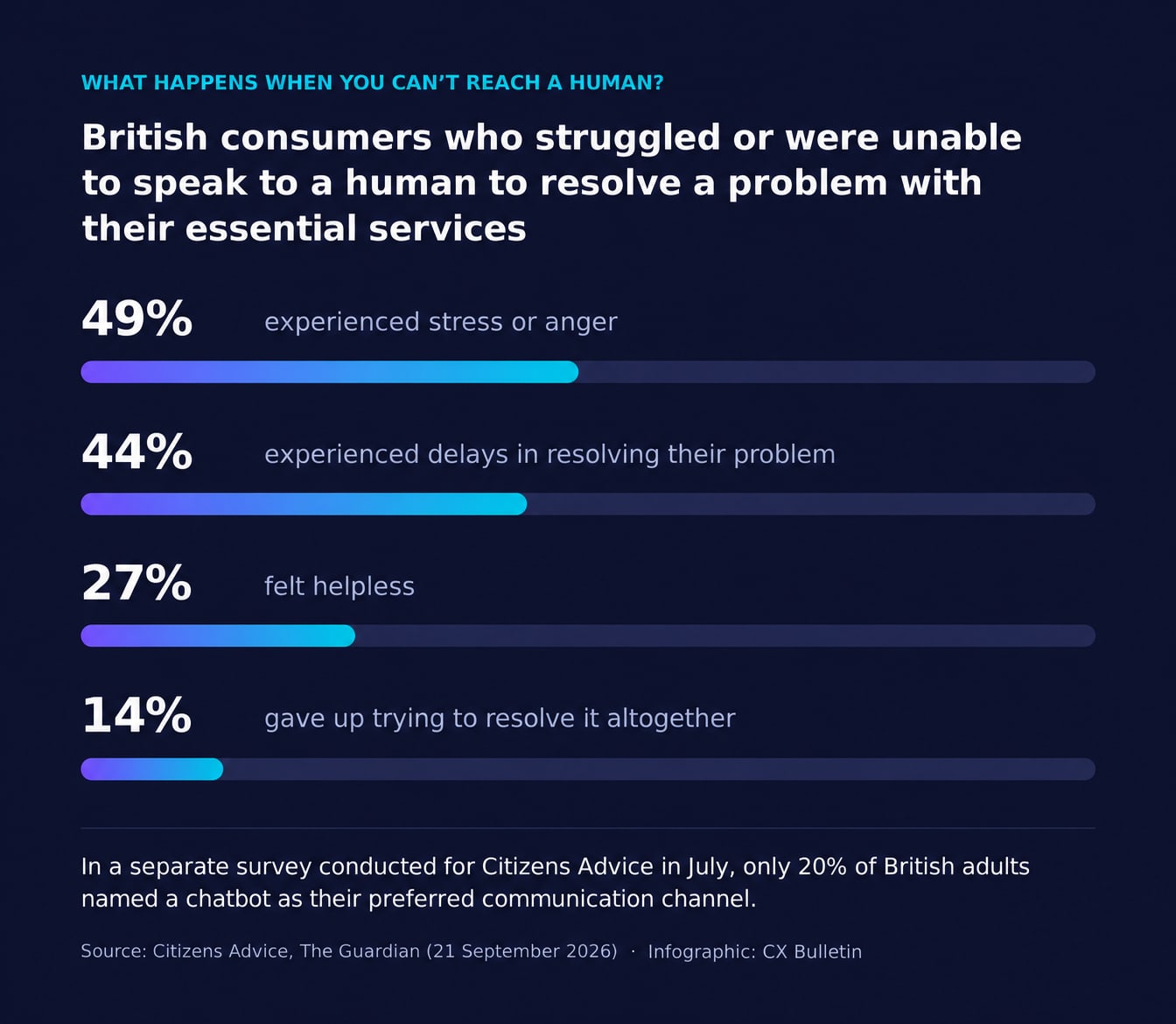
I want to dwell on that last figure for a moment. On our dashboards, a customer who gives up often shows up as an “auto-closed request.” It may well be the quietest line item pushing automation’s resolution rate up. There are reportedly stories going around on forums of users shouting “human!” at chatbots over and over; our local equivalent is pressing the zero key again and again. It’s practically a national reflex.
The organization’s policy director, Tom MacInnes, also strikes a balanced note, not denying that chatbots have their uses but stressing that the quiet erosion of traditional phone and face-to-face channels has left many people overlooked and harmed. The organization’s examples range from billing problems to debt restructuring and even homelessness prevention services. One adviser says people who struggle with online applications are staying homeless for longer.
I understand the cost pressure
In light of this data, I don’t want to be quick to cast companies as the villains. At an energy or telecom company serving millions of subscribers, every contact has a cost, and as someone who spent years on the call center side, I know the mood in those budget meetings all too well (unfortunately 🙂). Wanting to scale up automation is understandable.
What bothers me is that problems the bot isn’t yet authorized or ready to solve get handed to it as well. Steering customers into the bot channel and leaving unresolved requests waiting there is no different from sweeping the problem under the rug. The rug looks flat for a while, but the pile underneath keeps growing.
An old management principle applies squarely here: When you assign responsibility to someone without authority, nothing comes of it but frustration and conflict. We always say this about employees, but the same principle holds for bots. When we saddle a system that can’t correct a bill, initiate a refund or make a call on an exceptional case with the responsibility of being the first, and sometimes the only, point of contact in the customer relationship, the conflict plays out this time between the customer and the bot. And the brand foots the bill.
In June, in my analysis of Parloa’s Customer Patience Index, we saw that about 70% of customers abandon automation after two failed attempts. Where patience runs that short, honestly defining the bot’s limits before it goes live is no longer optional. Opening the channel without using real customer scenarios to test which requests the bot can resolve end to end, which it can only provide information on and where it gets stuck is like certifying a building for occupancy without checking the fire escape. The bill for broken trust arrives late, too: a drop in NPS, reviews on complaint platforms, rising churn at the end of the quarter. And most of the time, nobody traces the first line of that bill back to the bot.
The system may be ready, but what about the customer?
The part of this story that gave me the most to think about was the organization’s emphasis on digital exclusion. Citizens Advice points out that at least 14 million people in the UK experience some form of digital exclusion; 1.7 million households have no laptop, tablet or desktop computer. (Sadly, the situation is much worse in Türkiye.) The erosion of phone, face-to-face and paper-based communication has, in the organization’s words, created a two-tier support system. Those comfortable online move along in the fast lane, while everyone else waits their turn on a slow and unreliable road.
“Our systems may be ready. But we will always have customers who aren’t ready for those systems.”
Who are these customers? A subscriber over seventy. A visually impaired customer navigating with a screen reader. Someone who, juggling two separate devices, can’t complete multi-factor authentication in time; the organization counts this as a distinct form of exclusion, too. Or simply any one of us, going through the hardest day of our lives and wanting to explain the problem to a human being.
The figures show how costly this divide turns out to be. Correcting an incorrect energy bill with a meter reading takes less than an hour online when the systems are working properly. For someone without digital access, the same process can drag on for as long as six weeks. The report’s most ironic example is the low-cost social tariff for internet access designed to reduce digital exclusion: in some areas, you can only apply for it through a digital channel.
From an experience design standpoint, the principle that emerges seems very clear to me. Keeping alternative routes in plain sight, without adding friction to them, should be treated as the keystone of the design, not a flourish. Burying the option to reach a human on the fifth level of a menu, having the bot suggest the FAQ page for the third time to a user who types “agent,” tucking the phone number away in small print at the very bottom of the site — none of these are technical necessities. Every one of them is a design choice, and customers understand perfectly well that they are choices.
The UK government’s response to the story is telling, too: businesses apparently already have an obligation to make their contact details clear and easily accessible. On paper, they do. The question is whether that information actually opens a door to a human.
Türkiye has the rule; will its spirit carry over to new channels?
Türkiye actually started out a step ahead of many countries on this. The Regulation on Determining the Service Level and Quality of Bank Call Centers, published in 2020, requires that customers aged 60 and over who call their bank be offered the option of being connected directly to an agent from the main menu, without any identification step. The same regulation also states that the length of an agent’s conversation with a customer cannot be capped.
But these rules were written at a time when the first point of contact was the touch-tone IVR. Today that first contact is increasingly shifting to chatbots, in-app assistants and AI agents that can hold a conversation. Carrying the spirit of the rule over to the new channels is largely left to brands’ own discretion. The demand side is already clear: in the MDYD, Deloitte and PRAGMA study I cited in that same Parloa piece, 40% of Turkish consumers named being unable to reach a live agent as their worst experience, while 61% still choose the phone.
In sectors like energy, banking and telecom, where life can’t be allowed to grind to a halt, this balance is even more delicate. On September 17, I wrote about what listening to customers can achieve in electricity distribution, using the example of YEDAŞ; automation decisions need to be made with the same disciplined listening. In the piece where I examined the maturity of autonomous AI agents, we reached a similar point: the technology’s capacity is growing fast, but we are still the ones who decide how much responsibility to give the channel.
With CX Day just days away
We will celebrate CX Day on October 6, and customer experience teams around the world will share their success stories. This year, among those stories, I would like to hear this as well: “We know what our bot can’t solve, and when a customer reaches that point, we hand them over to a human without making them wait or repeat themselves.” Perhaps the most honest way to measure automation’s maturity is to look not at how much it solves, but at how it hands off the customer the moment it can’t.
Will your next automation project’s business plan include a line set aside for the customer who isn’t ready for that channel?
Update note (October 14, 2026): When this piece was moved to The CX Brief, time references were updated and typos were corrected (correction type: time, spelling). The content and views of the piece are unchanged.
This piece was first published in Turkish in CX Bulletin on September 26, 2026. English translation.