What is a customer health score, and how do you build one?
How do you build a customer health score? Start with progress toward the outcome, usage and unresolved problems; separate out missing data, and tie each risk to an owner and an action.

What is a customer health score?
A customer health score is an assessment that considers usage, service and relationship signals together to identify the action needed for each customer. The first goal is not to produce a single score but to help the team take timely action for the right customer. This guide recommends starting by tracking three signals side by side.
A customer may log in every day and still not reach the outcome they paid for. Or they may look healthy because their support requests have dropped, when in fact they have stopped using the product. GitLab’s open health scoring method looks at risk, customer outcomes, feedback and the relationship as well as usage. It is one example of the practice, not a justification for using the same weightings at every company.
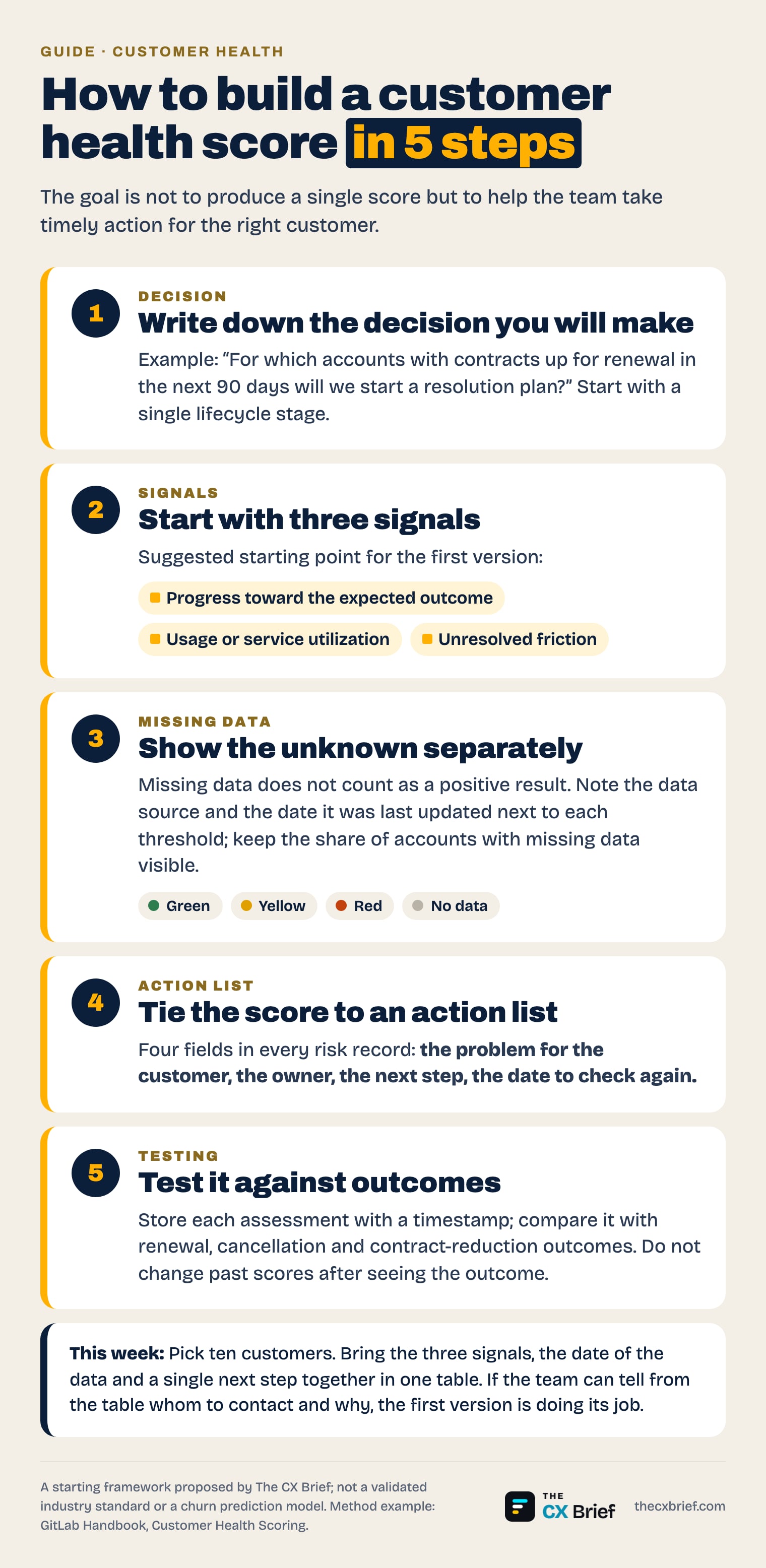
1. First, write down the decision you will make
Instead of “Let’s understand our customers better,” start with a question such as “For which accounts with contracts up for renewal in the next 90 days will we start a resolution plan?” Then choose a single customer group at the same lifecycle stage. Do not judge the usage of a customer who has just started and one you have worked with for three years against the same threshold. To assess your team’s readiness for measurement and governance, you can use Nord CX’s free CX maturity test.
2. Start your customer health score with three signals
The table below is the starting framework we propose for a team serving business customers in Türkiye. It is not a validated industry standard or a churn prediction model.
| Signal | First record to check | Action if needed |
|---|---|---|
| Progress toward the expected outcome | Latest status of the business outcome agreed with the customer | Identify one obstacle with the customer and agree on a completion date. |
| Usage or service utilization | Change from the customer’s own baseline | Confirm in a conversation whether a drop in usage is due to seasonality or an access problem. |
| Unresolved friction | Requests reopened on the same issue and open critical items | Write down who owns the problem, the outcome for the customer and the check-in date. |
As a team, define the specific records that will justify green, yellow and red ratings for each signal. For example, instead of “the relationship is weak,” write “the business owner on the customer’s side has changed and no new owner has been named yet.” Next to each threshold, note the data source and the date it was last updated. If you will also use survey signals, clarify the differences between NPS, CSAT and CES in your measurement plan.
3. Show the unknown separately
Missing data does not count as a positive result. Instead of marking an account green when its data feed has stopped, mark it as “no data.” In GitLab’s method, too, a missing measure is not counted as red; its weight is spread across the measures that do have data. Go one step further: keep the share of accounts with missing data visible in your report. That way, the customers the score does not cover do not drop out of sight.
4. Tie the score to an action list
A single composite score is not required in the first version. Showing the three signals side by side and flagging a critical blocker separately preserves detail that an average score can hide. For each risk record, add four fields: the problem for the customer, the owner, the next step and the date to check again.
How is a customer health score calculated?
There is no single weighting or threshold that suits every company; Gainsight also ties the choice of model to the organization’s needs. If you choose a numerical model, first convert the signal scores to a common scale, then state the weights and the calculation method explicitly. In a model that uses a weighted average, the calculation is:
Score = Sum of (signal score × weight) ÷ sum of the weights
This is one of the methods you can use. Explain separately how missing data changes the calculation. Show the signals next to the total score, so that a critical blocker does not get lost in the average.
5. Test it against outcomes
Store every assessment with a timestamp. In the next period, look at outcomes for renewals, cancellations and reductions in contract size: Do the accounts you marked red really have more problems? Which of the customers you had marked green did you miss? Do not change scores retroactively after seeing the outcome to make the model look successful. Record the accounts where you intervened separately; the intervention may have changed the outcome you observed. To weigh the cost and the return of an intervention together, see the article on calculating the return on customer experience investments.
This week’s task
Pick ten customers. Bring the three signals, the date of the data and a single next step together in one table. If the team can read the table and understand whom to contact and why, the first version is doing its job.
Sample assessment record. The sample record below is designed to illustrate the method; it contains no real customer data.
| Field | Example |
|---|---|
| Observed situation | The business owner on the customer’s side has changed; no new owner has been named yet. |
| Data source | The account manager’s latest meeting note |
| Data date | The day the meeting note was entered |
| Problem for the customer | It is unclear who now owns the agreed work. |
| Owner on the team | The account’s customer success manager |
| Next step | Agree with the customer on the new owner and a single next task |
| Check-in date | Two weeks after the meeting |
Frequently asked questions
Is a customer health score the same as NPS?
No. NPS asks how likely a customer is to recommend you. The health assessment proposed in this guide looks at progress toward the expected outcome, changes in usage and unresolved problems together. NPS can be used as one of the signals, but on its own it cannot replace a health assessment. Producing a single score is not required in the first version; the action the team will take should be visible next to each signal.
Is there a single formula for a customer health score?
There is no single weighting or threshold that can be carried over to every company. First, define the decision and choose your customer group. If you use a numerical model, convert the signal scores to a common scale and explain the weighting method; a weighted average is one of the options. Test the result against renewal, cancellation and contract-reduction records, and do not present the weights as a validated standard.
How should missing data be handled in a customer health score?
Missing data does not show that a customer is healthy. Mark an account whose data feed has stopped as “no data.” In GitLab’s practice, the weight of a missing measure is spread across the measures that do have data; if you use this method, also show which measures are missing. Reporting the share of accounts with missing data keeps the customers the assessment does not cover visible.
How can you tell whether a customer health score is working?
Store every assessment with a timestamp and compare it in the next period with renewal, cancellation and contract-reduction outcomes. Review the accounts you flagged as at risk together with the problem accounts you missed. Do not change past scores after seeing the outcome. Record the customers where you intervened separately; the team’s work may have changed the outcome observed later.
For background: The difference between monitoring customer health and reporting what has happened.
Translated from the Turkish original.