The Missing Link in the Age of AI: Motivation and Leadership in Workforce Transformation
Drawing on the latest research from PwC and McKinsey, this analysis explores why employee motivation and people-centered leadership are critical to AI-enabled workforce transformation.

PwC has recently published a series of closely related studies. Following my article From Invisible Crisis to Customer Loyalty: How Employees’ Financial Well-Being Shapes Customer Experience, here is my take on a new PwC study, drawing on other sources as well:
While the tech world celebrates a new generative AI model every day, a far quieter, deeper crisis is unfolding in corporate meeting rooms. Multimillion-dollar technology budgets are approved and the latest systems are integrated into corporate networks, yet at the end of the day, no one sees that magical “expected impact.”
A Lack of Motivation
To understand why, we need to look not at the software but at the person sitting in front of the screen. PwC’s 2025 Global Workforce Hopes and Fears survey clearly identifies this major contradiction: perhaps the most important of AI’s missing links in the workplace is employee motivation. The fact that only 13% of US workers have used generative AI tools daily in their workflows over the past year proves there is a serious barrier to adoption. Leaders assume that once the technology arrives, usage will follow on its own; but the real fuel employees need for full adoption is motivation, and a lack of motivation is causing organizations to leave enormous value on the table. Indeed, this lack of enthusiasm and belief also lies at the root of a finding from the 29th Global CEO Survey, on which the same analysis draws: 56% of CEOs say they have yet to see a clear revenue or cost benefit from AI over the past year.

Building motivation isn’t just a matter of running training sessions that show employees how to use new tools. Employees are less afraid of the technology than curious about what it will bring, but a sense of uncertainty keeps them from taking the initiative. Leaders need to lay this future out openly — a future that can feel more daunting, particularly for entry-level employees just starting their careers. Once the trust gap is closed, anxiety gives way to commitment, and employees find within themselves the psychological capital they need to try new methods. PwC data shows that when communication is done right, 35% of employees believe AI will increase their job security over the next three years. This is exactly where motivation takes off: once employees start to see AI not as a threat that will replace them but as a lever to take their work further, an intrinsic drive kicks in.
The motivation to transform workflows endures only when security and capability-building go hand in hand. As we saw in McKinsey’s latest State of AI report, 88% of organizations globally have tried AI, yet the share of “high-performing” organizations that generate real value from AI and lead the way in redesigning workflows remains at just 6%. What will close this enormous gap isn’t technological capability but the motivation to innovate. This topic also forms the backbone of our earlier in-depth analysis, “AI in Customer Operations: Big Promises, Low Returns. Why?”. Unless they drive a cultural evolution and motivate their employees to experiment, make mistakes and reinvent processes, organizations can’t join that successful 6%.
PwC’s 6 Recommendations for HR Leaders
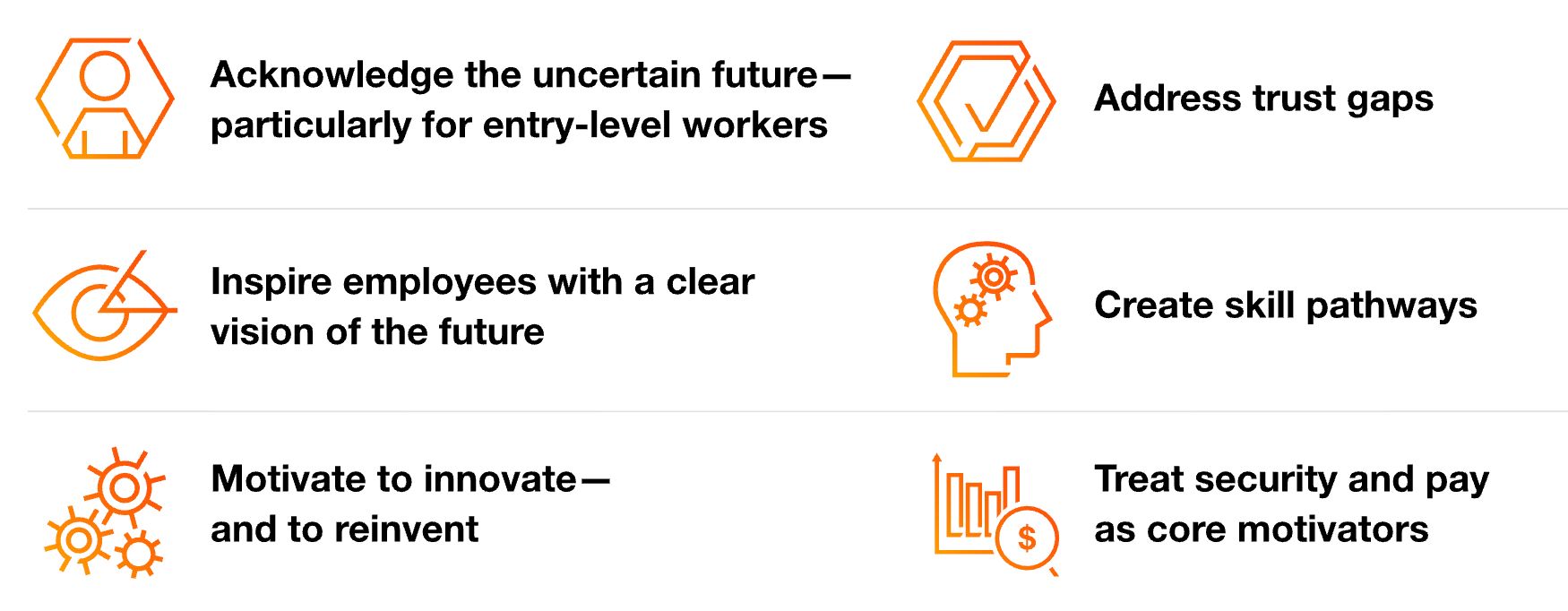
At the same time, we can’t ignore one of the biggest silent killers of motivation: financial insecurity. Although a large majority of employees — 66% of PwC survey respondents — acknowledge that they have access to the learning and development resources they need at work, upskilling alone isn’t enough. HR leaders must treat elements such as pay, job security and financial peace of mind not as peripheral factors but as core motivators. Only when employees feel secure in every sense does their performance naturally pick up; they then contribute far more wholeheartedly to the organization’s overall quality and, by extension, to customer experience outcomes at the very end of the chain. Organizations that give their strategy meaning and instill in their employees the motivation to reinvent will be the true winners of the AI era.
This piece was first published in Turkish in CX Bulletin on April 15, 2026. English translation.