Salesforce's Memory, Claude's Mind
The Claudeforce partnership lifts a serious constraint in customer experience. But where that constraint lies varies from one organization to the next.
At the end of August, Salesforce and Anthropic announced that they were expanding their partnership. They’ve named it Claudeforce. My first thought on reading it was “another corporate handshake.” On a second read, I changed my mind.
Here’s what’s in it, in brief: Salesforce is coming to Claude — as a plug-in that knows the sales cycle and ships with 37 ready-made skills. Things like meeting prep, opportunity health and pipeline review. In the other direction, Claude becomes Agentforce’s reasoning engine and can run inside Salesforce’s security boundary via Bedrock. It’s also the default model in Slack. At the time, it was available to select pilot customers; the open beta began on September 15.
So why did I change my mind?
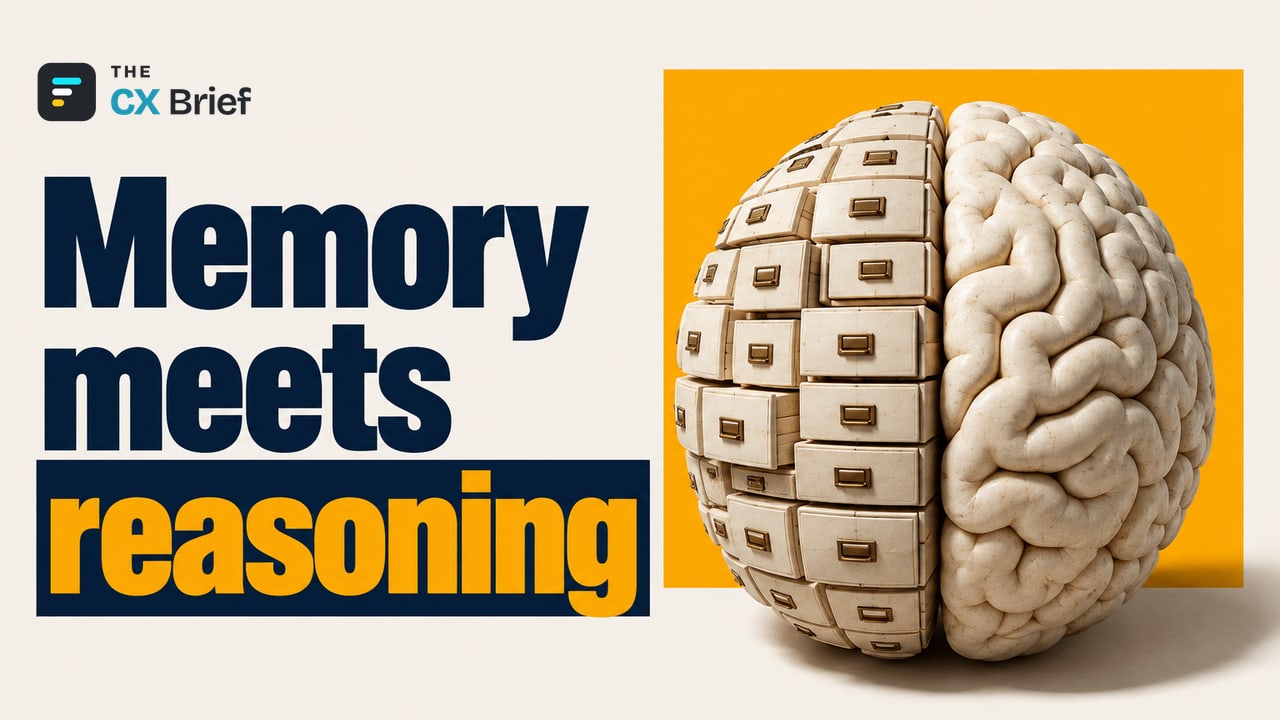
For twenty-five years, we’ve been piling things into CRMs. What the customer bought, when they complained, which campaign they responded to, whom they talked to, what their contract says. An enormous memory. But that memory couldn’t reason; we always told it what to do, rule by rule, screen by screen. On the other side, the past few years have produced models whose reasoning gives us a run for our money — but they had no memory. They didn’t know the customer, and they had no authority to act. On its own, neither meant much to the customer.
What Claudeforce does is connect the two. Salesforce calls the layer in between a harness: the structure that opens an organization’s data, workflows, rules and governance to an agent. The intelligence stays in the model, while every action runs through the organization’s rules.
When I start thinking about what this means on the customer experience side, I get a little carried away 🙂
Say a customer complains. In that moment, the system sees everything at once: their six-year history, last month’s late delivery, the request they opened and closed two weeks ago, their account’s margin and the limit the compensation policy allows. It also decides for itself what to do with this information — within the authority it has been given. The representative doesn’t have to click through six screens and ask someone senior, because the answer they’d be asking for is already in the system.
And I won’t even try to count how many times we’ve pinned journey maps to the wall. Every one of them was really a photograph — a snapshot of the day it was drawn. They could become maps that are continually consulted and keep themselves up to date.
It’s worth adding that none of this is a new idea. It has been talked about at conferences for decades; we used to dream about what the future would bring. Now the dreams are starting to come true…
The announcement itself does tap the brakes a little, though. All 37 of those skills are on the sales side. There is no ready-made skill for customer service in the first round; additional skills are expected to arrive from the end of the year onward. In other words, when it came to showcasing the year’s biggest AI partnership, the company looked inward first.
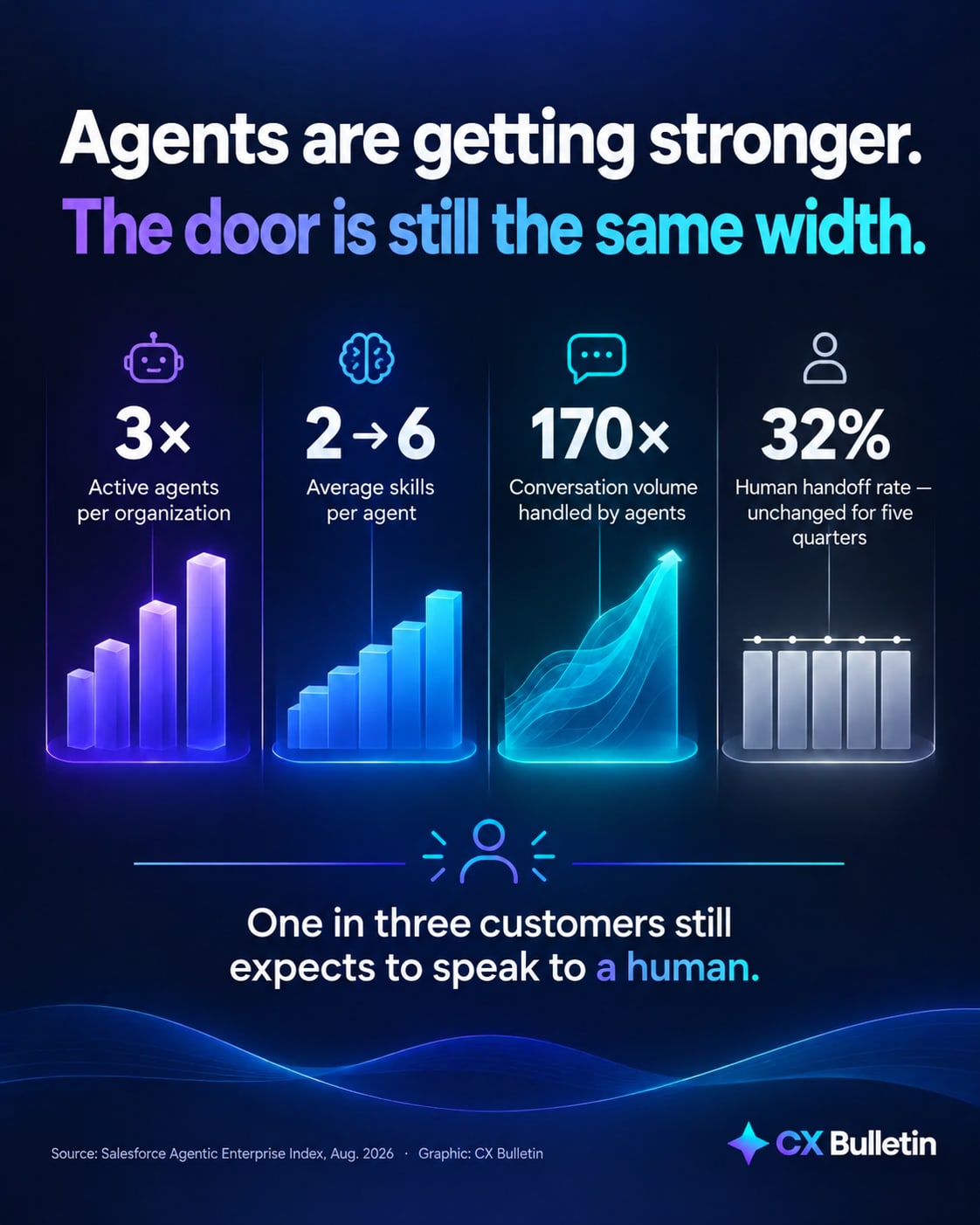
Salesforce’s Agentic Enterprise Index, published on August 7, points in a similar direction. The average number of skills per agent has risen from two to six, and the volume of conversations handled by agents has grown 170-fold over five quarters. Even so, the human handoff rate stands at 32% and isn’t budging. It’s good news, of course, that quality isn’t deteriorating as scale grows. But one in three customers still expects to find a human on the other end; in a way, that is where autonomy hits its limit today.
In Türkiye, the issue starts a little further back. A figure from my article on the Talkdesk report had stuck with me: 98% use AI in some form, but 15% manage to combine it with cross-departmental orchestration. Claudeforce’s architecture is built for that 15%. It assumes that an organization’s rules are written down somewhere and are machine-readable.
When I wrote about Microsoft’s Dynamics 365 vision, I talked about CRM becoming the memory of customer experience. This partnership calls for going a step further: memory alone isn’t enough; it also takes authority. The system needs to know not only what the situation is, but also what it can do next. I think this partnership lifts a serious constraint in customer experience. But where that constraint lies varies from one organization to the next. A company whose rules are written down can set up this structure and have it running within a few months. At a company whose rules still live in people’s heads, though, lifting that constraint isn’t even on the agenda yet; the work starts much further back, with writing the rules down.
The odd thing is that this is work we’ve been putting off for years, and that nobody gets very excited about. Clarifying the refund limit, defining compensation authority, spelling out who escalates, and in which situations. It’s not something you present at a conference. But I think that in the period ahead, this is what will separate organizations that can put agents in front of customers from those that can’t.
And I think this is the question we need to ask our own teams: are our rules for refunds, discounts, compensation and escalation written down today clearly enough to be handed over to an agent, or is it still “we’ll handle it case by case”?
Update note (October 14, 2026): When this article was moved to The CX Brief, time references were updated and typos were corrected. The article’s content and views have not changed.
This piece was first published in Turkish in CX Bulletin on September 12, 2026. English translation.