Employees Shift Into High Gear While the Organization Keeps the Parking Brake On
Microsoft heard from 20,000 workers: what really holds AI back is the organization, not the individual — here's my take on the findings for CX teams in Türkiye.
When an AI transformation stumbles, employees usually get the blame: slow to adapt, short on skills, highly resistant… Take your pick 😆 Microsoft’s 2026 Work Trend Index report, published in May, turns that diagnosis on its head. According to the report, 67% of the relative weight of the factors that determine whether employees get real value out of AI comes from the organizational environment; individual attitudes and behavior account for just 32%. In other words, the problem usually lies not with the individual but with the system around them.
The report bases this claim on a body of data that’s hard to dismiss. Microsoft analyzed trillions of anonymized Microsoft 365 productivity signals; on top of that, Edelman Data x Intelligence surveyed 20,000 knowledge workers who use AI across 10 countries between February and April 2026. Microsoft calls the resulting picture the “Transformation Paradox”: employees are ready to reimagine their work, but the metrics, incentives and habits around them keep rewarding the old way of working.
This picture will look familiar to all of us. Operations in Türkiye show a similar gap: AI licenses have been handed out, and a few enthusiastic team leads have long since built their own workflows; yet the organization’s quality scorecard, bonus model and shift schedule run as if AI had never been invented.
A workforce split into five zones
The report’s most talked-about chart maps respondents along two axes: the individual’s AI proficiency and the organization’s capacity to support that proficiency. The intersection produces five zones. Just 19% of employees are in the “frontier” zone, where both axes are strong; the largest group, at 50%, sits in the middle zone, where both individual practice and organizational conditions are still taking shape. Another 16% are weak on both axes. What’s really striking are the remaining two groups: 10% of employees have built strong skills but lack a system in which to apply them; for another 5%, it’s the exact opposite — the organization is ready, but the employee hasn’t caught up yet.
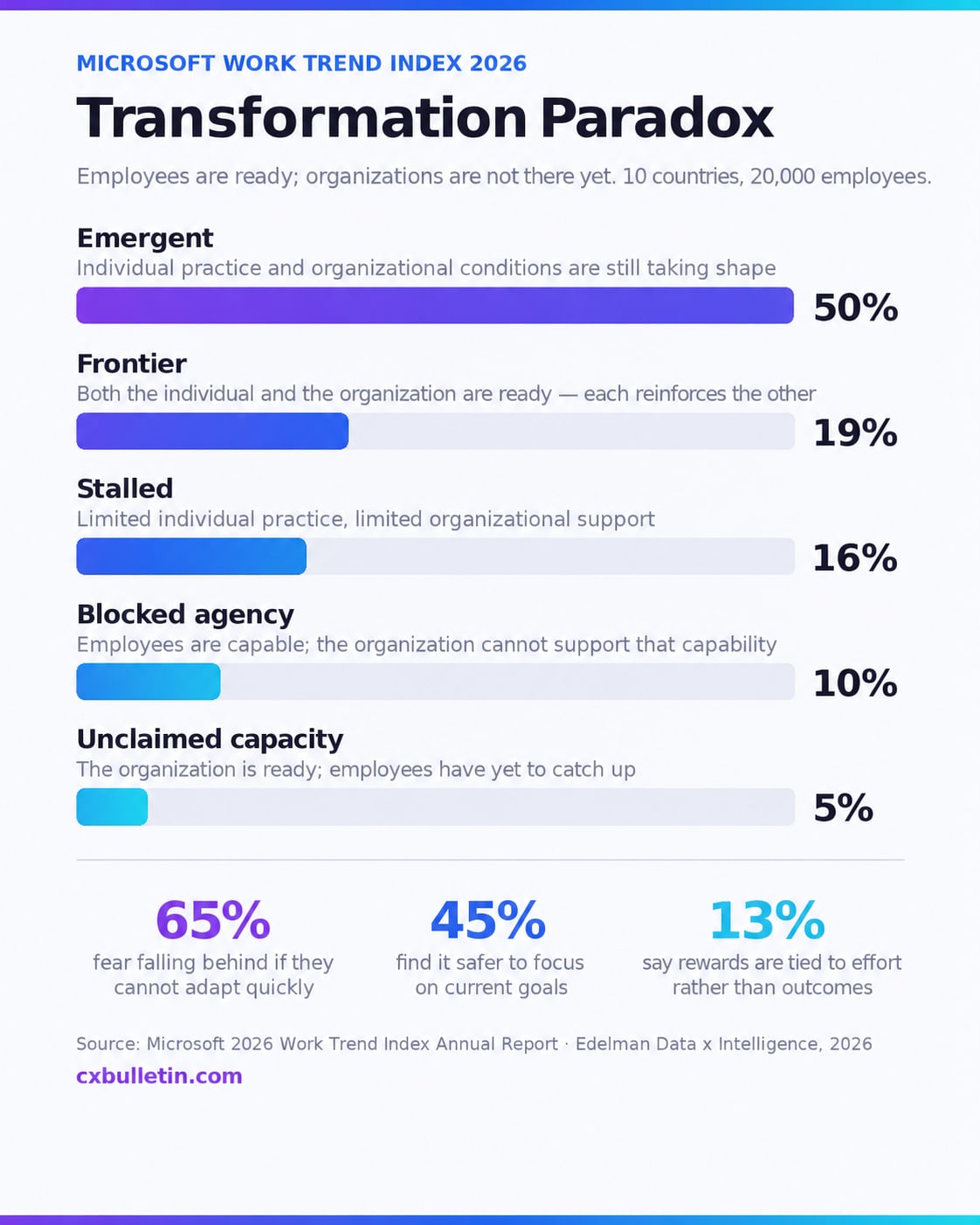
The emotional side of the paradox was measured too. Among AI users, 65% fear falling behind if they can’t adapt quickly; even so, 45% find it safer to focus on current goals than to redesign their work with AI. And just 13% say redesign efforts are rewarded even when results don’t come right away. The leadership picture isn’t encouraging either: only one in four users believes their leadership is clearly and consistently aligned on AI. Put these numbers side by side, and what emerges isn’t a skills gap but an incentive design problem.
In June, when I looked at Forrester’s data on agentic AI, I pointed to the chasm between adoption and moving into production. Microsoft’s data shows the human side of the same chasm: the technology is being bought, people are learning, but the organizational fabric that would bring the two together is lagging behind.
The premium on judgment is rising
The report’s second strong finding concerns which work AI is taking over. An analysis of more than 100,000 conversations in Microsoft 365 Copilot shows that 49% of user intents involve cognitive work: analyzing information, solving problems, evaluating, thinking creatively. In other words, AI is now at work not only on routine tasks but also on work that once required deep expertise. Meanwhile, 66% of users say they can spend more time on high-value work, and 58% say they’re producing work they couldn’t have produced a year ago. That figure rises to 80% among “frontier professionals,” the study’s most advanced user group, who make up 16% of the total.
The interesting part is that as the machine grows more capable, human judgment gains value. When respondents were asked which human skills become more important as AI takes on more work, two items topped the list: quality control of AI output and critical thinking. Among users, 86% say they treat AI output as a starting point rather than a final answer, and that the responsibility for thinking stays with them. Frontier professionals are even more deliberate about this: the share who intentionally do some tasks without AI so their skills don’t atrophy is markedly higher in this group, and so is the share who stop before starting a task to ask, “Should a machine do this, or a human?”
The report divides this relationship into four working modes: delegating, where direction rests with the human and execution with the agent; collaborating, where the work genuinely needs both sides; asking, made up of quick questions and answers; and exploring, done to test the agent’s limits. What sets frontier professionals apart isn’t that they use any particular mode, but that they know which work calls for which mode. The tone of a reply to a customer complaint calls for collaboration, while the summary of a standard returns process can comfortably be delegated; teams that can’t make this distinction either hand everything to the machine and lose quality, or hand over nothing and lose efficiency.
What this means for call(!) centers is already visible. The human agent’s job is shifting from producing answers to evaluating them; the quality team’s oversight now covers an AI agent alongside the human agent. Recently, in my commentary on Parloa’s patience index, I wrote that more than half of customers won’t put up with automation for more than three minutes. When unchecked output from an AI agent reaches a customer, that three-minute window of patience closes very fast; that’s why it’s no coincidence that quality control sits at the top of the list of “skills gaining importance.”
Managers hold the lever
The report also pinpoints where the transformation gets stuck: middle management. According to a separate Microsoft study of 1,800 employees, in teams where the manager openly models AI use, employees’ perceived value from AI is 17 points higher, critical thinking about its use is 22 points higher and trust in agentic systems is 30 points higher. When managers create a psychologically safe space for trial and error, readiness and perceived value are up to 20 points higher; employees on these teams are 1.4 times more likely to be heavy users of agentic AI.
The working environment of frontier professionals bears this out. Compared with everyone else, this group reports at much higher rates that their managers openly use AI, set quality standards for AI-assisted work, make room for experimentation and encourage more ambitious work design. They are twice as likely to say redesign efforts are rewarded even when results don’t materialize.
In the day-to-day reality of operations in Türkiye, this lands squarely on the team lead’s desk. For a team lead chasing AHT and service level all day long, “making room for experimentation” sounds like a luxury, because nothing in the current quality scorecard or bonus model accounts for it. What’s more, in a busy, shift-based operation, a failed experiment has a visible cost: the service level drops on the spot, and someone has to answer for it the same day. The return on learning, meanwhile, shows up months later and on a different ledger. Expecting team leads to experiment without fixing this asymmetry isn’t realistic. And yet the data says this is exactly the level the transformation runs through. I wrote earlier that the invisible root of customer experience is employee experience; Microsoft’s findings describe what that root looks like in the age of AI: the quality of employees’ relationship with the machine is determined by the quality of their relationship with their manager.
Why do gains die locally?
The report’s thesis at the organizational level revolves around the idea of a “learning system.” The number of active agents in the Microsoft 365 ecosystem grew 15-fold in a year, and 18-fold at large enterprises. As agents do work, they also generate valuable signals: what worked, what failed, where the outcome strayed from expectations. In most organizations, these signals stay in the team that produced them and evaporate there. Organizations that pull ahead, by contrast, capture these signals and build them into shared routines; the report calls this “owned intelligence” — institutional knowledge that builds up over time, becomes specific to the organization and is hard to copy.
The difference shows up clearly in the behavioral data. Teams of frontier professionals are roughly twice as likely as other teams to report discussing AI opportunities together, sharing lessons and mistakes, and talking through quality standards for AI-assisted work. But to me, the report’s most thought-provoking number is this one: even in the most advanced group, the share who say agent workflows, human handoff points and quality standards are documented and repeatable at the organizational level is 25%. Even the best can’t institutionalize most of what they learn.
In the CX world, we all know a very old version of this story. Every operation has a few agents who do the job better than anyone else; the language they use and the way they calm a difficult customer never spread to other teams. An insight that comes up in a calibration meeting gets written into the minutes, and the process stays the same. A voice-of-the-customer finding gets applause at the quarterly presentation and never makes it into the workflow. AI agents don’t change this equation; they just raise the price, because an AI agent plugged into a system that doesn’t learn repeats the same mistake at scale.
There’s one more layer specific to Türkiye. Much of the content in our knowledge bases was written not for customers but for human agents — and often, in fact, for audits. Now the same content will be taught to AI agents too; every gap in the text, every outdated entry will be scaled up and passed on to the customer. On the other hand, Türkiye also has grounds for hope: in sectors subject to BDDK regulation, the discipline of record-keeping, approval and audit is already muscle memory. When it comes to building what the report calls “evaluation infrastructure” — the answers to who audits agent performance, who updates the workflow and how local gains get scaled — banks and insurers are starting from a more advantageous position than people assume.
Agents scale mistakes, too
Reading the report with Türkiye in mind, I keep coming back to the cost side of the equation. Inflationary pressure keeps cost per contact at the top of management’s agenda, and the business case for agent investments is mostly built on it. This is exactly where Microsoft’s warning is valuable: approving a single bad output is a manageable risk; once bad outputs start flowing at scale, the risk compounds. A fleet of agents that scales without evaluation infrastructure amplifies efficiency and errors at the same rate. In other words, the real divide will emerge not in the speed of adoption but in the capacity to absorb it.
In my previous piece, taking Gartner’s agenda as my starting point, I looked at the second traveler joining the customer journey — AI acting on the customer’s behalf. Microsoft’s report fills in the internal side of that picture: an organization that will serve two travelers on the outside has to learn to manage a blended team of humans and agents on the inside. The previous report, which introduced the idea of the “Frontier Firm” in 2025, drew the org chart for this transformation; the 2026 report shows where that chart still exists only on paper.
Five years from now, the differences between organizations won’t come down to which model they licensed; everyone will have access to roughly the same technology. The variable that explains the difference will be how fast an organization learns from its own work, and Microsoft’s data clearly shows where that loop breaks today: gains are born locally and die locally. So I’d like to close with a question. As agents take over the work, whose job will it be to learn from that work — and does that job have any place in the quality scorecard, the bonus model or the org chart?
This piece was first published in Turkish in CX Bulletin on July 11, 2026. English translation.