AI, Data and Trust: The New CX Infrastructure for SMBs
For SMBs, AI creates real CX value only when it is combined with data and trust.
In the first part of this series, we looked at Salesforce’s Small & Medium Business Trends report from a customer experience perspective. The strongest finding was this: Growing SMBs prioritize improving customer experience ahead of acquiring new customers.
In the second piece, we discussed the big obstacle standing in the way of that goal: technology clutter. SMBs are using more tools and investing in more technology, but if those tools aren’t connected, customer experience gets more fragmented, not better. Customers repeat the same thing, teams work from different information, and the company’s customer memory gets scattered.
Now we come to the third and final installment of the series:
AI, data and trust.
That’s because for SMBs, the real value of AI isn’t just producing content faster, automating more responses or operating at lower cost. The real value lies in understanding customers better, supporting employees with more accurate information, scaling personalization and making the experience more consistent. But there’s a condition:
If AI is layered on top of a poorly built customer experience infrastructure, it won’t work miracles. It may even scale a bad experience faster.
The Salesforce report says 9 in 10 SMBs using AI see more efficient operations, and that AI can improve customer experience through speed, personalization and scalability. The same report also stresses that AI’s performance is directly tied to data quality. So the question is no longer “Should we use AI?”
The real question is this:
How do we set up AI to give customers a better experience?
AI’s first promise is speed; its real value is experience
For SMBs, the most appealing thing about AI is usually speed.
Producing content faster.
Preparing campaigns faster.
Responding to customers faster.
Running analyses faster.
Generating reports faster.
All of these are valuable. Especially for SMBs trying to do big things with small teams, AI can be a powerful lever. But from a customer experience perspective, speed alone isn’t enough.
Because giving a bad answer quickly isn’t a good experience.
Quickly serving an unsuitable recommendation to the wrong customer isn’t personalization.
Sending automated messages without understanding the customer isn’t building a relationship.
Closing a support ticket quickly doesn’t mean actually solving the problem.
AI’s real value in CX begins when it goes beyond speed: when it understands the customer’s context, gives employees the right information, better anticipates what customers need and reduces friction in the experience.
IBM’s CEO guide to generative AI and customer service takes a similar approach: AI is positioned not just as an automation tool but as a capability that empowers employees and helps them understand customers better.
This perspective matters a great deal for SMBs. In small businesses, the person dealing with customers often has to be salesperson, support rep, operations staffer and relationship manager all at once. AI creates real value when it is an assistant that helps that person make better decisions, not one that takes them out of the picture.
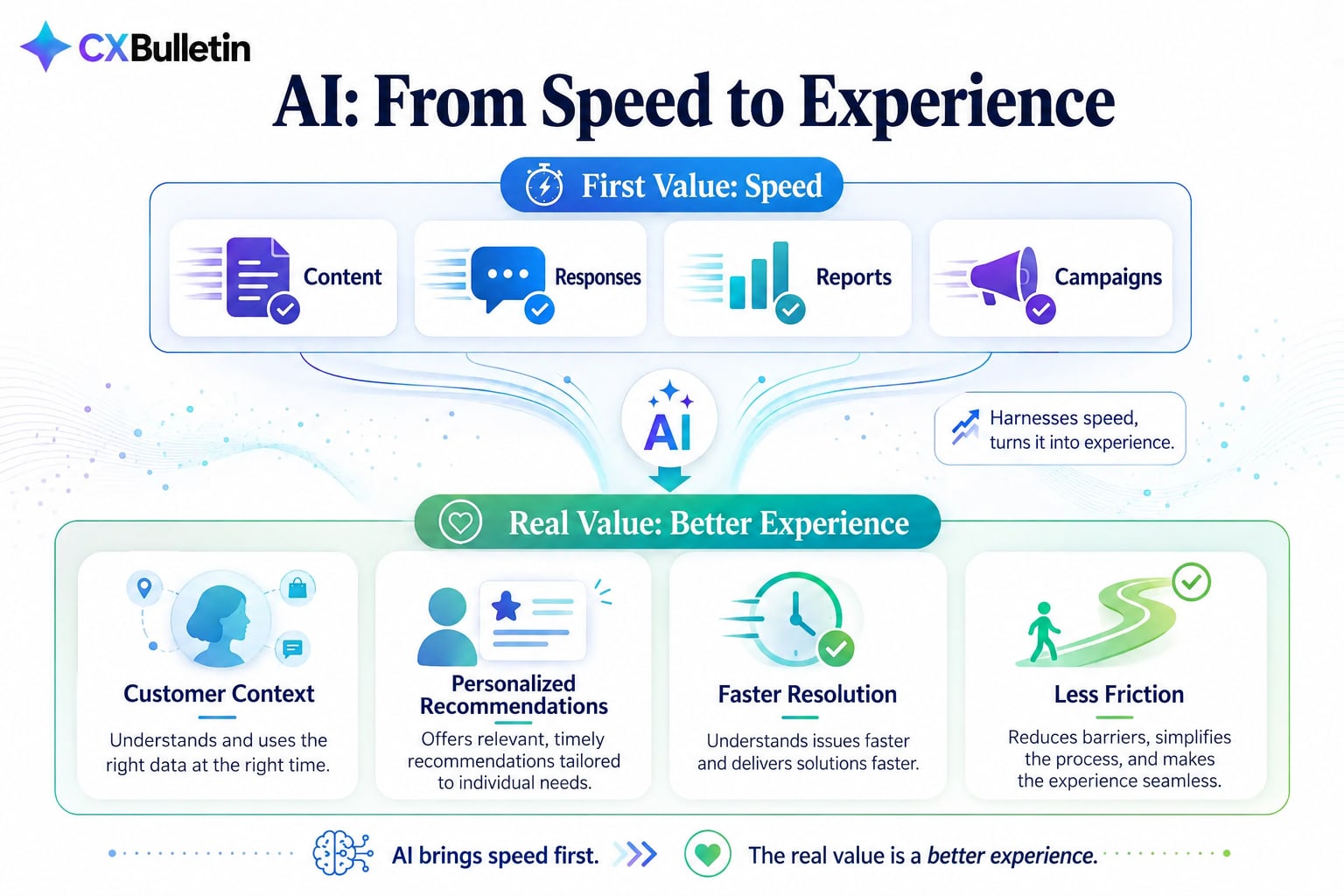
AI’s real value emerges when it goes beyond speeding up work and starts to understand customers better.
Without customer memory, AI is flying blind
In the previous piece, we discussed how easily customer memory gets scattered at SMBs. CRM can sit in one place, payment information in another, support tickets in a third and email history in yet another. AI doesn’t fix this fragmentation on its own.
If a customer’s history is incomplete, AI works with incomplete context. If data is inconsistent, AI produces inconsistent recommendations. If channels are disconnected, AI can’t see the customer journey as a whole. That’s why an SMB’s AI strategy is really a data strategy first.
According to the Salesforce report, 80% of SMB leaders believe improving data quality will increase revenue. In addition, 66% of SMBs plan to increase their investment in data management over the next year. Among SMBs using AI, that share is even higher. This finding makes one thing very clear:
AI is only as good as the customer information it is fed.
This isn’t just a technical issue. It bears directly on customer experience.
Wrong data produces wrong recommendations.
Incomplete data produces incomplete answers.
Scattered data produces a fragmented experience.
Outdated data erodes trust.
That’s why the soundest way for SMBs to get started with AI is to first answer some basic questions about their customers:
Where is the customer’s latest interaction recorded?
Is the purchase history up to date?
Can the sales team see support tickets?
Are customer preferences stored in the system?
Are permissions, consents and communication preferences clear?
Without answers to these questions, AI may end up automating the chaos instead of improving the experience.
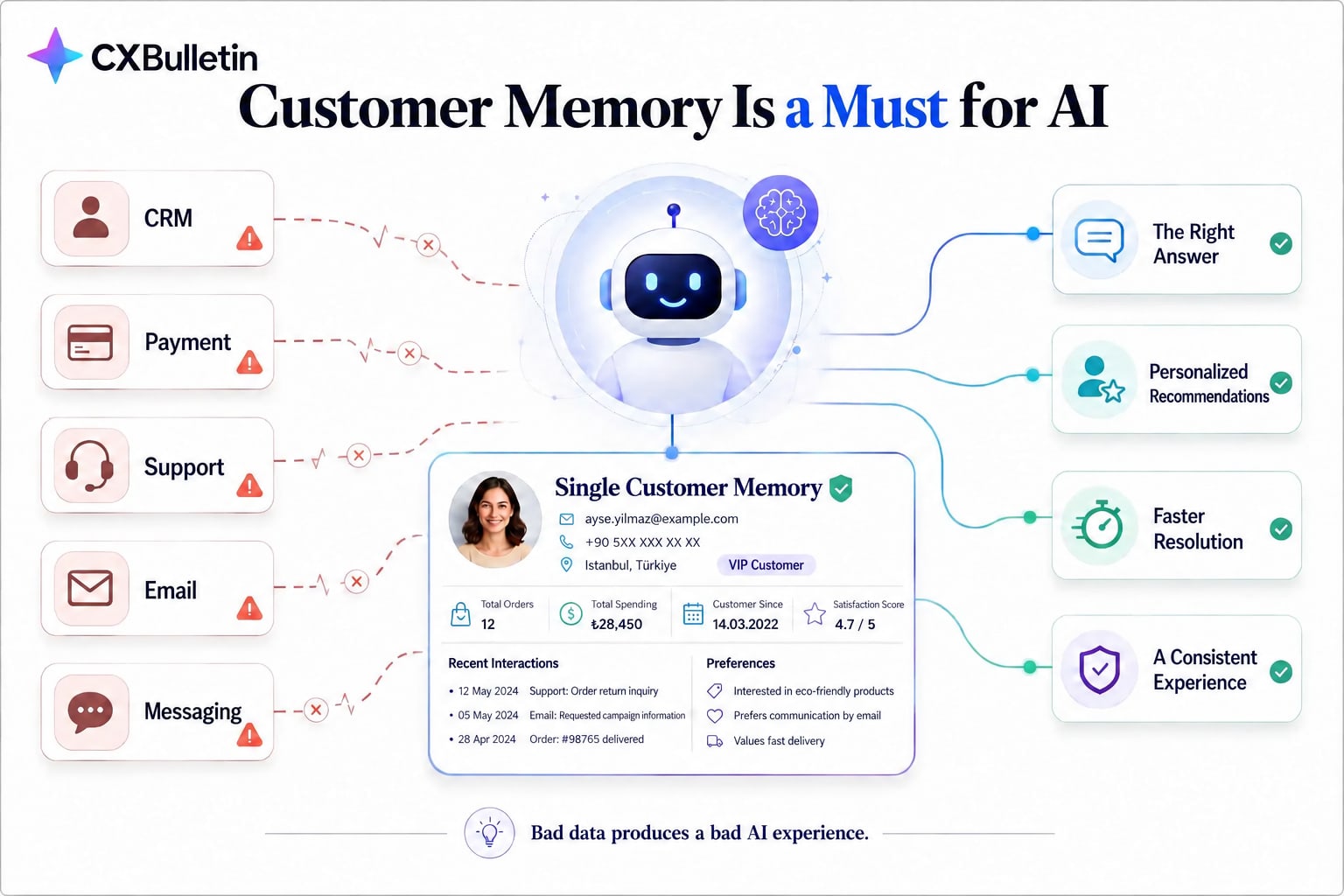
For AI to understand customers, the company first has to remember them correctly.
There’s a fine line between personalization and creepy tracking
Personalization is one of the areas where AI promises the most in customer experience. Offering the right recommendation to the right customer at the right time can be a very powerful advantage for SMBs.
Reminding customers of a product they need is a good experience.
Providing support with knowledge of a problem they had before is a good experience.
Communicating in line with their preferences is a good experience.
Not asking for the same information twice is a good experience.
But when personalization is poorly designed, it can quickly become unsettling.
Customers may feel watched rather than understood.
A recommendation may come across as pushy rather than helpful.
An automated message may feel artificial rather than personal.
If data use isn’t transparent, trust can be damaged.
McKinsey’s work on personalization stresses that AI and generative AI give companies the ability to personalize experiences at greater scale. But that ability becomes valuable when it is combined with customer context and the right data. For SMBs, there’s a simple principle here:
Personalization should make customers say “they know me,” not “they’re tracking me.”
What determines the difference isn’t just technology. It’s tone, timing, permission, context and benefit. If customers understand why they received a message, if the recommendation matches their needs and adds value for them, personalization is a good experience. But if the message is out of context, if it’s unclear how customer data is being used, or if the recommendation looks like nothing more than sales pressure, AI-powered personalization damages CX.
Trust, the invisible metric of the AI experience
When AI interacts with customers, trust stops being a technical or legal detail. It becomes a direct part of the customer experience. Customers want to know:
How is my data being used?
Did a human or an AI give this answer?
Who is responsible if a recommendation is wrong?
Is my personal information safe?
Is the company really trying to understand me, or just to sell me more?
NIST’s AI Risk Management Framework approach is a valuable reference here. The framework highlights the need for trustworthiness, governance, risk awareness and context-sensitive assessment in AI systems. SMBs don’t have to apply this as a heavyweight corporate procedure, but the core idea is very important: if AI is entering the customer experience, trust has to be designed in from the start.
That trust can be boiled down to a few practical principles:
- If AI is talking to the customer, that shouldn’t be hidden.
- AI shouldn’t make critical decisions on its own.
- Customer data should be used within the limits of permission and purpose.
- Employees should be able to check AI output.
- Wrong answers and bad experiences should be monitored.
- Automation shouldn’t leave customers unable to reach a human.
For SMBs, the last point is especially critical. Human warmth and closeness are a small business’s biggest advantage. AI should be used not to destroy that closeness but to make it more consistent and scalable.
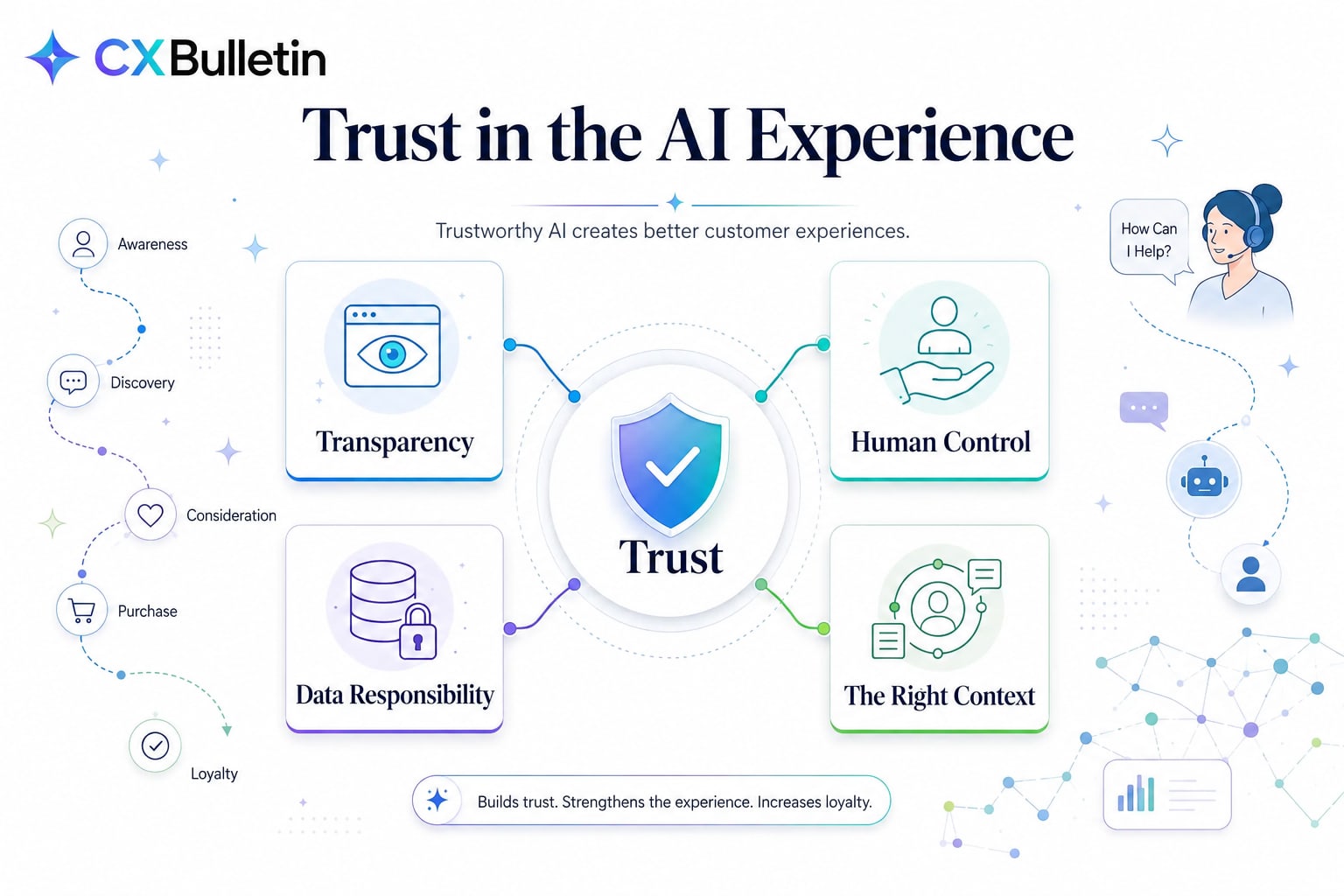
When AI interacts with customers, trust and transparency are part of the experience.
7 questions SMBs should ask about AI-powered CX
If SMBs approach AI investment only by asking “Which tool should we buy?” they start out with an incomplete picture. A better place to start is with customer experience questions.
1. Which customer pain point will AI ease?
Faster responses? Better recommendations? Less repetition? Easier support?
2. What customer data will AI work with?
Is that data up to date, clean, permissioned and accessible?
3. Will employees be able to check AI output?
AI can make suggestions, but the final check should stay with humans, especially on sensitive customer matters.
4. Will customers know they’re talking to AI?
Transparency is one of the cornerstones of trust.
5. Will AI make the experience more personal, or will it feel more automated?
Personalization and automation are not the same thing.
6. How will incorrect AI responses be tracked?
Because SMBs work with small teams, catching mistakes early is crucial.
7. Will customers be able to reach a human easily when they need to?
AI shouldn’t close off the path to human support; it should make that path easier at the right moment.
These questions may look simple, but they give SMBs a very sound way to vet AI. After all, a good AI investment is one that makes the customer’s life easier.
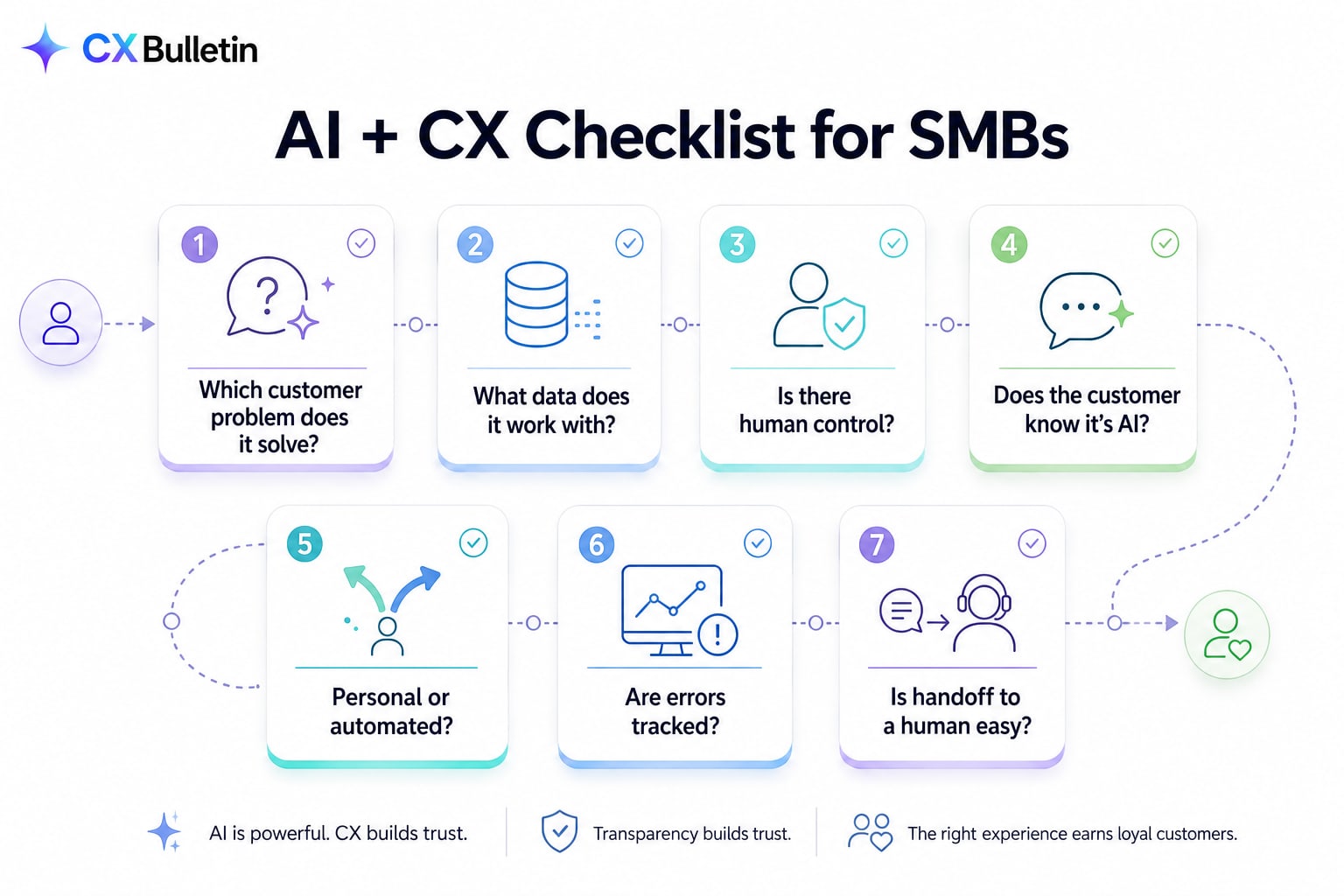
AI investment should start with customer experience questions.
AI doesn’t take employees out of the picture; it gives good employees more context
At SMBs, the AI debate sometimes gets stuck on the idea of replacing employees with technology. Yet from a customer experience standpoint, the healthier view is this:
AI should leave employees better prepared to serve customers.
If a support employee can quickly see a customer’s history, the answer will be better.
If a sales rep can understand a customer’s needs more accurately, the conversation will be less pushy.
If a business owner can see which customers are satisfied and which are at risk, they’ll set better priorities.
If a team can analyze frequently recurring problems with AI’s help, it won’t just respond; it will improve the experience.
The approach in Zendesk’s 2026 CX Trends also puts the spotlight on the idea of “contextual intelligence,” which combines AI, data and human understanding with real-time context. This view shows that in customer service, AI can be used not just for automation but for more contextual and personal interactions.
For SMBs, this is a very practical lesson: putting AI behind employees before putting it in front of customers can often be safer and more effective.
Because it is still employees who sustain the relationship. AI, used correctly, adds speed, context and consistency to that relationship.
The risk of growing with AI: More contact, weaker relationships
AI makes it possible to send more messages, produce more campaigns and respond to more customers faster. But that also creates a new risk:
More contact doesn’t always mean a better relationship.
As SMBs use AI to step up their communication, they need to be careful not to wear customers out. Not every automation is helpful. Not every recommendation is valuable. Not every fast response is a good experience.
Sometimes customers want clearer information, not more messages.
Sometimes they want better timing, not more campaigns.
Sometimes they want a real person, not a chatbot.
Sometimes they want privacy, not personalization.
That’s why AI-powered growth built solely on a “more” mindset can damage customer experience. Good CX doesn’t require more contact; it requires the right contact.
This is where a link can be drawn to the earlier piece on customer experience metrics and benchmarking. When measuring AI’s impact, it’s not just speed and cost that should be tracked, but also satisfaction, repeat purchases, support quality, complaint rates and willingness to recommend.
Conclusion: AI can close the CX gap for SMBs, but not on its own
The Salesforce report shows that SMBs have reached a significant turning point on AI and data. AI offers a powerful opportunity in terms of efficiency, speed and scalability. Rising investment in data management also shows that this opportunity is being taken more seriously.
AI’s real value emerges when it is combined with clean data, the right context, employee support, transparency and trust.
That is a big opportunity for SMBs. After all, a small business’s greatest strength is already its closeness to customers. If AI can make that closeness more consistent and scalable without destroying it, it can give SMBs a significant experience advantage over large companies.
Because customer experience is no longer a discipline only big companies can afford.
For SMBs, it is the infrastructure for growth.
This piece was first published in Turkish in CX Bulletin on May 15, 2026. English translation.