The Collapse of the Search Box: The Era of Autonomous Commerce and AI Shopping
Worn out by price chaos across marketplaces, consumers are abandoning the ordeal of hunting for products and handing their shopping over to AI assistants. Research from NIQ and Kearney reveals what awaits brands in this era of autonomous commerce.
Ordering online gets more exhausting by the day. In an ecosystem where the same product is sold on different marketplaces at prices that bear no relation to one another, we try to get our bearings and protect our wallets. The inflationary environment has turned even an ordinary grocery run for dinner into hours of torment spent comparing prices, flipping back and forth between dozens of tabs. Consumers are buckling under questions like “Where is it cheaper?”, “Who has free shipping?” and “Is this seller trustworthy?”, and the enormous cognitive load on their shoulders has become too heavy to carry. And at precisely this moment of exhaustion, the disruption that will shake retail to its foundations is under way: agentic AI, our new favorite buzzword, has gone from a flashy talking point in presentations and articles to every consumer’s go-to assistant. People are abandoning the ordeal of hunting for what they need, and the era of shopping by proxy — autonomous commerce, or agentic commerce — is dawning. (If you haven’t yet read our other articles on the subject, I recommend A New Era in Customer Experience: Shopping Is No Longer a Passive Act and How Is Agentic AI Changing the World of Home Improvement? The Home Depot and Google Cloud Partnership Begins.)
NIQ and Kearney tackle the subject with some truly striking findings in their newly released study, The New Growth Frontier. (You can access the full report at this link.)
Consumers no longer scroll through page after page of products. Autonomous systems are stepping in instead: rather than browsing content the way people do, they pull structured data and make decisions based entirely on parameters. An assistant that instantly scans old recipes at the user’s request, compares prices across different supermarkets and has the best combination ready for delivery within minutes is no longer the stuff of science fiction.
You Can’t Explore a New World with Old Maps
The most urgent and painful reality we need to confront as customer experience professionals is this: those colorful, multi-stage journey maps decorating our walls no longer work, especially in e-commerce. Your traditional sequence — recognizing a need, searching, evaluating options, adding to cart and checking out — shatters with a single AI prompt.
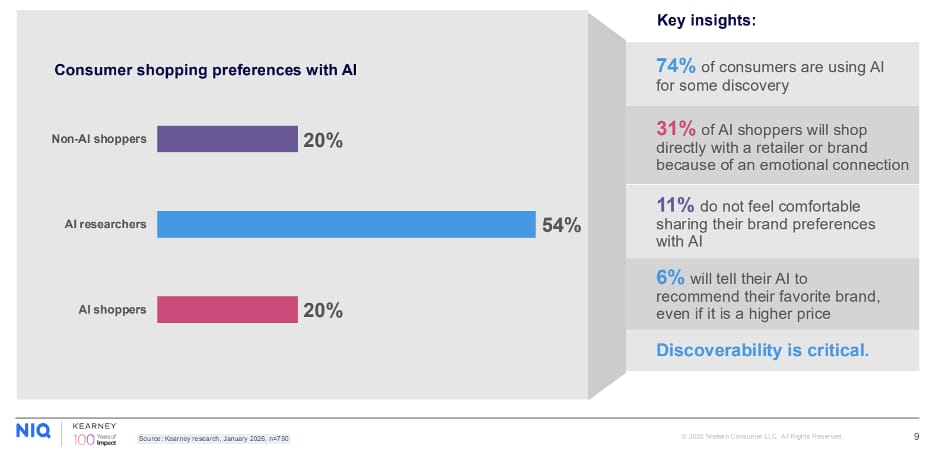
AI-Assisted Consumer Shopping Preferences and Key Findings
Already, 74% of consumers have brought AI into their product discovery process in some way. What’s more, on this new discovery journey, brand loyalty all but evaporates. Only 6% would tell their AI assistant to specifically recommend their own favorite brand even if it costs more. Everyone else — the vast majority — has surrendered to algorithmic logic and a rational weighing of price against performance. Brands must urgently and rigorously audit every touchpoint on their customer experience strategy maps and get their systems ready for the world of autonomous commerce.
The Era of “Growth Through Acquisition” Is Over for Big Companies
The strategy of giant companies buying a nimble start-up to keep growing once they turn sluggish is collapsing. In the face of slowing consumption, big consumer packaged goods companies are being forced to break up. It is no coincidence that Kraft Heinz is splitting up a decade after its megamerger, or that Unilever has spun off its ice cream business.
The impact of this collapse on market share is brutal: between 2022 and 2025, large and mid-sized national brands saw their unit share erode by 2.1 points, while established niche brands posted a net gain of 1.5 points. Scale is no longer an advantage; it is the very definition of sluggishness.
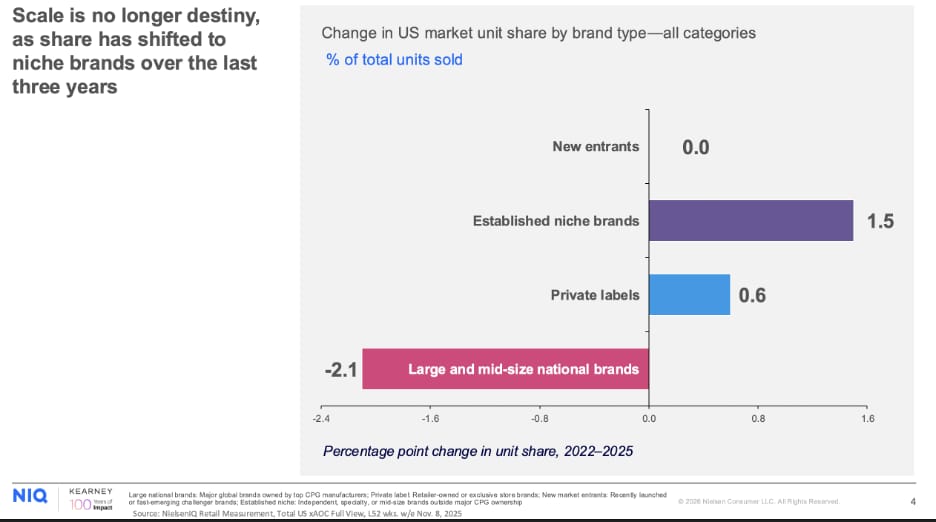
Change in Market Share by Brand Type – The Rise of Niche Brands.
The Capital Barrier Has Come Down: From $1 Million to $50K
Inflation-weary consumers are as hungry for convenience as they are price-sensitive. According to 2025 data, among young people aged 18-28 in particular, the share willing to pay more for innovative products that make tasks easier and save time has shot up to 62%.
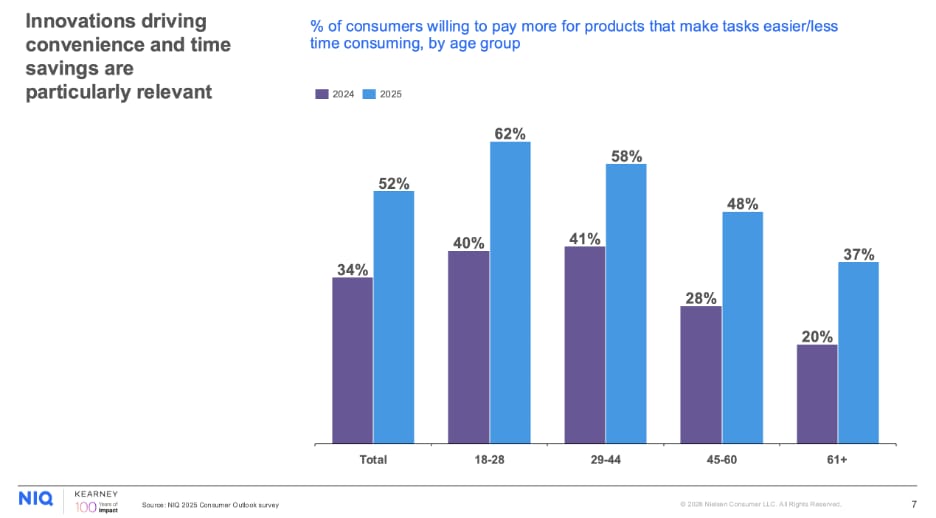
Analysis of Willingness to Pay for Innovations That Offer Convenience and Save Time.
Giant companies, with their ponderous boards, will find it very hard to respond to this extraordinary demand. The ability to innovate has become the cornerstone of growth. A traditional product launch takes 9 to 18 months and requires an upfront investment of $1 million to $5 million, but today AI has completely rewritten the rules. A next-generation launch takes just 4 to 8 weeks, and its cost has dropped to the $50,000 to $250,000 range. Niche brands that use AI agents to scan customers’ email complaints and online reviews in seconds, and run packaging and formulation tests with synthetic personas, get a new product onto the shelf (and into the algorithm) before the giant conglomerates have even set up a meeting.
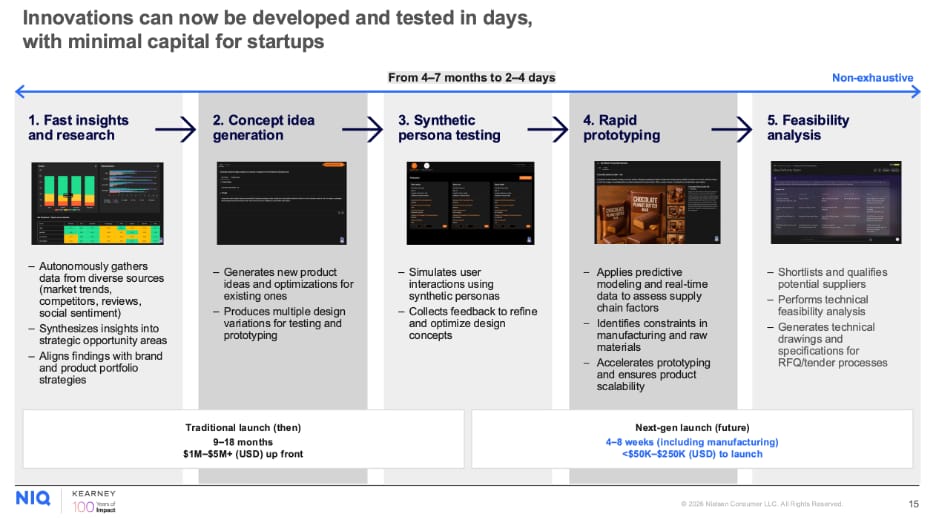
The Next-Generation Product Development and Innovation Cycle: Traditional vs. Future Approaches.
The Critical Takeaway for Türkiye
Only brands that manage their data infrastructure flawlessly will be able to win over Turkish consumers fleeing the price chaos of marketplaces and the cognitive load of constant searching. Companies that don’t speak the language of autonomous assistants, and that can’t turn their products into structured data that large language models (LLMs) can read, will be left out of the digital cart, however much space they take up on physical shelves. The rules of the game are being rewritten, and in this new order, it won’t be your size but your speed and transparency that keep you alive.
This piece was first published in Turkish in CX Bulletin on March 29, 2026. English translation.