Metrigy 2025 Report Analysis: How Leaders Stand Out With AI and Proactive Communication
In the world of customer experience, technology has evolved from what was long a "nice-to-have" into the "heart" of operations. The report published by Metrigy signals that this transformation is complete.
Reviewing Metrigy’s Q1 2025 report, “Shaping the Smarter, More Automated CX of the Future,” I can see that this evolution is now complete and that the gap between “Leaders” and “Followers” has widened dramatically.
As a CX consultant, I was most struck by this finding in the report: Choosing the wrong technology or lagging in AI adoption doesn’t just create inefficiency; it can more than double customer churn and nearly double employee turnover.
Here are the report’s highlights and my critical takeaways for the Turkish market:
1. The AI Maturity Model: There Is No Middle Ground
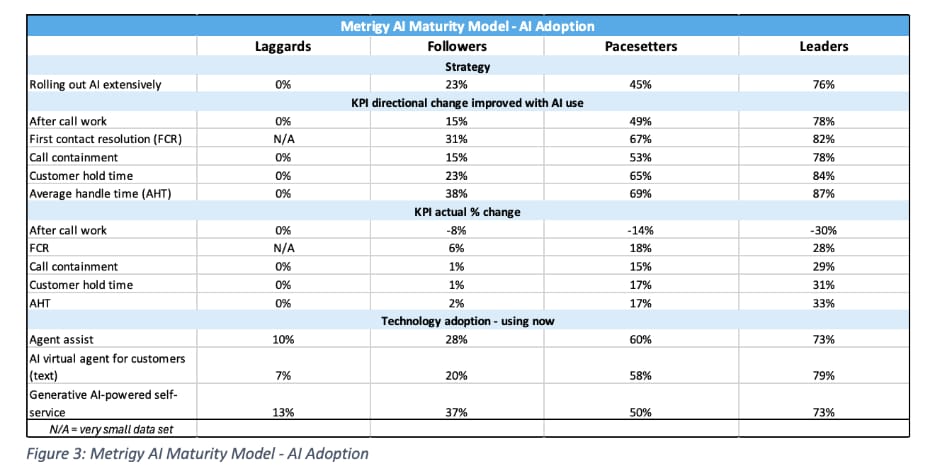
Metrigy divides companies by their use of AI into “Leaders,” “Pacesetters,” “Followers” and “Laggards.” The share of Leaders with widespread AI adoption is 1.7 times that of Pacesetters and 3.3 times that of Followers.
The impact on business results is surprising:
- Churn: At companies that don’t expand their use of AI, average customer churn is 50.3%, compared with an overall average of 21.5%.
- Employee Turnover: While the overall average is 24%, agent turnover soars to 42.3% at companies that don’t expand their use of AI.
These figures send a loud and clear message: AI is a critical tool not just for customers but also for retaining employees and lightening their workload.
2. Three Key Trends: Adoption, Proactivity and Operational Excellence
The three key trends highlighted in the report clearly show where CX strategies need to go:
- Trend 1: Generative AI and “Agent Assist” Are on the Rise: Leaders rely most on text-based virtual assistants, “Agent Assist” and GenAI-powered self-service tools. While 73% of Leaders actively use Agent Assist technologies, the figure among Laggards is 10%.
- Trend 2: The Shift From Reactive to Proactive: While 86% of companies reach out to their customers proactively, Leaders stand out by making that outreach “AI-triggered.” In other words, the real point isn’t just sending bill reminders but using data analysis to anticipate customer needs (churn risk, for example) and make offers accordingly.
- Trend 3: Auto CSAT and Hyperautomation: Instead of traditional methods that cause survey fatigue, Leaders are turning to “Auto CSAT,” which analyzes conversations and generates scores automatically, and to “Hyperautomation” technologies that manage processes with dynamic data.
What Does It Mean for the Turkish Market?
At Nord CX, when I compare the markets in Türkiye and Canada, I see very clear lessons for Türkiye to draw from this report:
- An Efficiency Shield Against Cost Pressure: Given high inflation and rising operating costs in Türkiye, AI is not a luxury but a necessity. The report ties AI use to average improvements in traditional KPIs (such as AHT and FCR) that reach or exceed 30%, gains that are vital for Turkish companies to protect their margins.
- A Solution to the Turnover Problem: High employee turnover is the single biggest pain point for call centers in Türkiye. The report’s data show that turnover is markedly lower at companies that expand their use of AI; technologies such as “Agent Assist” can help close this gap by reducing employees’ cognitive load. In Türkiye, empowering employees with technology is the biggest investment to be made in “Employee Experience,” even before “Customer Experience.”
- Bringing Technology Into Our “Proactive” Culture: Turkish culture prizes proactive service. But delivering it through manual processes isn’t sustainable. If our companies process their CRM data with AI and reach customers “before a problem arises,” it will be a game changer in building loyalty.
The Metrigy report shows that success in CX is now a matter of the “smart technologies” working behind the scenes to make that service possible.
The future is being shaped by proactive, predictive and empathetic AI.
This piece was first published in Turkish in CX Bulletin on January 28, 2026. English translation.