Macy's Simple Secret: A 10-Point NPS Gain, a Billion-Dollar Result
Macy's invested in the in-store experience, not discounts; NPS rose 10 points and its profit outlook improved. The recipe is startlingly simple.

As I write this, one contrast keeps running through my mind. On the same North American continent, at roughly the same time, two major retail stories played out. One — Hudson’s Bay — ended a 350-year legacy by closing its doors in 2025. The other — Macy’s — emerged from a two-and-a-half-year transformation program able to tell investors, “we’ve increased our profit, and our customer satisfaction is at a record high.” The same sector, similar macroeconomic headwinds, similar inflation and tariff pressure. Yet two completely different outcomes.
I studied the presentation Macy’s CEO Tony Spring and CFO Tom Edwards gave on September 15 at Goldman Sachs’ Global Consumer and Retail Conference (you can find the details of the investor presentation in this Investing.com report). On September 10, the company raised its full-year guidance for adjusted diluted earnings per share to $2.15–$2.35, up from the $1.90–$2.10 range it set at the start of the year (it had already lifted it to $2.00–$2.20 on June 3). It has posted five consecutive quarters of comparable sales growth and has beaten Wall Street expectations for six quarters running. It reads more like a story of expansion than of economic crisis, yet consumer spending has slowed in the US and Canada, too, and economic hardship is pushing people to tighten their belts.
Earnings-per-share forecasts and financial figures may not be our direct focus, but the story behind them is squarely in our territory: in Spring’s own words, the Net Promoter Score (NPS) in stores has risen a full 10 points since the strategy began, and customer service scores are at a record high.
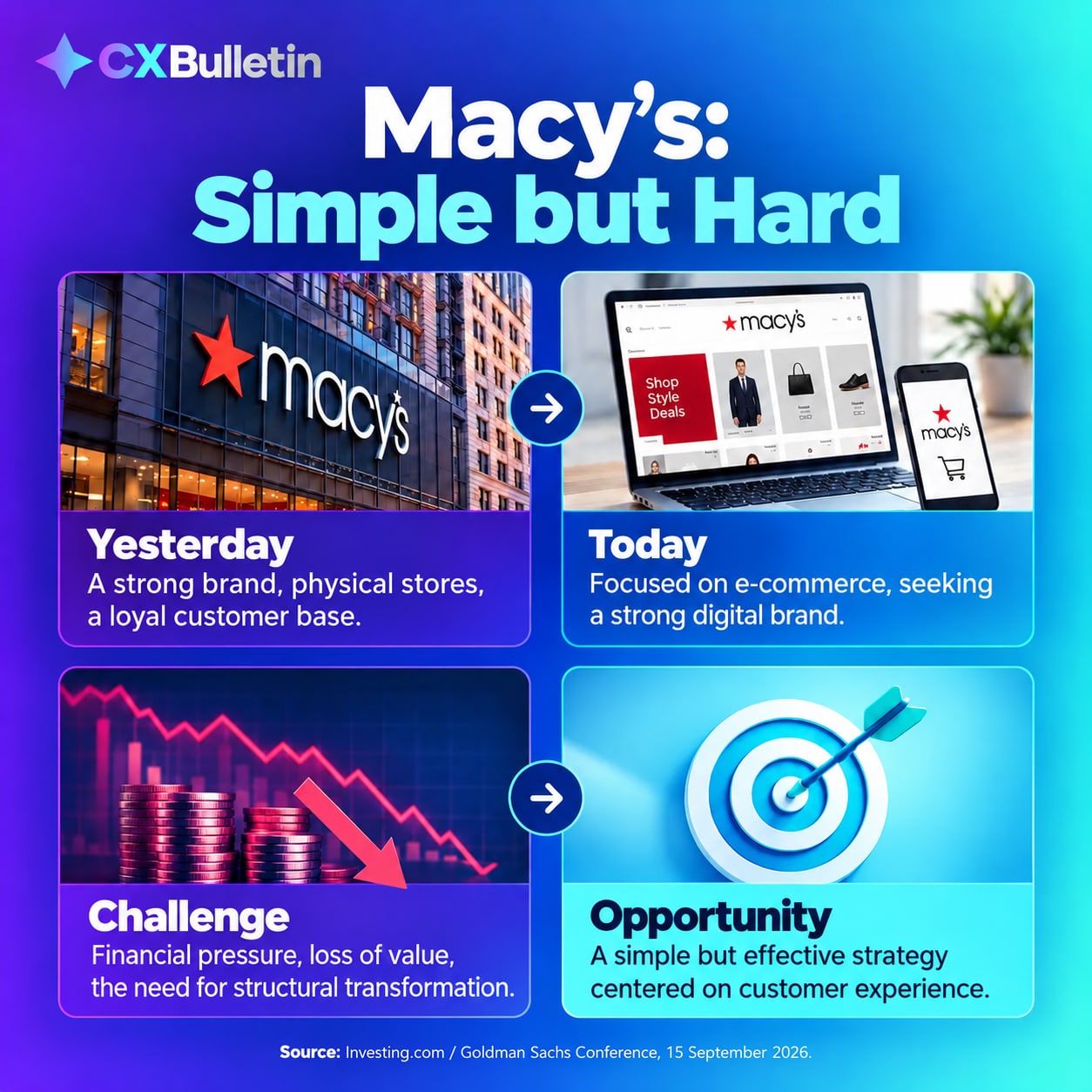
So where did those ten points come from? The answer is annoyingly plain: not discounts. Not a price war. Not an AI miracle either — although Macy’s rolled out a chat assistant first online, then in stores and then at Bloomingdale’s (Macy’s chain of luxury department stores), the company positions it not as a tool that “replaces people” but as a helper that empowers the team. The real engine is the store refresh program they call “Reimagine.” They started with fifty stores, learned along the way, and expanded to 200; it now covers 60% of the store fleet and 75% of Macy’s store sales. The investment requires little capital: not major construction, but people. More staff in the fitting room areas and in the handbag and shoe departments, better flow in the fitting rooms, and “more choice, less repetition” on the racks.
An analogy Spring used at the conference became the very theme of this piece: Reimagine is like a recipe — all the ingredients have to cook together, at the same time. None of them works a miracle on its own; when good visual merchandising, the right staffing, the right density and the right assortment come together, the score and sales rise in tandem. In other words, the formula isn’t complicated. The hard part is applying it across 200 stores, for years, patiently and consistently. The cliché everyone in CX knows but very few manage to live up to is proven true here once again: simple is not easy.
This brings me back to the conclusion I reached when writing about T-Mobile’s NPS-centered transformation — the sector doesn’t matter; whether it’s telecommunications or retail, at companies that genuinely invest in experience, financial success often follows quickly. If you recall the $1 billion budget Target set aside for experience, the same pattern was at work there: scaling up rather than cutting back in hard times. Macy’s did exactly that. It channeled most of the one-time tariff refund that came out of the tariff wars ($96 million of the $116 million, according to the company) into brand marketing, Reimagine pilots and price support in categories such as furniture and jewelry, while roughly $20 million will flow through to annual earnings per share.
The lesson here is especially valuable for retail chains in Türkiye, because our market is shaped by price sensitivity, and that is simply a fact of life. But as I wrote earlier about Costco, loyalty is won through consistency, not campaigns. Customers finding what they’re looking for in a mall or a hypermarket, not waiting at the checkout, floor staff being able to help them — none of this requires a revolutionary technology investment. What it requires is discipline and patience. Turkish retailers often set aside budgets for big digital transformation projects while pushing these “boring” but fundamental in-store elements — adequate staffing, shelf layout, the fitting room experience — to the back burner. Macy’s story says exactly the opposite: fundamentals first, technology second.
For readers unfamiliar with NPS methodology, I recommend a look at Bain & Company’s resource page on the Net Promoter System; understanding the logic behind the score goes a long way in internal discussions.
In the end, one question remains: in your organization, when you hear the sentence “all the ingredients have to cook at the same time,” which missing ingredient comes to mind first?
Update note (October 14, 2026): When this article was moved to The CX Brief, time references were updated, and spelling fixes and documented corrections of facts and attributions were made; the article’s content and views did not change.
This piece was first published in Turkish in CX Bulletin on September 17, 2026. English translation.