Gartner: “How Do We Explain AI Investments to the Board?”
Every C-level executive who speaks publicly these days says AI is the most important force that will change the course of business. But when it comes to explaining to the board what we gain from this technology, most of us get stuck.
A recent article published by Gartner laid out the magic formula we need most right now, and will probably keep needing for a long while to come: How do we explain AI investments to senior management, and how do we win them over?
Every C-level executive who speaks publicly these days says AI is the most important force that will change the course of business. But when it comes to explaining to the board what we gain from this technology, most of us get stuck. Why? Because we’re still trying to measure success with things like “we saved this many hours” or “this percentage of the team uses the app.” Yet these mean little in the boardroom; at the end of the day, board members want to see real figures that affect the financial statements and the bottom line.
That’s exactly why Gartner’s research says we need to move past talk of “how many hours we saved” and focus on 5 critical metrics that directly cut costs, grow revenue or affect the employee experience. What do these 5 metrics, summarized in the graphic below, actually mean? Let’s talk them through from our vantage point in CX.
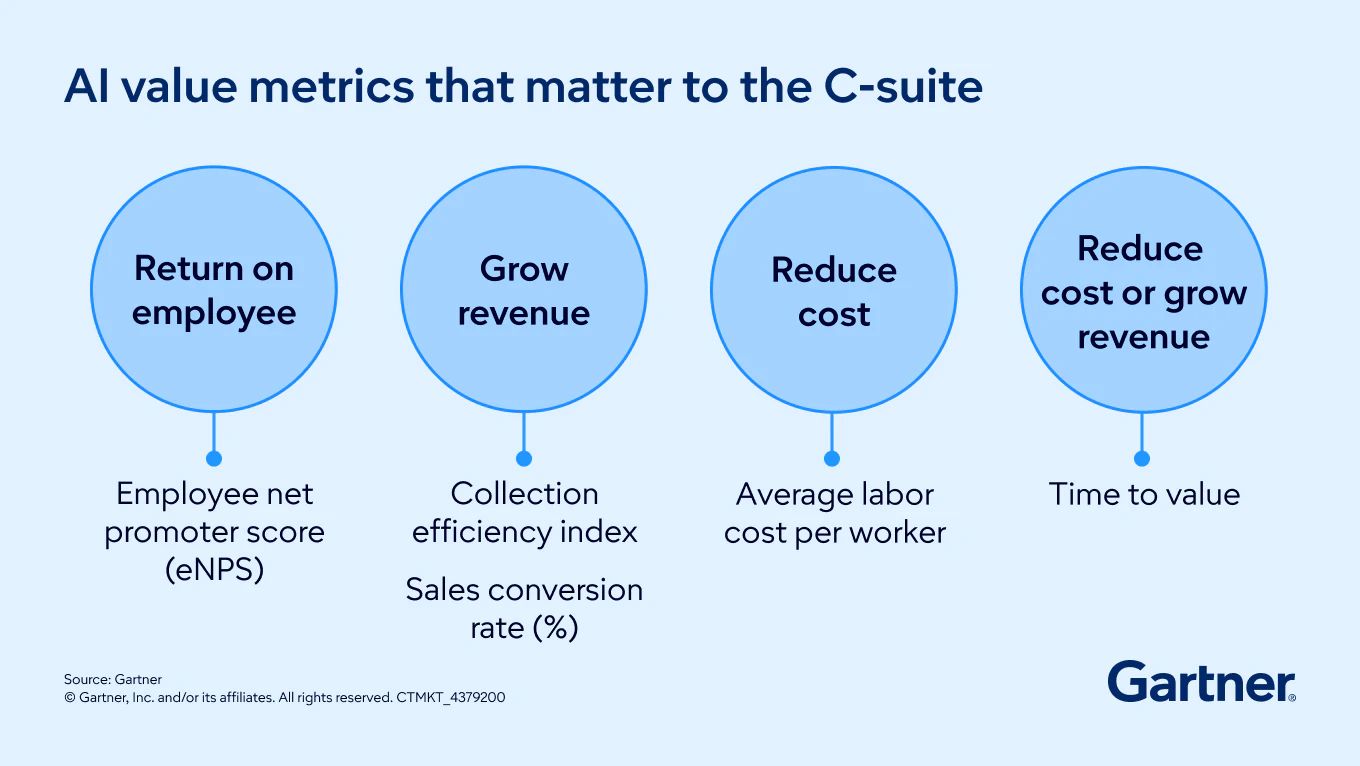
1. Sales Conversion Rate: Where We See the Impact Fastest
This, in our view, is exactly where we see AI paying off most clearly and most quickly. Many AI investments are made on the promise that “we’ll reap big benefits down the road,” but improvements on the sales and conversion side make themselves felt within weeks.
The system can instantly analyze a customer’s hesitation or confusion during an interaction and feed the sales rep real-time prompts. Systems that reduce the customer’s cognitive effort and can show empathy at the right moment send conversion rates soaring. Measuring how often sales teams use these AI suggestions and tying the results to conversions should be the first big argument you bring to the table.
2. Average Labor Cost per Employee: “Experience Compression”
Payroll is one of the biggest expenses at any company. Here Gartner uses a phrase we really love: “experience compression.” What does it mean? Thanks to AI, a relatively less experienced employee can work as well and as quickly as a seasoned veteran who has spent years in the role.
This is especially valuable in areas such as the customer service help desk. Measuring how much AI has shortened onboarding — the time it takes a new employee to reach full productivity — is a great way to prove you’re optimizing costs without sacrificing service quality.
3. Time to Value: Speed Equals Competitiveness
This metric both cuts costs and multiplies revenue. AI makes us dramatically faster at bringing a new product or service to market. It isn’t just about doing existing work more efficiently; the earlier you get to market, the earlier you make money and the further you pull ahead of your competitors. Going through your company’s projects from the past two years and drawing up a map of the places where you can say, “this is where we keep getting stuck; we can speed things up here with AI automation,” will grab the attention of everyone on the board.
4. Collection Effectiveness: How Fast You Turn Invoices into Cash
At the end of the day, cash flow is what keeps a company afloat. Complex processes, faulty invoices, drawn-out disputes and appeals put a serious strain on working capital.
AI lifts a huge burden off collections teams by finding the most appropriate language for communicating with and collecting from each customer — based on that customer’s history, payment habits and company culture — and crafting it automatically. The share of invoices processed smoothly without any human intervention (straight-through processing) is in the running to become one of the finance department’s favorite metrics.
5. Employee Net Promoter Score (eNPS): The Unsung Hero
The first four metrics speak directly to the company’s finances, but eNPS (employee engagement) is really the cornerstone of sustainability. As we stress at every opportunity in our work at Nord CX: employee experience is essential to creating a good customer experience.
Gartner’s finding is clear: employees who use AI assistants more than once a week have higher eNPS scores. Why? Because they’re freed from repetitive drudgery, they can add value to their work and they don’t burn out. When you use AI to ease the load on employees in high-turnover departments and reduce talent loss, the financial and cultural value you create turns out to be far greater than you’d expect.
The Takeaway
When you’re managing this work in your organization, trying to measure everything at once is the biggest mistake you can make. As Gartner also recommends, pick your main goal (revenue growth? cost optimization? employee experience?) and focus on just two or three metrics tied to that goal.
If you build on Gartner’s template by also spelling out the concrete gains for customer experience and tying them to ROI, you’ll be a star not only with senior management but with your customers, too!
This piece was first published in Turkish in CX Bulletin on March 6, 2026. English translation.