Bain & Company Warns: Digital Experience May Be Where Loyalty "Ends," Not Where It "Begins"
We live in a ruthless age in which customer loyalty takes years to build and only seconds to lose. A sales associate's smile in the store no longer makes up for a "404 Error" in your app.
Bain & Company’s recently published analysis, which examines how digital experience affects companies’ financial health, is full of data all of us should pin to our office walls.
The data in the report proves that our “margin for error” in digital channels has now dropped to zero. Let’s take a closer look at what these critical charts are telling us.
“NPS 57”: Even a Problem-Free Experience Has Its Limits
Let’s start with the report’s most striking finding. According to Bain’s data, consumers who had no problems with their digital transaction (about two-thirds of the total) give the brand an NPS (Net Promoter Score) of 57. For Bain, even this score is nothing to celebrate: a problem-free experience is no longer a sign of “outstanding achievement”; it is merely a hygiene factor, the bare minimum needed to stay in the game.
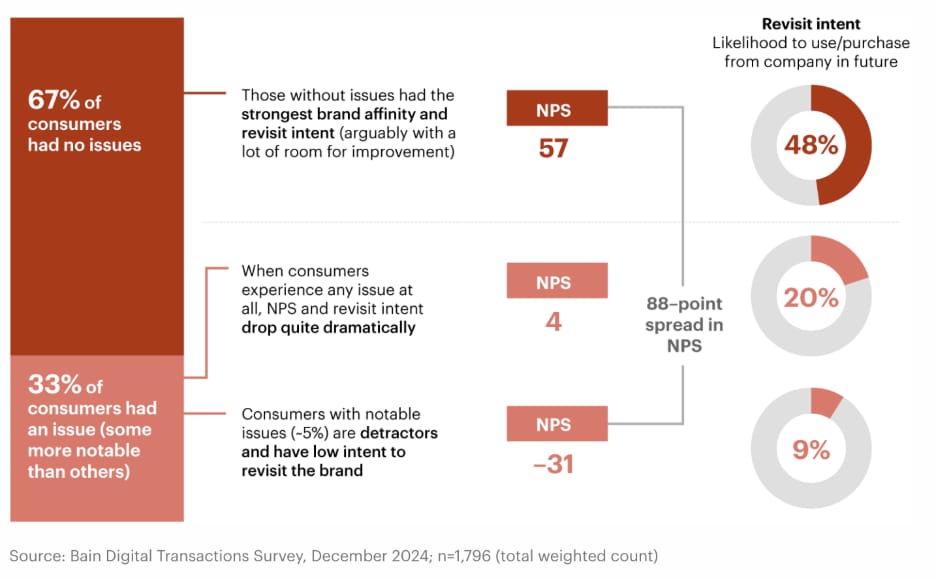
Look closely at the chart above and you can see how sharply the numbers collapse the moment a problem occurs: NPS falls to 4 among those who had any problem and to -31 among those who had a significant one, a full 88 points below the problem-free group. Intent to use the brand again likewise drops from 48% to 20% and 9%, respectively. What this tells us is that it isn’t enough for your app to simply “work.” Customers now see a “usable” experience as the baseline and a “personalized and frictionless” experience as a reason to choose you. A problematic transaction is a silent but deadly source of lost customers.
“Make One Mistake and You Won’t Get a Second Chance”
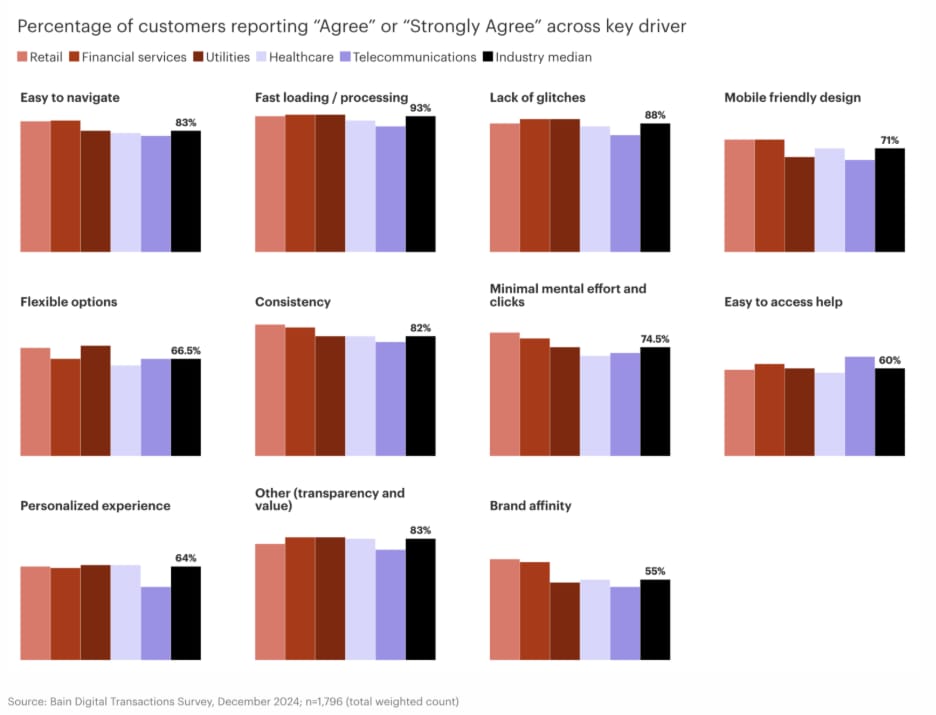
Another chart in the report shows, sector by sector, the criteria customers use to judge the digital experience: basic expectations such as fast loading (93%), being error-free (88%), easy navigation (83%) and consistency (82%) top the list, while affinity for the brand stands at just 55%.
One respondent’s comment sums up the situation: “The quality of the online transaction experience either makes or breaks my perception of that brand.”
As we saw in the first chart, a single hiccup at the payment step, a gray area that raises security concerns or a complicated form doesn’t just make customers abandon that cart. It can trigger the decision “not to come back.” In the digital world, you can’t make up for a faulty interface by saying, “Sorry, our system is busy.” The experience either flows and loyalty begins, or it stalls and loyalty ends that very second.
“Working” Isn’t Enough; It Has to “Delight”
So how do we earn loyalty? The pyramid below, adapted from Aarron Walter’s “Designing for Emotion” and used by Bain to assess digital experience, holds up a mirror to our level of digital maturity and, in fact, maps out the road we need to take.
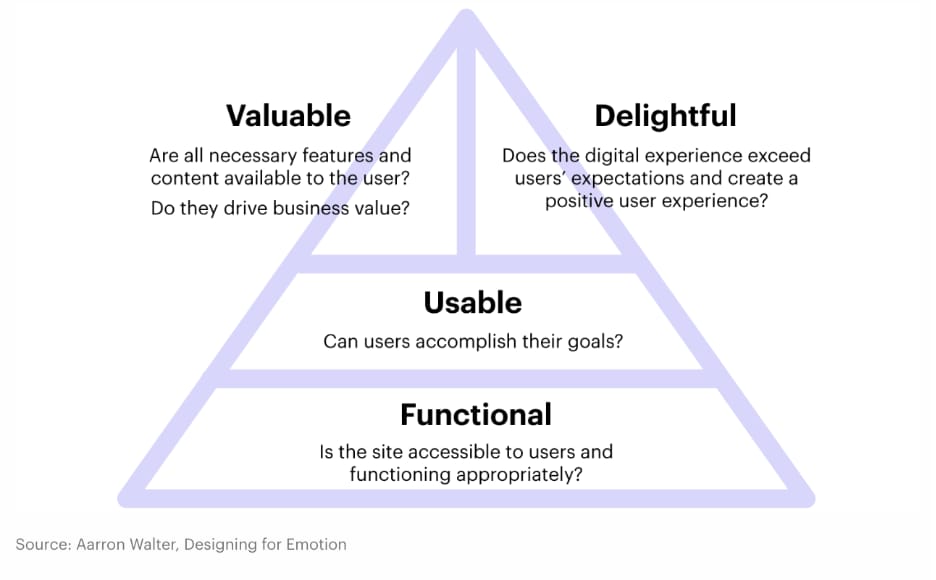
Most companies stop their digital investments at the bottom layers of the pyramid: “Functional” and “Usable.” In other words: “Does our site load? Yes. Do the buttons work? Yes.”
Yet this visual clearly shows that real commercial value lies hidden in the upper layers of the pyramid, the “Valuable” and “Delightful” stages. Simply meeting customers’ expectations isn’t enough; you have to exceed them and create a positive feeling. What increases business value isn’t that your site runs without errors; it’s that it makes customers feel good and valued.
A Roadmap for CX Leaders: Diagnosis and Treatment
Bain’s “Digital Experience Diagnostic” approach has three components: a user experience assessment and competitive positioning, journey mapping and analytics, and recommendations. We can translate this into a roadmap of our own as follows:
-
End-to-End Analysis: Measure the performance of every screen and its impact on users, not just the main flows.
-
Prioritization: Pinpoint the “make-or-break moments” that most affect revenue and loyalty, and shift your resources there.
-
Personalization: Once the basic functions are sorted out, move to a system that knows the customer and offers them a personalized, frictionless flow.
Loyalty used to begin with “the relationship built with the customer.” Today, it begins with “how fast your app opens” and is reinforced by “transaction security.”
This piece was first published in Turkish in CX Bulletin on February 7, 2026. English translation.