AI Is Closing the Book on the "Pilot" Era: The Shift to Real Workflows Has Begun
These days, it seems nothing can be said about business without mentioning AI. It's clear this is no passing buzzword but a concept that is disruptive in the fullest sense, yet also a force for renewal. Factor in AI's incredible pace of development, and the FOMO is bigger than ever.

In the world of customer experience, too, it is no longer possible to talk about innovation without mentioning AI.
Recently, the large-scale market research and accompanying executive summary published by Bain & Company put hard numbers on the shift we have been sensing. We are past the stage of watching showcase AI demos and applauding; we are leaving the “pilot” era and officially entering the “production and scaling” phase. As Bain puts it, we have stepped into a whole new era in the world of AI.
The data shows AI moving out of innovation labs and straight into budget meetings and executive scorecards. While 74% of companies rank AI among their top three strategic priorities, for 21% AI is now the “number one” item on the agenda.
So what does this macro trend mean for operations and for customer experience? Let’s take a closer look at the data Bain shared and at what this picture tells us about both the global and the Turkish markets.
Trials Are Ending, Real-World Use Is Spreading
The myth making the rounds that “everyone’s experimenting, but nobody’s scaling” has now been debunked by the data. The chart below from the study sums up this shift very clearly. Usage in software development has climbed to 73%, followed closely by customer service, knowledge worker productivity and marketing.
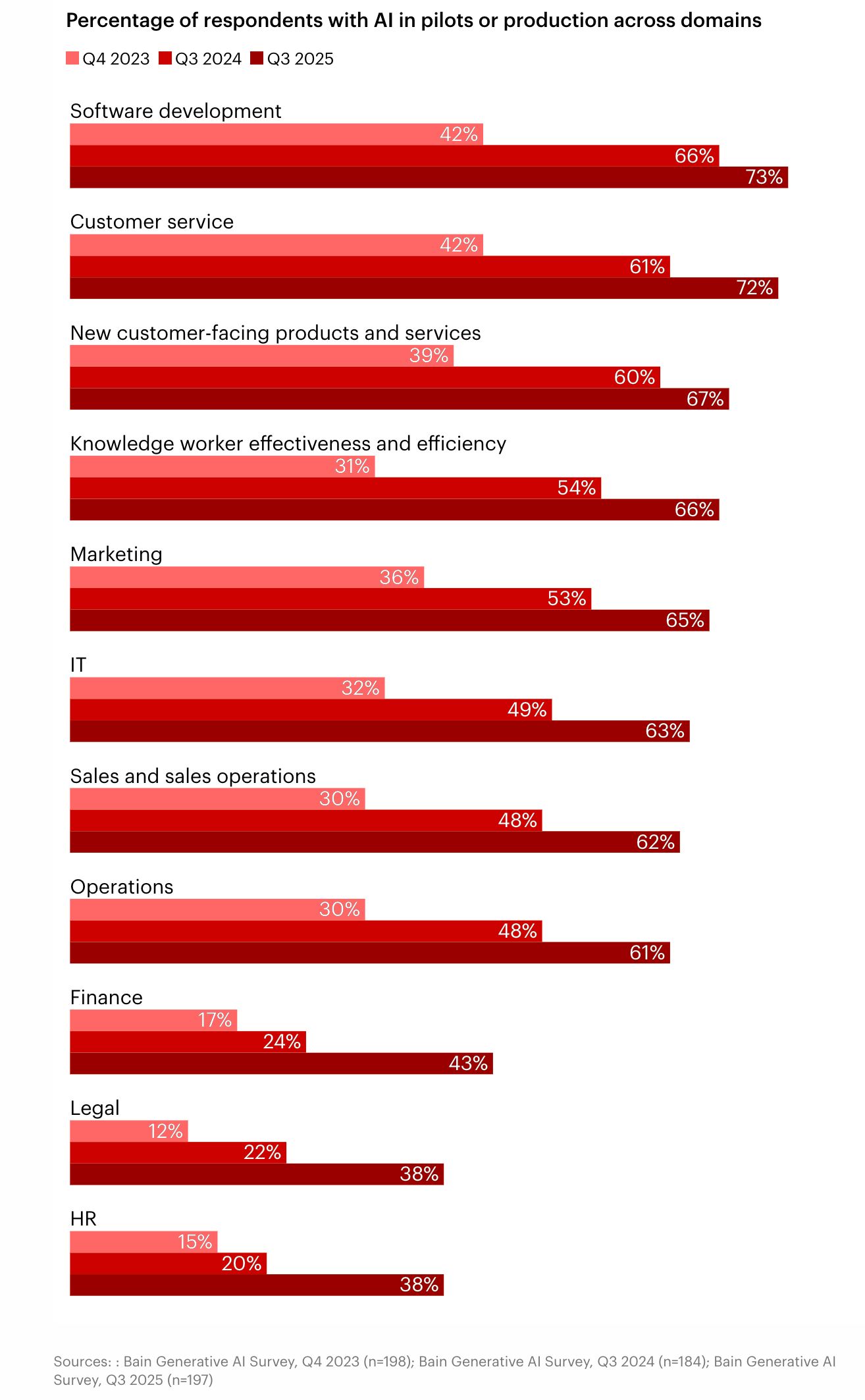
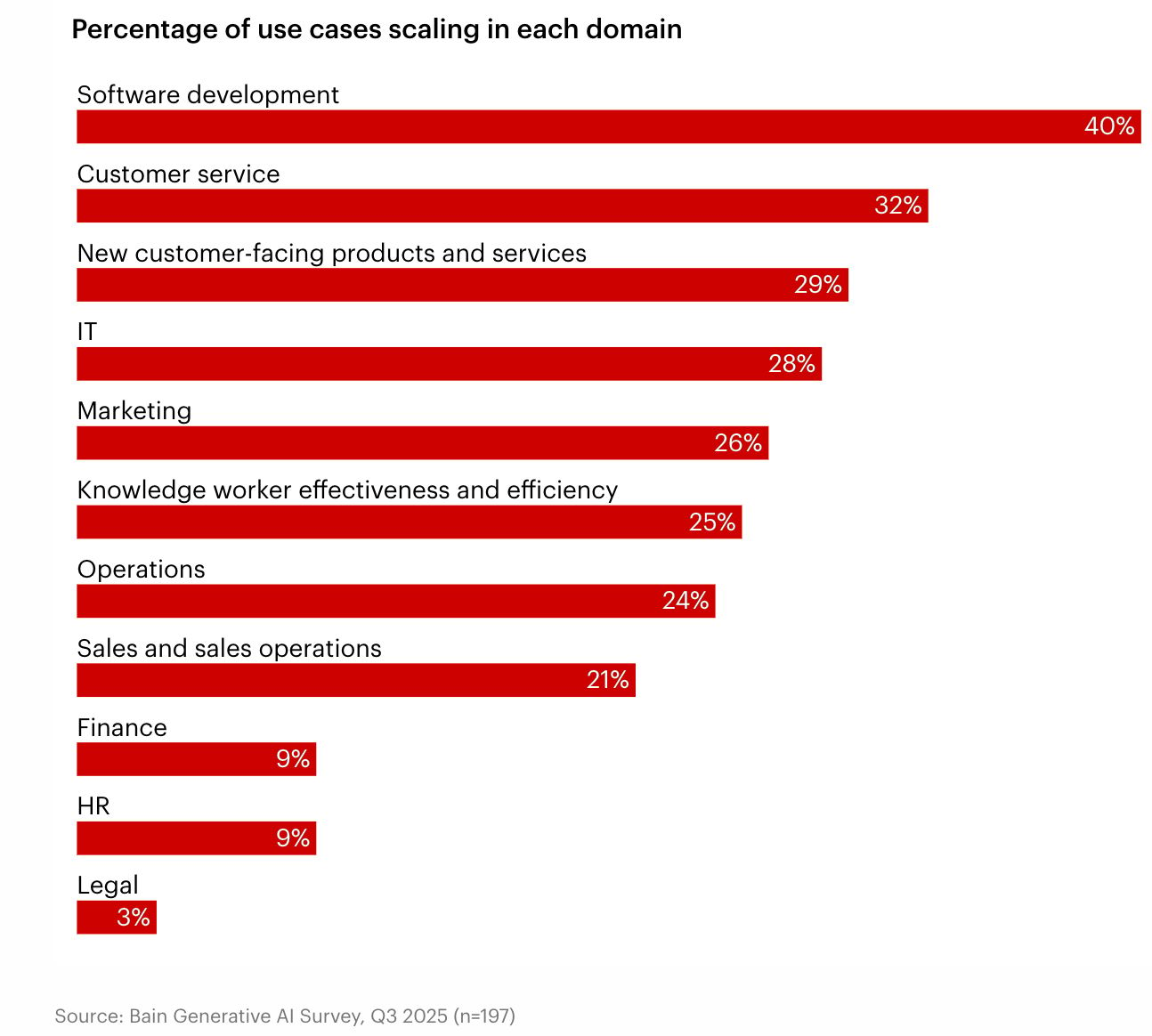
Massive change is under way on the customer-facing side of the business. Looking at the share of use cases that have scaled (chart below), we see that 40% of pilots in software development and 32% in customer service have scaled successfully. Sales, marketing and operations have also settled at a solid 20% scaling rate.
The Bottleneck That Grows with Scale: Data Security
One of the study’s most striking findings is the shift in how risk is perceived. The moment you bring AI systems out from behind closed doors and start integrating them into real workflows, you come face to face with real users, real data and, naturally, real security threats.
The chart below, which tracks how companies’ concerns have changed over the years, shows that concerns such as quality and a lack of in-house expertise have declined, while concern about data security and privacy jumped from 38% to 45% in a single year (it was 49% in 2023). The increase is especially pronounced among companies moving from pilot to production.
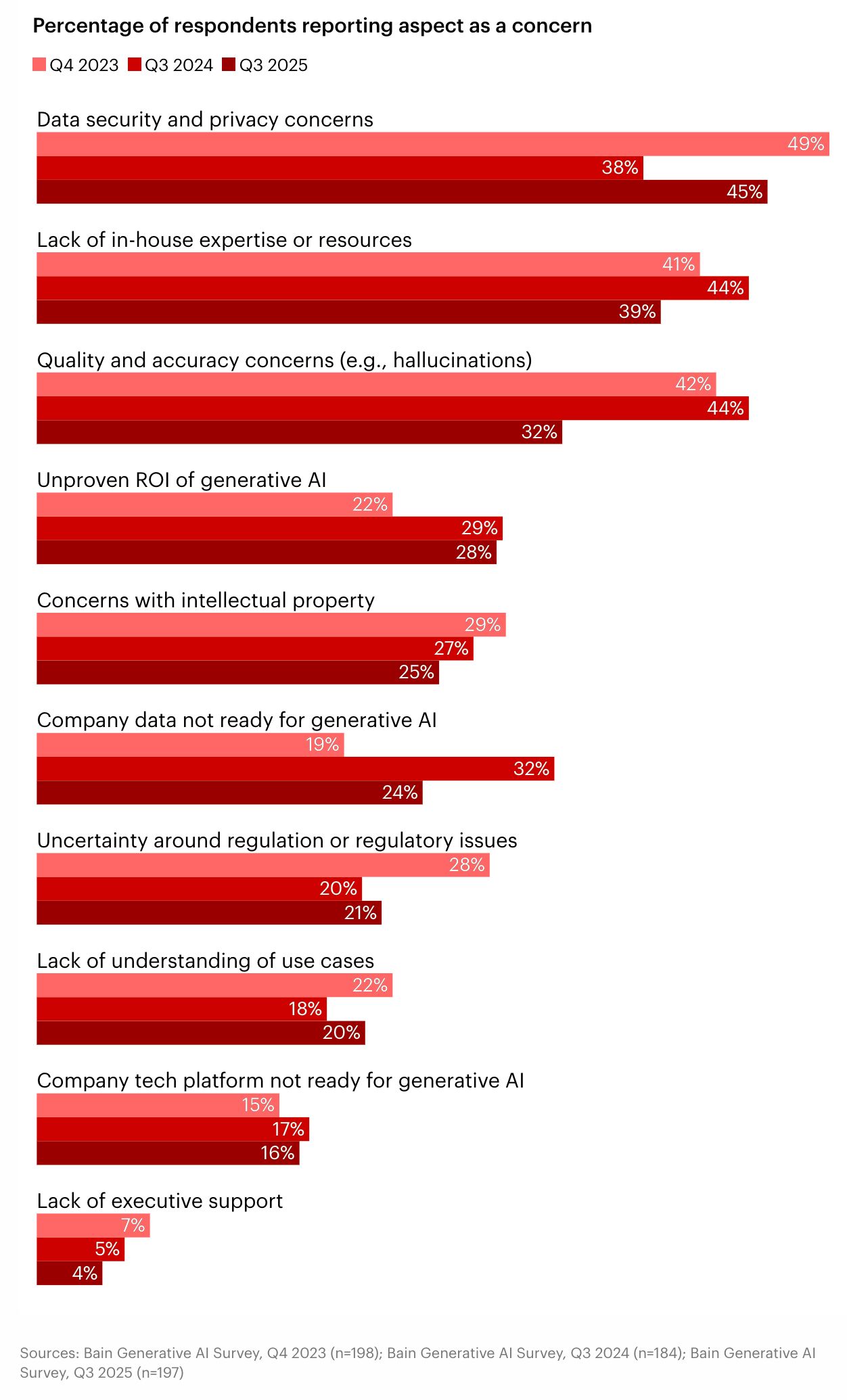
As the technology moves beyond the “assistant” role and becomes agentic, doing work autonomously from end to end, the benefits it brings multiply, but managing that power safely gets harder. When AI falls short of expectations, the problem usually isn’t that the model doesn’t work; it’s that the system isn’t prepared for unstructured real-world data and complex edge cases.
What Does This Mean for Türkiye’s CX and Technology Sector?
Globally, the gap between technology companies and those in other sectors is widening fast. The chart below from Bain shows that 44% of technology companies see a high or very high risk of disruption.
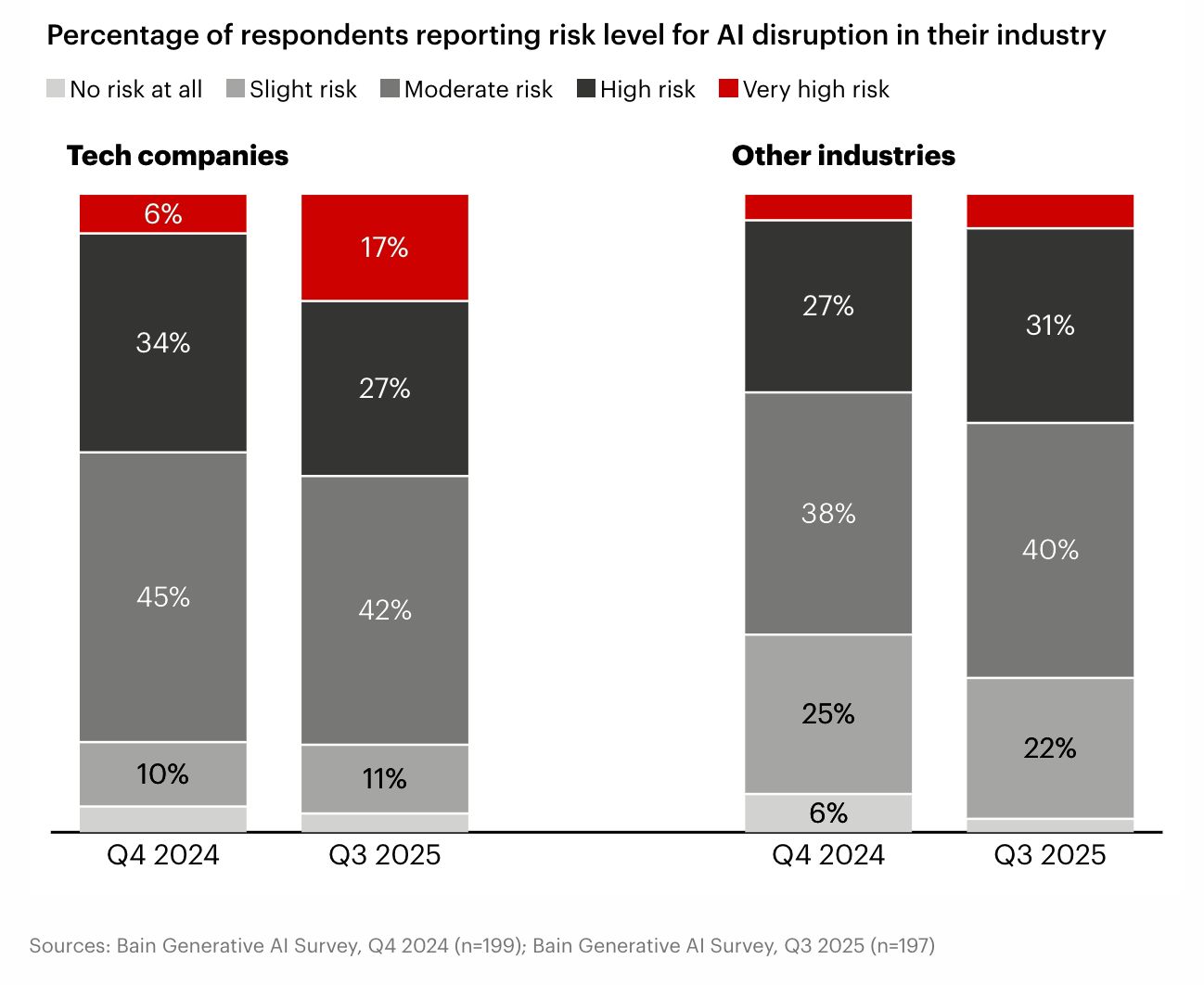
Looking at the CX and technology ecosystem in Türkiye, we see a market that is extremely eager and agile when it comes to trying out innovations and running “pilot projects.” But once it’s time to scale and fundamentally change the business, we can run into integration barriers.
Companies in Türkiye shouldn’t grow complacent by measuring themselves against global averages (or only against their local rivals). Your customers’ expectations are no longer set by the competitor down the street; they are set by global technology players that rebuild their processes end to end with AI and deliver personalized, frictionless experiences in seconds.
All the research points to one fact: simply slapping an “AI-Powered” label on your product or service is no longer a point of differentiation; it is the minimum requirement for a seat at the table. What matters is how much faster that process becomes, how much more reliable it gets, and what that means for your costs and, above all, for your customer.
The moment you slow down, your competitive advantage becomes merely the norm. You need to tear down your own business model and processes before anyone else does, redesign them flawlessly from a customer experience perspective and rebuild them with the scalable power of AI.
This piece was first published in Turkish in CX Bulletin on March 4, 2026. English translation.