A New Era in Returns: Customers Now Want Speed, Not Small Talk
Returns season, the busiest and most stressful period in retail, is in fact a critical juncture for brands, where loyalty is put to the test. A report published by Ada Research offers interesting data on the link between returns processes and customer loyalty.

New data published by Ada Research proves that the returns process is not merely a logistics operation but has become the most fragile link in customer relationships. Selling the product used to be the key to success; today, the way you take that product back determines whether the customer will still be with you tomorrow.
The study’s most striking finding is that a bad returns experience wipes out loyalty instantly. No matter how loyal they are, 57% of consumers say a bad returns experience would affect how likely they are to shop with that brand again. This shows that trust painstakingly built over the years can vanish in seconds because of a complicated returns form or a shipping code that arrives late. Customers no longer see returns as a privilege but as a standard indicator of service quality.
The long-running debate over the human touch in customer service also takes on a new dimension with this report. Consumers no longer care who is on the other end; they care how quickly their problem gets solved. If an AI assistant can answer their questions and complete the return with no wait time, 60% of customers are open to using it. In other words, the expectation of courtesy and empathy has given way to a focus on speed and results. Customers don’t want the person on the other end of the line to ask how they’re doing; they want their money back in their pockets.
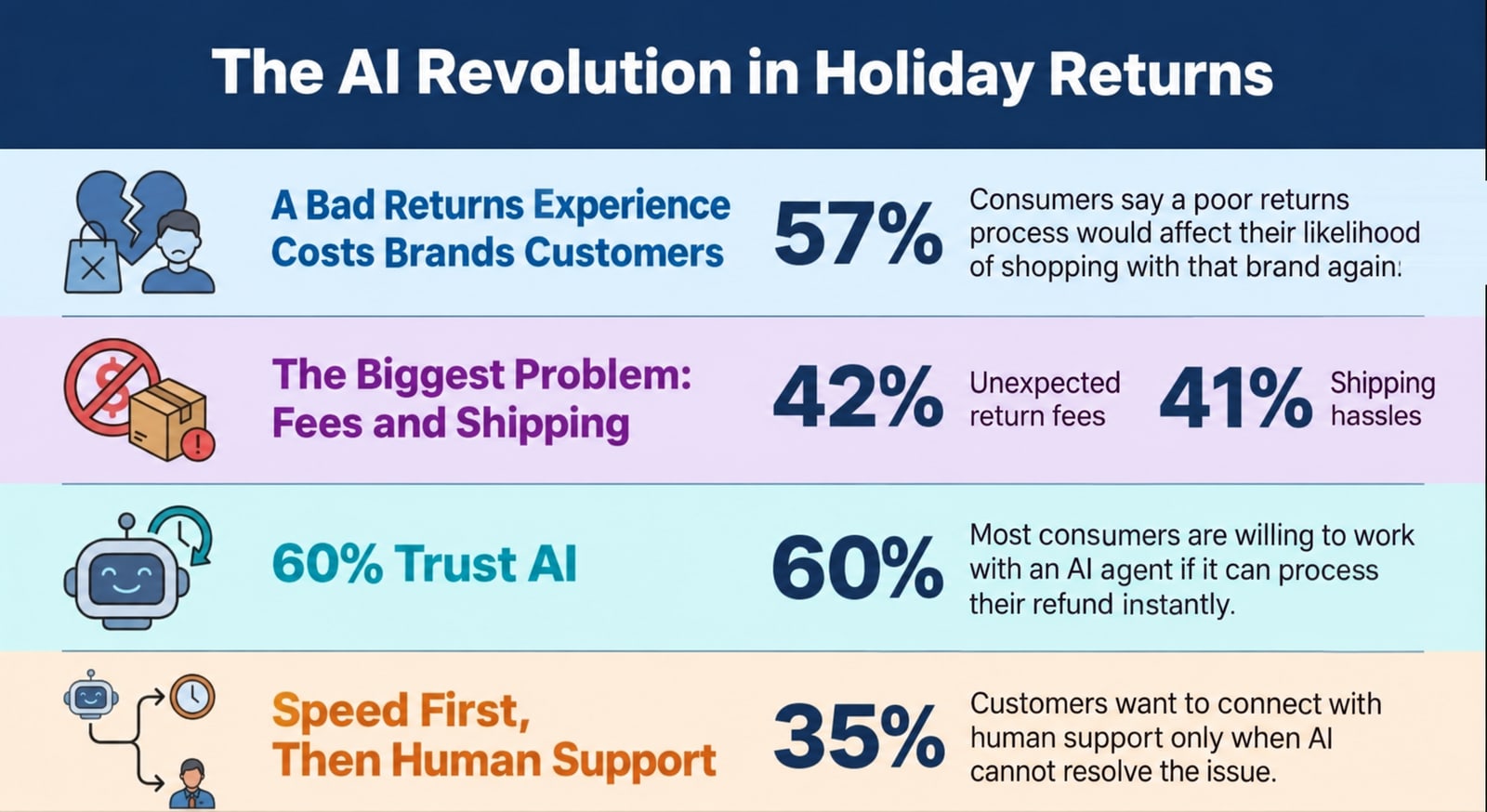
Source: Ada, 2026 holiday returns survey (1,000 consumers in the US).
Given the dynamics of the Turkish market, this picture matters even more. In an inflationary environment, the time value of money is vitally important to consumers. For Turkish customers, waiting days for a refund to show up on their card is not just a test of patience; it also creates a sense of economic loss. That is why the ability to issue instant refunds through AI-powered systems has the potential to become a far more powerful loyalty tool in Türkiye than discount campaigns. And given big-city traffic and how hard it can be to get to a carrier’s branch office, brands that digitize the process and complete it at the customer’s door will pull ahead of the competition.
But as we push the limits of technology, there is a fine line to tread. Consumers are willing to give AI a chance, but they leave no margin for error. When a bot fails to solve their problem on the first try or doesn’t understand the situation, 35% of customers want to reach a human right away, and 31% expect human support from the very start. Systems that lack transparency, trap customers in loops and block the handoff to live support risk doing more harm than good.
Ultimately, as 2026 unfolds, the returns process is evolving from an accounting task quietly carried out in the background into a stage on which the brand proves its reliability. The winners in this new era will not be those who try to lower return rates by making returns harder, but those who use technology to handle the process as quickly as possible and so smoothly that the customer barely notices it.
This piece was first published in Turkish in CX Bulletin on January 31, 2026. English translation.