The Cost of the Employee Experience Crisis: 20% Engagement and a $10 Trillion Loss
In light of the latest 2026 data from Gallup and Deloitte, discover how to reverse the steady decline in employee motivation and overcome the leadership crisis in the age of technology.
In a career spanning more than twenty-five years, I have witnessed many waves of corporate transformation, but today’s crisis is unlike any that came before. On every platform, we talk with great enthusiasm about technological revolutions and AI integrations. Yet the reality on the ground is far removed from these glittering presentations. While companies are investing in technology more than ever, the motivation of the people who will use that technology is quietly melting away.
The Silent Collapse: The Economic Cost of 20% Engagement
The Gallup State of the Global Workplace 2026 report, published in April 2026, lays this bitter truth bare. According to the report, global employee engagement has fallen to 20%, its lowest level in five years. This isn’t just a matter of low morale or office gossip; by Gallup’s calculations, this sweeping collapse in motivation is costing the global economy a massive $10 trillion in lost productivity.
There is a fundamental rule in customer experience strategy: a team that is unhappy on the inside cannot create happy customers on the outside. Today, many leaders tend to attribute this drop in employee motivation to remote work models or temporary fatigue. But the data pinpoints the problem far more clearly.
The Leadership Crisis: Manager Engagement Has Fallen to 22%
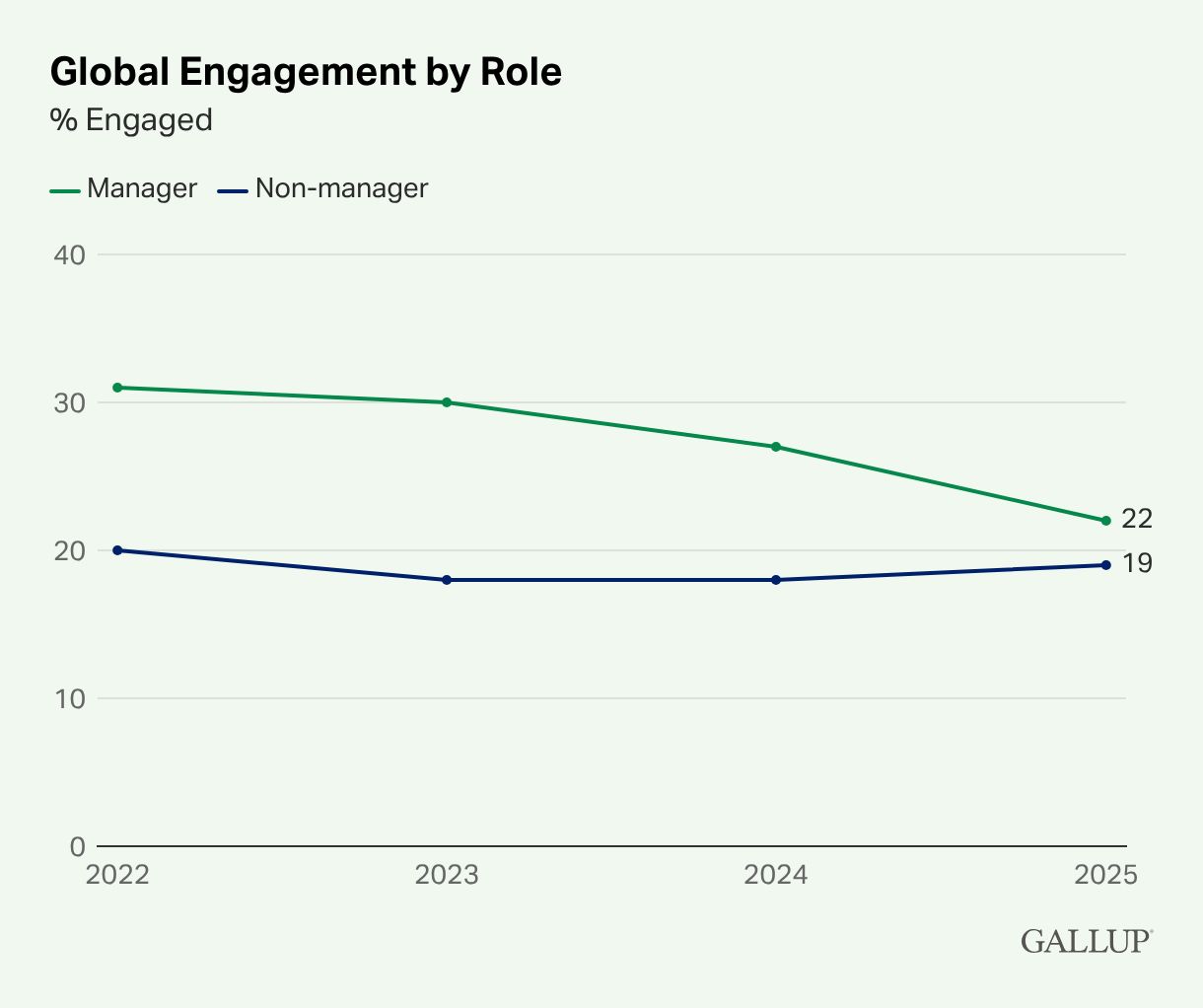
The most striking finding of the Gallup study is that manager engagement has fallen dramatically from 27% in the previous period to 22%. The very managers expected to inspire their teams, set direction and instill trust are themselves burned out. Seeking operational excellence through technology stacks without solving the leadership crisis is no different from trying to build a skyscraper without a foundation. This proves once again, beyond dispute, the lack of human-centered transformation we previously examined in detail in our newsletter analysis “AI in Customer Operations: Big Promises, Low Returns. Why?”. (This week’s articles focused on motivation and employee experience. As if by prior agreement, every report points to the same thing. I also highly recommend my articles The Missing Link in the AI Era: Motivation and Leadership in Workforce Transformation and From Invisible Crisis to Customer Loyalty: How Employees’ Financial Well-Being Shapes Customer Experience.)
Change Fatigue and Deloitte’s 2026 Reality Check
When the pace of technology starts to outstrip people’s capacity to adapt, organizational cracks become visible. Indeed, Deloitte’s 2026 Global Human Capital Trends research puts very clear numbers on the psychological pressure being felt on the ground. According to the report, the workforce has been left stranded in an uncontrolled storm of change, so much so that one-third of employees say they were hit by a full 15 major waves of organizational change in the past year alone.
These constantly shifting work demands and the expectation of nonstop adaptation are taking a heavy toll on employee well-being. Only 27% of the leaders surveyed believe their organizations can manage this change effectively. A management mindset that treats people like cogs in a machine and always expects them to go faster has run its course. In a climate where human-machine interaction and new ways of working haven’t been designed properly, expecting flawless adaptation and high motivation from employees is not a rational approach.
From Technology Stacks to Human-Centered Organizations
The solution lies in no longer seeing the workforce as a cost item or a dataset to be integrated into technology, and instead repositioning it as the organization’s most valuable asset. In an environment where trust has been shaken, managers are burned out and employees are being crushed under a technological deluge, rebuilding engagement is only possible by strengthening human bonds.
Leaders must address employees’ concerns through active listening, map out learning and development paths transparently and put psychological safety at the center of the organization’s culture. But as the data I’ve shared also shows, someone needs to look after leaders and support them, too!
Employee experience isn’t just about designing cool offices; it’s the art of preserving the meaning people bring to their work and their sense of being valued. Organizations that master this art and invest in their people rather than in technology are making a difference; those that don’t are bogged down in tactics instead of strategy.
This piece was first published in Turkish in CX Bulletin on April 16, 2026. English translation.