Customer Experience Starts on the Factory Floor
Unless factory data is tied to decisions on the floor, customer experience won’t be transformed.

We tend to look for customer experience on screens. In the app interface, the call center, the store, the delivery message or the loyalty program… But what customers actually experience often begins much earlier: on the factory floor.
Whether a product arrives on time, whether quality problems keep coming back, whether spare parts are available, whether service times drag on, whether operations keep the promise the sales team made… All of this is part of customer experience. Customers simply don’t see the factory behind it.
That is why McKinsey’s May 1, 2026 analysis of factory transformation is in fact valuable not only to operations leaders but to anyone who cares about customer experience. Real transformation in factories comes not from installing digital tools one by one, but from building a continuous learning system that connects data, capabilities, technology and action on the floor. In McKinsey’s survey of more than 100 manufacturing COOs, 74% of executives said their company has a global production system, yet only 29% said it is fully implemented across all sites. What’s more, not one respondent said they had fully integrated advanced analytics, AI or generative AI into their decision-making.
In many companies, production transformation gets stuck at one of two extremes. Either each site runs its own pilot, its own dashboard and its own improvement project, and the result is a set of disconnected islands. Or headquarters hands down rigid standards without really understanding the reality on the ground. The first never scales; the second never builds ownership. Both are missing the same thing: a living feedback loop between insight and action.
One of the most valuable ideas in McKinsey’s article is this: a real production system is about more than having the same standards everywhere. Performance data has to make visible what matters, that insight has to turn into priorities and routines on the floor, and results have to flow back into the system quickly. Only then does learning accumulate across sites and transformation stop being a one-off project.
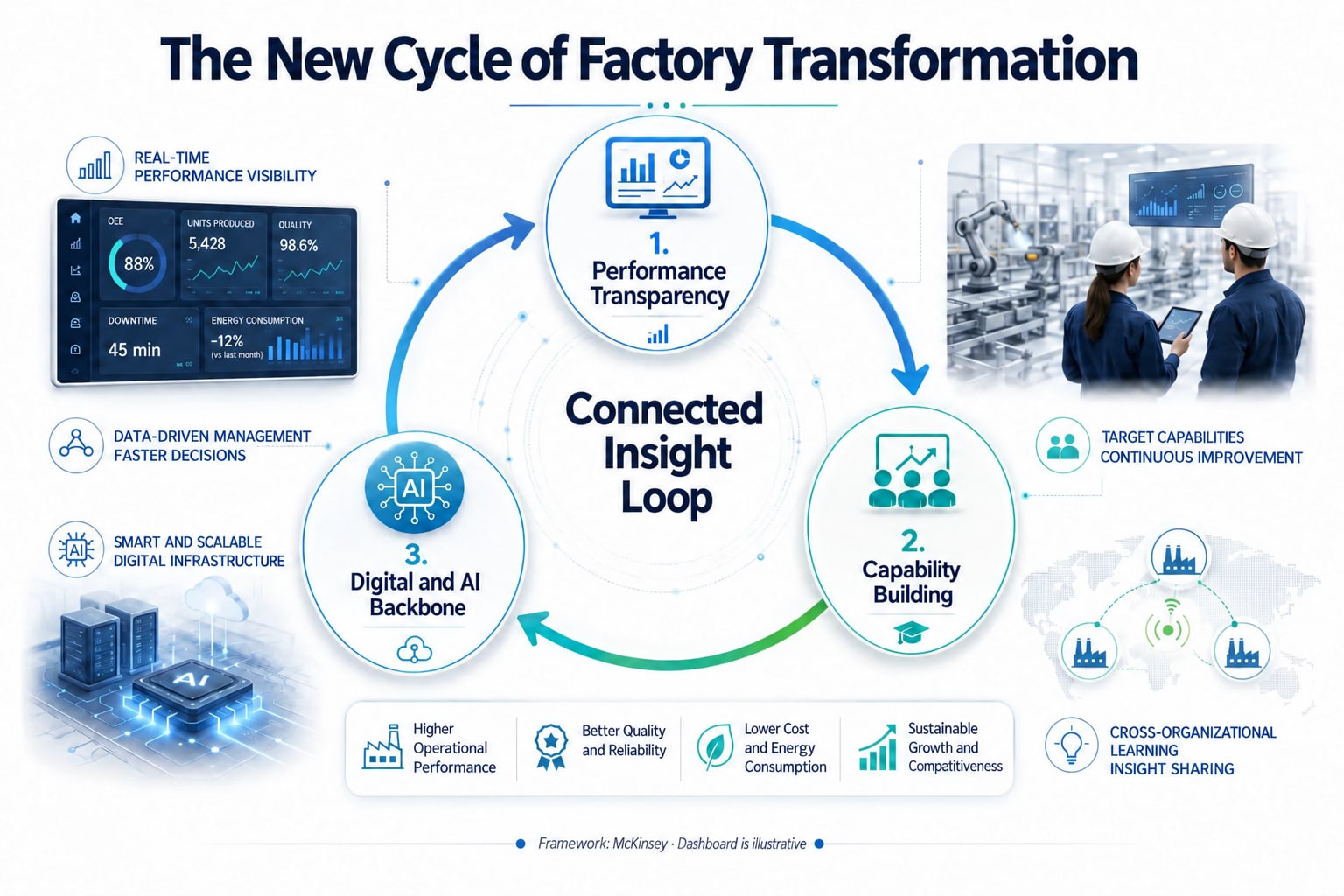
Manufacturing excellence is no longer a one-off project; it is a continuous system in which data becomes action and action becomes learning.
This article reminded me of the Soviet Union’s 1960s dream of digitally linking its factories. (In fact, Emrah Safa Gürkan’s Omnibus channel on YouTube recently took up this very subject. I recommend it to anyone curious.) Yes, the internet might have emerged first in the Soviet Union. OGAS, proposed by Viktor Glushkov, aimed to connect factories and enterprises to a central data-processing network. In its most ambitious form, it would have consisted of one central hub, about 200 mid-level computing centers and up to 20,000 terminals, turning the planned economy’s slow, paper-based flow of information into a nervous system running at the speed of electricity.
In theory, it was a fascinating idea. Data would flow in from the factories, the center would make better decisions, resources would be allocated more efficiently, and planning errors would decline. But the real lesson of the story is not technological. It is institutional.
What stood in the project’s way was not just computing power, cabling or software. Rivalry between ministries, fights over funding, the reflex to protect the status quo and internal conflicts of interest weakened it from within. In academic circles, it is a failure often pointed to in debates over when the Soviet Union’s collapse began…
For today’s companies, this is very much a live issue: there are dashboards, there is data, there is an AI pilot, there is a transformation office; yet the system still isn’t fully connected. Sales says one thing, production wrestles with a different reality, the supply chain pushes ahead with its own set of priorities, and customer service is left trying to clean up the damage all these disconnects cause for customers.
Seen this way, the production system is not the back room of customer experience; it is the load-bearing pillar of the customer promise.
I reached the same conclusion when I wrote earlier about ROI on customer experience investments: an investment in experience can’t be justified simply by saying “customers love us.” It has to be tied to business results. On the production side, that link is even more concrete: fewer errors, shorter cycle times, better quality, more reliable delivery, lower costs and less customer effort.
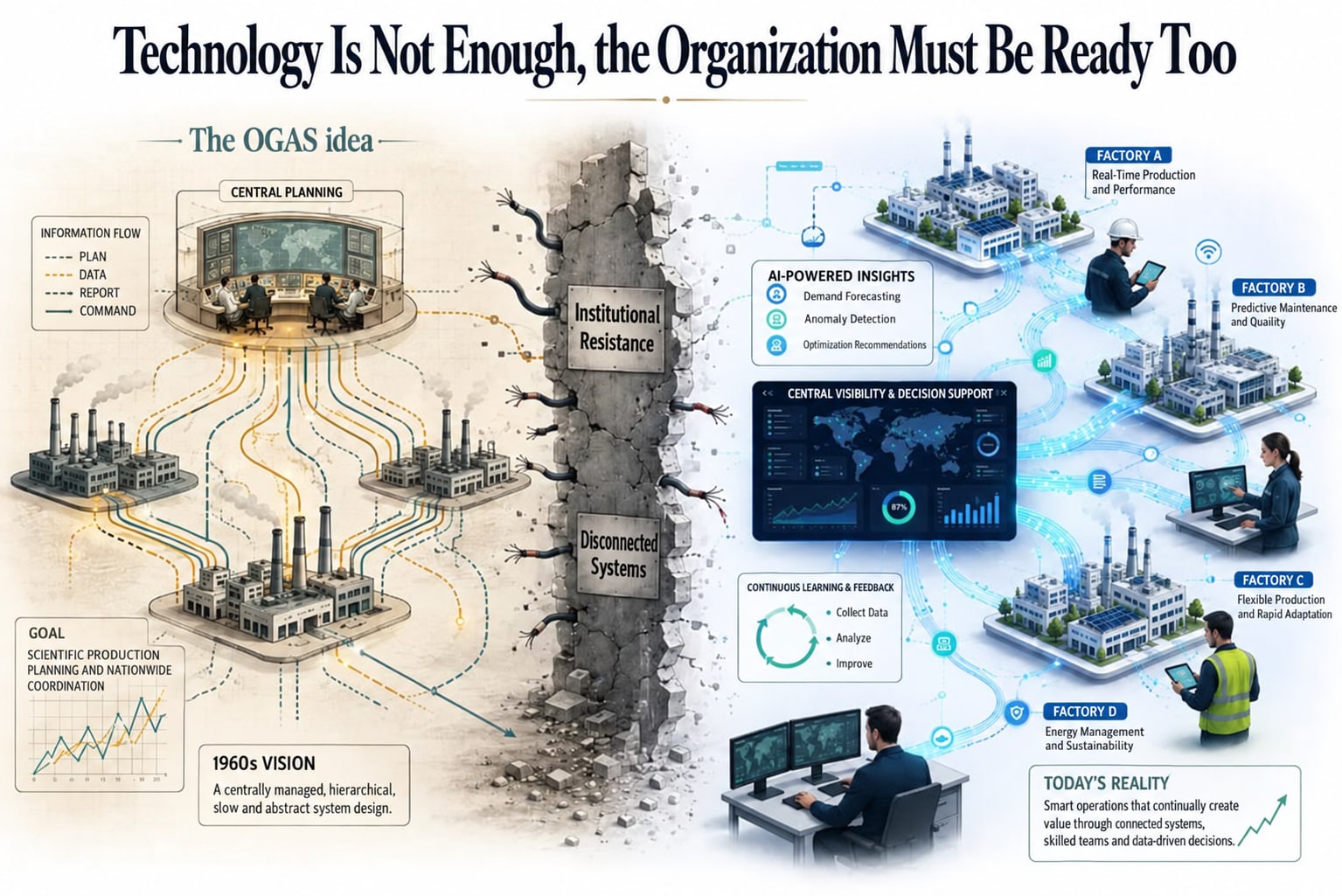
A technology vision alone is not enough. If a network linking factories is to work, organizations must also be ready for visibility, collaboration and shared learning.
That is why the first step McKinsey proposes is not technology but transparency. First you have to see where each site really stands. When operational, cultural and digital maturity aren’t measured in the same framework, every site tells its own story. And headquarters struggles to work out which of those stories is real and which is a defense mechanism.
One of the examples in the article is especially instructive here. A multinational consumer goods company runs a structured diagnostic across 15 sites. The results expose significant differences in core areas, from maintenance routines to performance ownership. At a global pharmaceutical company, site-level differences in equipment effectiveness and problem-solving maturity come to light as well. In other words, performance gaps often stem not just from machines, budgets or technology, but from the discipline of daily management.
The link to customer experience here is very clear. If a company can’t see which quality problem keeps recurring at which site, which line is causing delays, or which process is generating customer complaints, it can’t manage the promise it makes to its customers either.
When a customer asks, “Why did my product arrive late?” the answer behind the scenes is often not a logistics explanation but a systems one. The data didn’t flow. The problem didn’t become visible. The learning wasn’t carried over to another site. The same mistake happened again.
Years ago, while working for a retail giant, I would sit down with factory, production quality control and product management teams, among others. Using an algorithm I had built for customer insight analysis, we tried to identify the “usual suspects” among the products, and we usually caught them with a high degree of accuracy. Products that had somehow slipped through every check but were defective and could cause a serious customer experience problem were put through another, very strict quality inspection, and if they failed it, we quickly pulled them from sale. It was a simple but highly effective process, and it brought a meaningful improvement in customer experience.
That is why production transformation is not just on the COO’s agenda. It is something CX leaders should follow closely, too, because the consistency customers experience depends on how consistently the company learns internally.
The second step is capability. Here, too, McKinsey points to an important misconception: making performance gaps visible doesn’t mean people will automatically do the right thing. Many companies think the job is done once the training has been delivered. Some hand out playbooks but don’t design how those playbooks will feed into day-to-day decisions. The result: capability varies from site to site, improvement rests on the shoulders of a few strong individuals, and when they leave, the gains melt away.
According to McKinsey, effective transformations take capability building out of the classroom and embed it in the flow of work. Operators, engineers and supervisors learn by working on real problems. The playbook stops being a document sitting on a shelf and becomes part of the daily management rhythm. At one consumer goods company, this approach delivers a productivity gain of about 25 percent at the pilot sites. At two different companies, shared digital platforms make performance gaps visible across 15–20 sites, and within a few months more than 3,000 users are brought together around a common language of improvement.
This is the same core issue that comes up when we discuss why AI investments in customer operations fail to deliver the expected results: technology alone doesn’t create transformation. If the way people do their work doesn’t change, the new tool simply becomes an expensive layer on top of old habits.
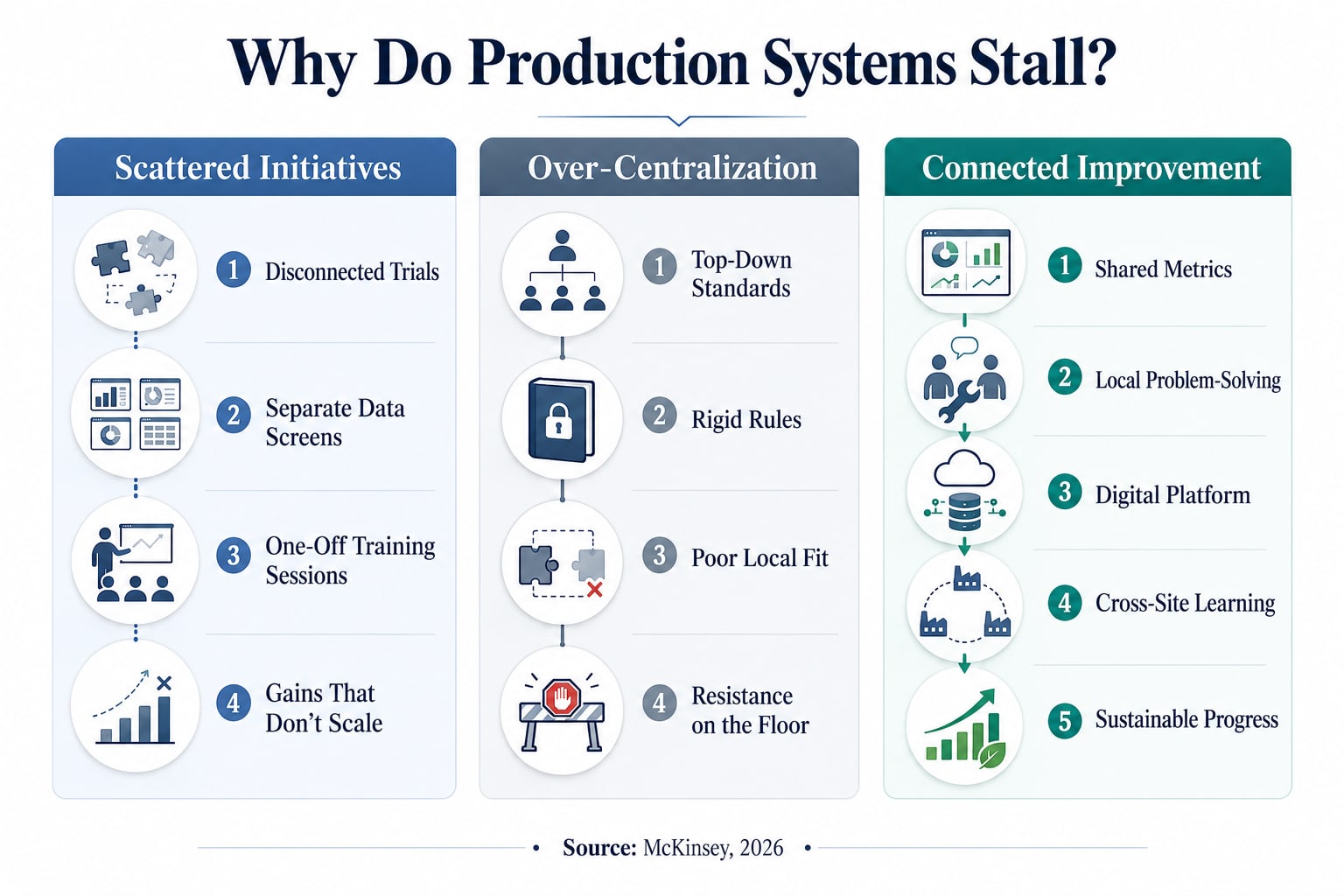
Most transformations get stuck either in disconnected pilots or in over-centralization. Lasting progress comes from shared measurement, local ownership and connected learning.
The third step is digital tools and AI. But here, too, the point isn’t to say “let’s use AI.” What matters is where AI sits within the production system.
According to McKinsey’s article, 88% of organizations say they use AI regularly in at least one business function, 23% are scaling agentic AI somewhere in the organization, and 39% are experimenting with AI agents. Yet in the COO survey, the share of companies that have fully embedded AI in their production operations is just 2%. In other words, talk of AI is widespread, but AI built into the backbone of the production system is still rare.
That distinction is critical for customer experience, too. As long as AI remains confined to a secondary screen, a pilot or a presentation topic, it doesn’t transform the experience. But once it enters the decision flow, from visual anomaly detection to route planning, and from predictive maintenance to drafting improvement plans, the outcome customers experience changes.
In McKinsey’s examples, some automotive and defense companies use agentic AI for visual anomaly detection and autonomous routing/scheduling; intelligent workflow agents can cut cycle times from days to hours. By combining AI-powered insights with human expertise, a chemicals company completes the move from diagnosis to implementation at three major sites in about ten months, whereas such journeys used to be measured in years. A consumer goods company, meanwhile, brings digital dashboards, best-practice libraries and generative AI–powered assistants together on a central platform.
The customer experience payoff here is very direct: fewer delays, fewer quality deviations, more consistent service levels, less customer effort.
This is especially visible in industries like automotive. When I wrote earlier that in automotive, customer experience is won after the sale, I stressed the same thing: customers choose a brand in the showroom, but it is through service, parts, software, warranty and ownership that they decide whether they can truly trust it. In the customer’s eyes, disconnects in production and operations turn into the feeling that “this brand keeps giving me a hard time.”
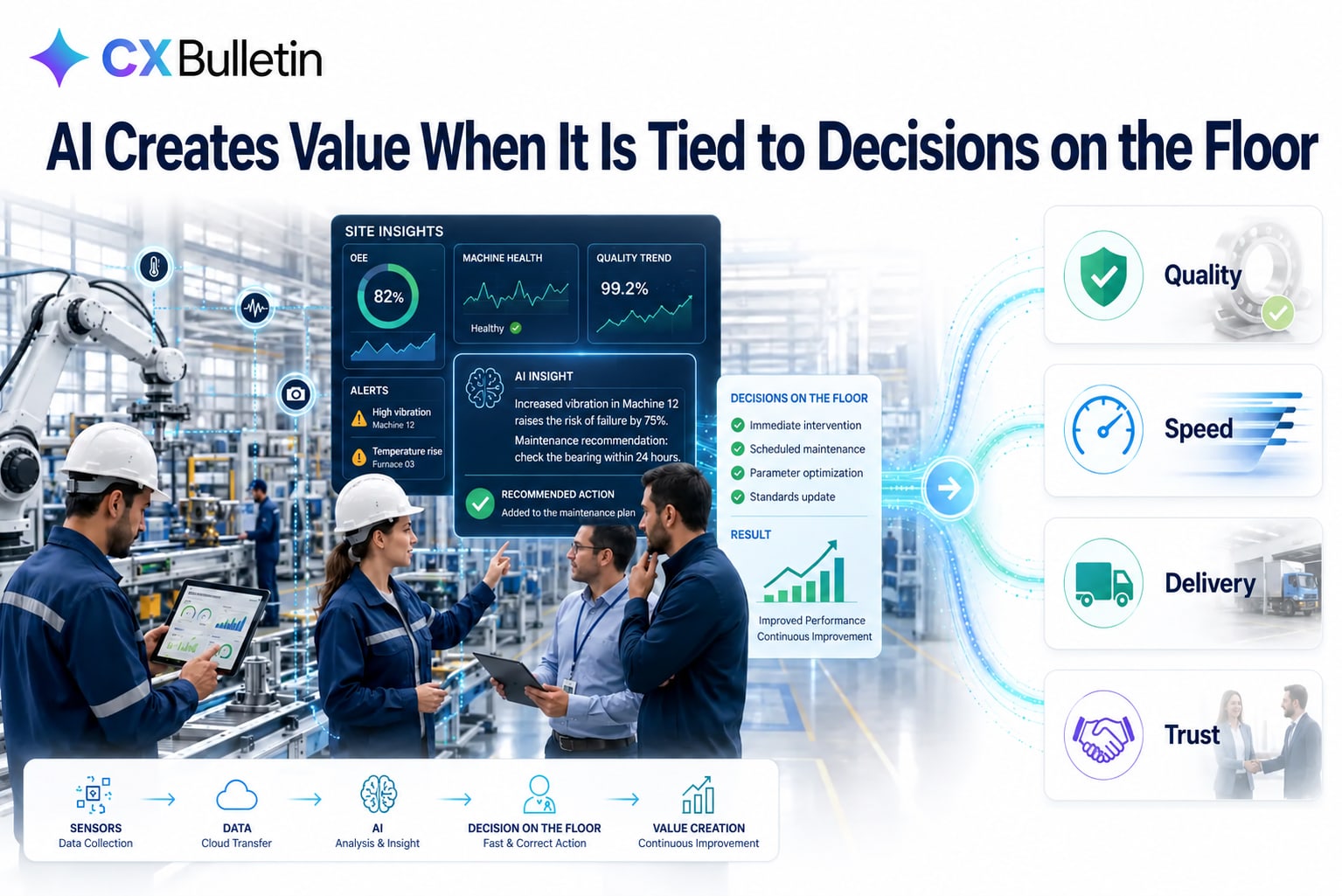
In manufacturing, AI improves the quality, speed and reliability customers feel only when it is tied into the decision flow on the floor.
The financial impact of this transformation is also far from trivial. In the examples McKinsey cites, a global industrial manufacturer raises production capacity by 40–50% through such changes. A life sciences company in Europe achieves more than $60 million in cost reductions across its network in a single year with a redesigned production system. And in one consumer goods example, the new approach brings a 15–20% cost reduction and employee satisfaction above 85%.
But I don’t read these figures as operational wins alone. They are customer experience outcomes, too.
If production capacity goes up, customers don’t wait.
If costs come down, the company can make sounder trade-offs between price and service quality.
If employee satisfaction rises, people on the floor bring more energy to solving problems.
If quality deviations decline, customers have fewer run-ins with the brand.
In other words, factory transformation is an investment in experience: customers never see it, but they feel its results very clearly.
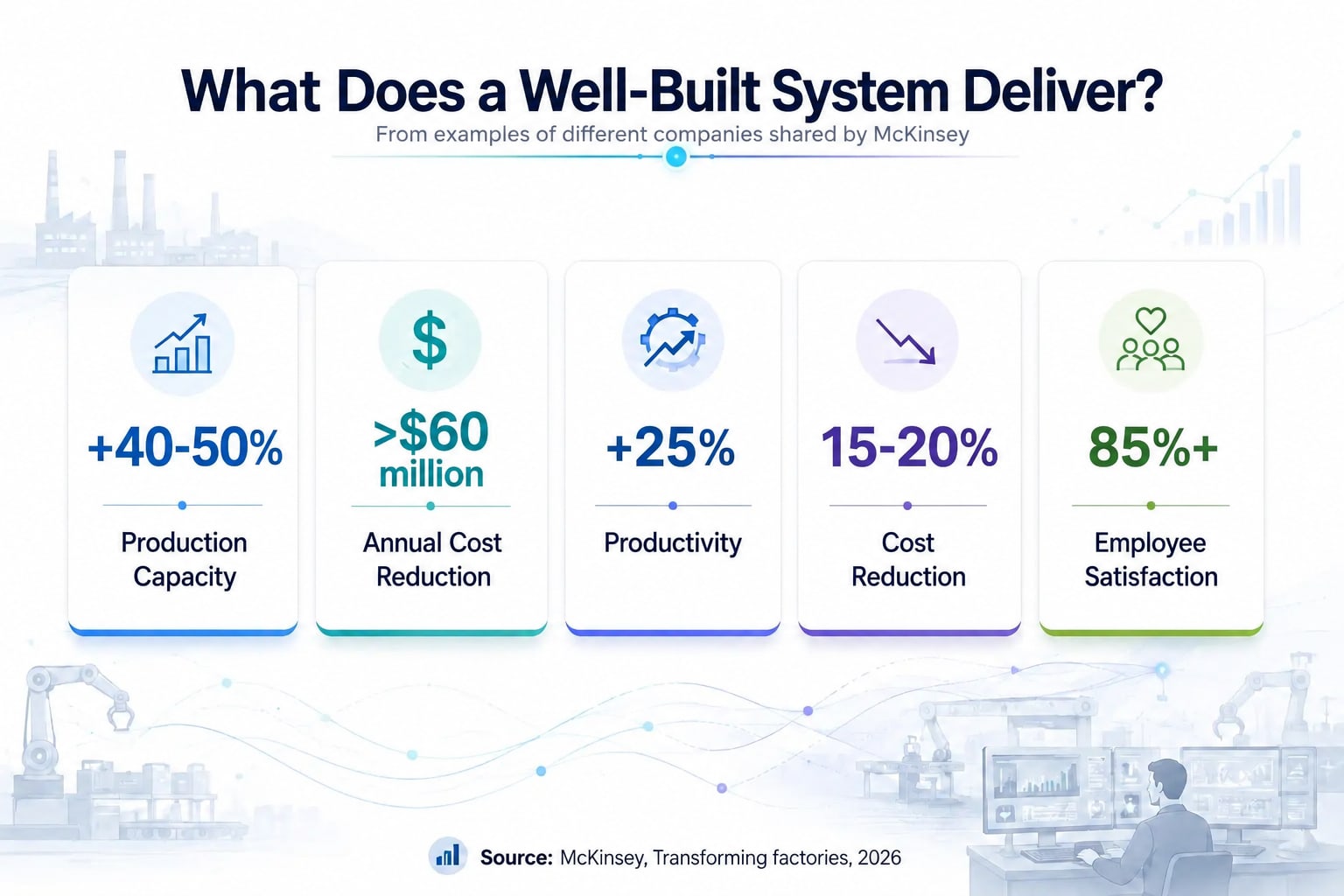
A well-built production system delivers results that reach customers through speed, quality, cost and employee experience.
In its final section, McKinsey arrives at a critical concept: governance.
Once a production transformation has achieved its first successes, the biggest risk is sliding backward, because people change, priorities change, technology changes and markets change. If the system isn’t fed by regular maturity assessments, peer learning, digital communities and cross-site coaching, the transformation gradually loses out to old habits.
This is very familiar in CX, too. Improving a customer journey once is not enough. That journey has to be monitored continuously, refined through what is learned, and carried over to other touchpoints. Otherwise, the experience is once again left to the goodwill of individual departments.
The same holds in manufacturing. Excellence can’t be sustained by the heroics of a single factory. It lasts when the system turns learning into an organizational reflex.
That is why there is a stronger link than you might expect between production systems and the question of CRM becoming the memory of customer experience. If CRM holds the memory on the customer side, a connected production system holds the memory on the operations side. When the two don’t come together, the company knows its customers but can’t keep its promise. Or it runs its operations but can’t see how they play out for the customer.
And here is the crux: if the data flowing inside the company isn’t connected to what customers actually experience, the transformation remains incomplete.
The Soviet Union’s story leaves us with a stark warning: even the most brilliant technology vision comes to life only to the extent that institutions are able to work together. McKinsey’s framework for production transformation today shows the positive side of that warning: when a shared reality, capabilities embedded on the floor, well-positioned AI and active governance come together, the production system can become a network that truly learns.
Customers don’t see this on a dashboard. But they see it when their order arrives on time. They see it when the product causes fewer problems. They see it when the service process is less exhausting. They see it when the brand keeps its word.
That is why customer experience doesn’t begin only at the touchpoint.
Sometimes it begins with a small deviation on a production line.
Sometimes with a slip in a maintenance routine.
Sometimes with one factory failing to learn what another has already learned.
And sometimes with data that no one inside owns, coming back to the customer as a problem.
The strong companies of the future won’t simply be the ones that buy more technology. The ones that stand out will be those that can turn data into behavior, behavior into learning, and learning into value that customers can feel.
After all, customer experience is a team sport! And we can only say the experience is improving when the whole organization is learning together…
This piece was first published in Turkish in CX Bulletin on May 12, 2026. English translation.