Lost Momentum and the Coming Storm
A serious storm is looming on the horizon for customer experience.

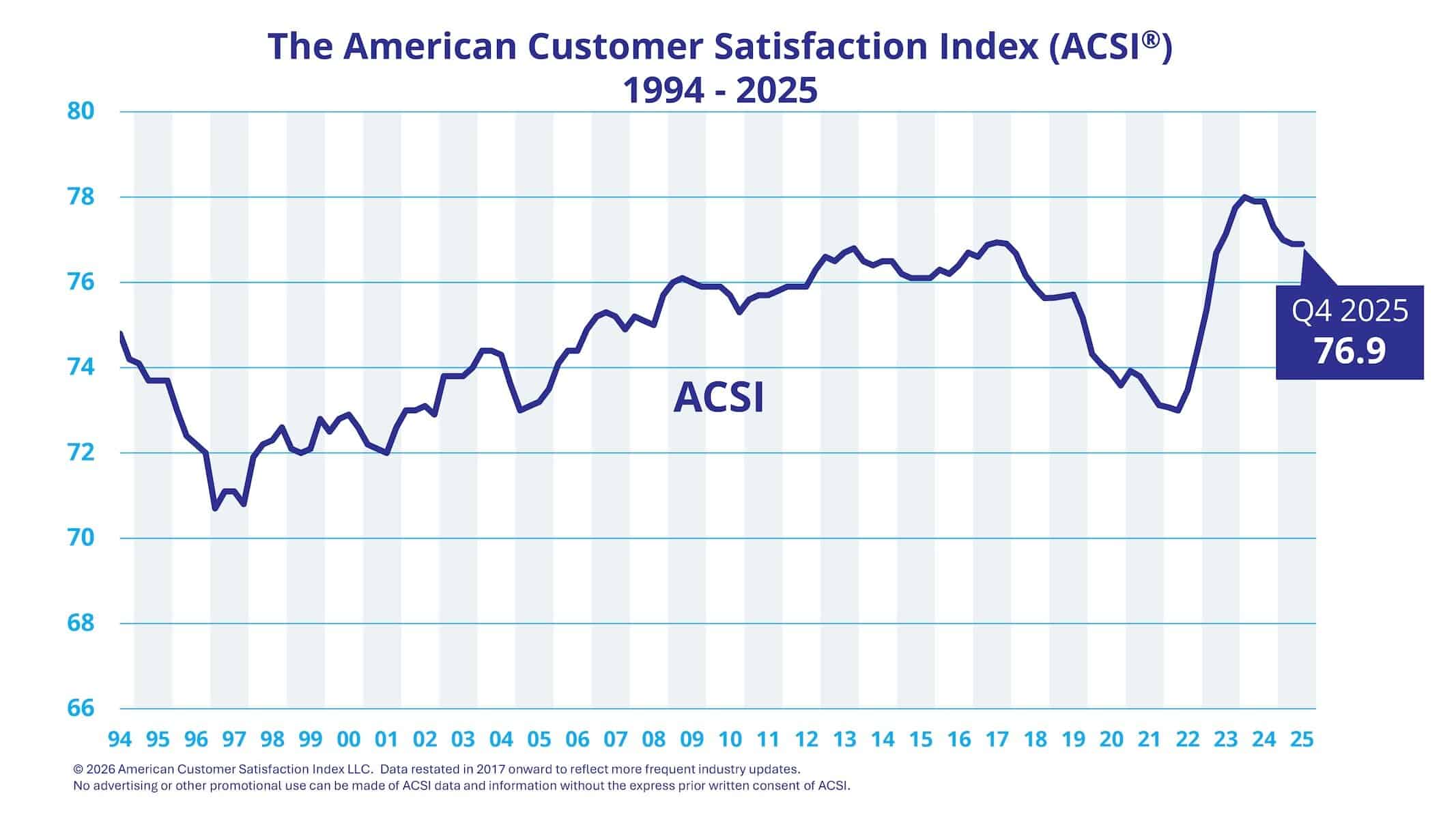
A serious storm is gathering on the horizon for customer experience. It is fair to say that the American Customer Satisfaction Index results for the fourth quarter of 2025 show only the tip of the iceberg. The national satisfaction score has slipped to 76.9. At first glance, this might look like stagnation, with the index showing no meaningful increase since 2017, but when we dig deeper into the data, we find a far more unsettling picture. After climbing to around 78 in 2023 and 2024 in the wake of the pandemic, the index failed to hold on to that tremendous momentum, turned downward again and fell back into its old range.
The fact that customer satisfaction has slid back down from its peak while companies keep reporting record profits points to serious dysfunction in the market. This situation, which researchers call pent-up customer churn, remains hidden for now because of high switching costs and a lack of competition, but once those barriers come down, a massive wave of losses is only a matter of time.
When we look at the index’s industry breakdowns, what stands out is how quickly the distance between the best and the rest is closing. From 1999 to 2019, the gap between the highest- and lowest-scoring companies in the index exceeded thirty points almost every year; since 2020, it has narrowed to around twenty-seven to twenty-eight points. Leaders turning to purely cost-driven strategies and shelving customer-facing innovation are eroding the unique competitive advantage they once enjoyed. In industries such as specialty retail, fiber internet and car rental, top brands are losing ground while lower-ranked companies improve their performance, producing a convergence toward the average, with both ends effectively meeting in the mediocre middle.
Of course, some brands avoid this commoditization trap and refuse to settle for average. Retail giants such as Costco, Trader Joe’s and Sam’s Club manage to push their satisfaction scores above the retail sector as a whole by understanding their own target audiences very well. Costco’s model, whose impact we also see clearly in the Canadian market (If you haven’t read our article on Costco, don’t miss it.), is about far more than just low prices. The quality standard of its private-label brands and the strong sense of belonging created by its membership model form the real loyalty engine that keeps customers coming back. Companies that keep their focus like this are able to protect themselves from the slide toward mediocrity.
When we read this data alongside the dynamics of the Turkish market, an even more pressing risk emerges for local brands. In Türkiye, high inflationary pressure means frequent price increases, yet there is no comparable improvement in the service experience on offer. It is effectively a relationship of necessity, and it is laying the groundwork for a storm of pent-up customer churn. Players that enter the market with a disruptive vision and truly hear the voice of the customer could, within months, upend the market shares that established brands stuck in the middle have relied on for years. Leaders who want to protect their competitive advantage should stop burying themselves in cost spreadsheets and focus instead on giving customers genuine reasons to stay with the brand.
This piece was first published in Turkish in CX Bulletin on February 24, 2026. English translation.