What Do the 2026 Employee Trends Tell Us?
We are living through a time when technology, digital transformation and AI are shaking the way we do business to its core. Everyone has the same question on their mind: How can we make the value we deliver to customers more memorable, more seamless and more profitable?

There’s no need to look far for the answer. Published by Qualtrics and based on the responses of roughly 34,000 employees in 24 countries, the 2026 Employee Experience Trends report shows very clearly that every tremor we feel on the customer side actually stems from a fault line rupturing inside our own organizations.
The Change Paradox: Technology Energizes, Organizational Turmoil Drains
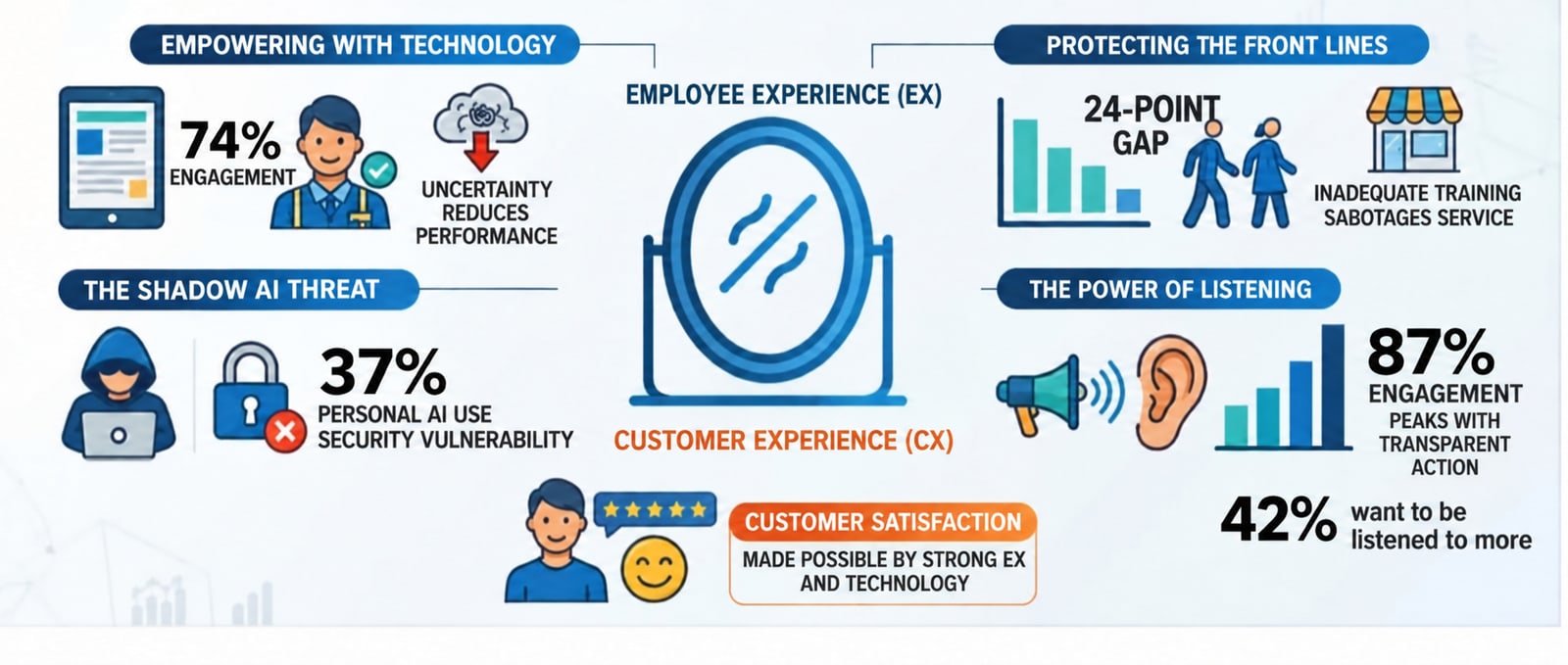
As leaders, we tend to assume that change wears employees out. Yet the data fundamentally refutes this assumption. Far from frightening employees, changes that modernize the organization, such as new technologies, AI tools and workflow optimizations, actually boost their energy. According to the report, engagement among employees who experienced significant change over the past year stands at 74%, while engagement among those working in a static environment remains at 59%.
What is truly destructive is not change itself but its source. Layoffs, restructurings that lack vision and constant turmoil in management do deep damage to employees’ bond with the organization. Concern about the future is growing by the day, especially among employees with five or more years of tenure, who carry the organization’s cultural memory. Managing change isn’t just about rolling out new software; it’s about making the people who will use it more confident in their future at the organization.
AI is no longer a vision; it is a reality at the very heart of daily operations. More than half of employees actively use AI, saying it improves the quality of their work, helps them produce faster and enables them to do work they couldn’t do before.
But there is a massive blind spot here that should keep leaders up at night. Of employees who feel heavy pressure to be productive, 37% find the approved tools their organizations provide inadequate and turn to their own personal AI solutions. This phenomenon, which we call shadow AI, isn’t just a compliance problem; it also means corporate data, and above all customer insights, leaking out unchecked. When we ask more of employees without giving them the right, secure tools, we end up sabotaging our own corporate security.
The Cost-Cutting Fallacy: Lose the Front Line and You Lose the War
As organizations turn to part-time or flexible work models to optimize costs, it is the customer who pays the heaviest price. Frontline staff who deal directly with customers are seeing dramatic declines in job satisfaction. The share of frontline employees who say they receive feedback that helps them improve their performance fell 7 percentage points in a year, to 63%.
Here is one of the report’s most striking findings. When asked about the root causes of bad customer experiences, both consumers and the frontline employees who serve them point to exactly the same two problems: a lack of communication and errors in service delivery. In other words, whatever your employees go through inside, your customers experience the same thing outside. For new hires, the situation is far worse, and the honeymoon period is officially over. Among those who have been with the company for less than a year, the share who intend to stay at least three years is 24 percentage points lower than among more tenured employees (40% vs. 64%).
The remedy for all these crises is actually remarkably simple, and just as remarkably rare in practice: 42% of employees want their companies to listen to them more often. In organizations where employers increase how often they listen, employee engagement reaches an incredible 87%. But listening isn’t just about sending out periodic surveys. While 85% of senior leaders say they see positive changes as a result of surveys, that figure plunges to 48% among individual employees. There is a vast gap in perception and communication.
In the competitive world of 2026, standing out in customer experience naturally starts with understanding your own people, investing in them and positioning technology tools to safely unlock your people’s potential. If you can’t win a battle inside, you’ll never win it outside, in the customer’s heart.
It feels as if employee experience has lately been neglected more than ever, practically ghosted. What do you think?
This piece was first published in Turkish in CX Bulletin on March 11, 2026. English translation.