Turkish Airlines and Samsung Usher In a New Era of Baggage Tracking: A 700-Million-Device Network in Your Pocket
The unmatched peace of mind that comes from knowing your suitcase's whereabouts is now just a tap away.
A Technological Answer to Travel Stress
The anxious wait at the airport baggage carousel can spoil even the most enjoyable trip. Driven by a vision of eliminating this common stress and digitalizing the passenger experience, Samsung and Turkish Airlines have entered into an innovative partnership. Called the “Smart Tagged Baggage Service,” the system promises travelers a smarter, stress-free journey.
3 Key Features That Set This Partnership Apart
Here are three important details that make this partnership and the “Smart Tagged Baggage Service” so special:
1. Not Just a Tag: A Global Network of 700 Million Devices
At the heart of the system are Samsung’s SmartThings Find service and the Galaxy SmartTag2 tag attached to your suitcase. But what is truly impressive is the power behind the service: a vast network of more than 700 million Galaxy devices worldwide. Thanks to this global network, which uses Bluetooth Low Energy (BLE) and ultra-wideband (UWB) technologies, travelers can securely locate their belongings “anytime, anywhere.” This feature turns a small tag into part of a massive global tracking system that gives you constant peace of mind.
2. Personalized Control: A Photo of Your Suitcase in the Palm of Your Hand
The service is remarkably easy to use. With the “Change Device Image” feature in the SmartThings Find app, travelers can save a photo of their own suitcase to the system. This simple but clever detail makes a lost suitcase far easier to identify. The real breakthrough, however, is the passenger’s active participation in the process. If a bag goes missing, passengers can add a link containing location data to their lost baggage reports. This allows Turkish Airlines to recover the suitcase much more efficiently, speeding up the process significantly.
Jaeyeon Jung, Vice President of Samsung Electronics and Head of SmartThings, sums up the partnership as follows:
“Samsung is expanding the SmartThings Find experience through cross-industry partnerships to help its customers stay connected and at ease wherever they are. We are pleased to work with Turkish Airlines to deliver a more relaxed and seamless travel experience.”
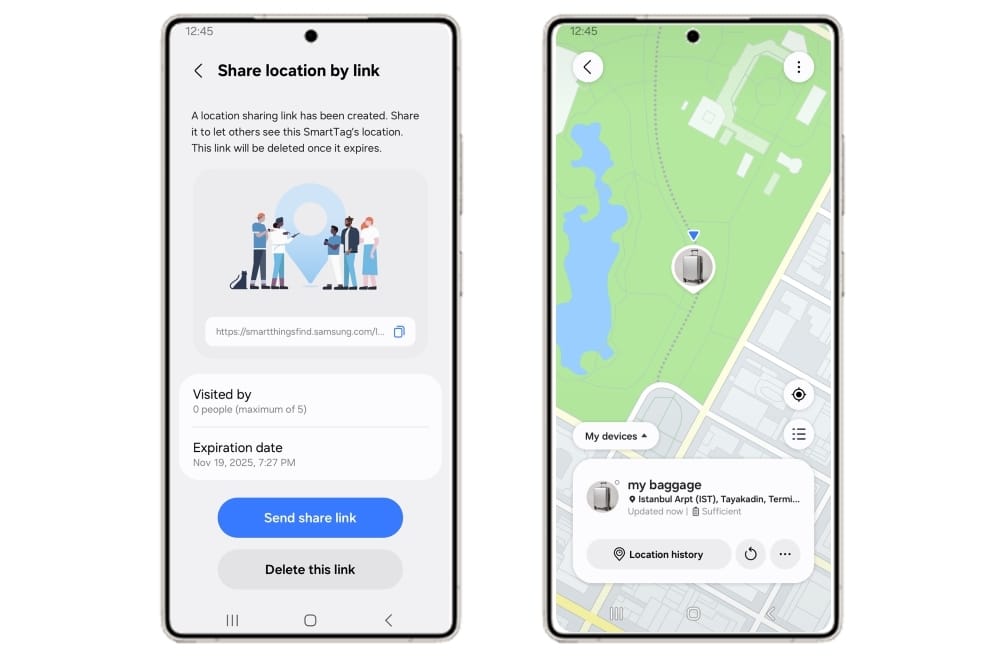
Users who save a photo of their Galaxy SmartTag-equipped luggage in the SmartThings Find app can check the location of their lost baggage.
3. This Is Just the Beginning: AI-Powered Travel of the Future
The partnership between Samsung and Turkish Airlines not only solves the lost baggage problem but also represents an important step in digitalizing the passenger experience. Turkish Airlines aims to take the SmartThings Find service beyond baggage tracking and use it in other areas of customer service as well. The real vision, however, is to build a long-term collaboration with Samsung to drive innovation in customer experience through AI-powered devices and software solutions.
Kerem Kızıltunç, Deputy General Manager of Information Technology at Turkish Airlines, explains this vision as follows:
“Turkish Airlines continues to lead the industry on the path to digitalization. We are delighted to partner with Samsung to harness the latest technologies for the benefit of our passengers. We will continue to strengthen our industry leadership through technology partnerships that prioritize guest satisfaction and set new standards for the aviation industry.”
Editor’s Note:
Beyond being a concrete example of how technology can eliminate one of the travel industry’s biggest worries, the Samsung and Turkish Airlines partnership sends an important signal about the future of integrated travel ecosystems. By setting a new standard for airline-technology partnerships, it opens the door to a future in which everything from your suitcase to your flight information is managed seamlessly on a single platform.
So how much more do you think technology will change our travel habits in the future?
This piece was first published in Turkish in CX Bulletin on December 10, 2025. English translation.