The Customer Experience Revolution in Utilities: How a KPMG Publication Prompts a Rethink of the Sector
Insights from the "Understanding the Energy Transition" event with experts from BP, Yorkshire Water and KPMG
There’s a paradox I’ve observed in customer experience for a long time: the sectors that deliver the most critical services usually end up last in line for CX transformation. Electricity, water, natural gas — the services that make up the infrastructure of everyday life — fit squarely into this pattern.
KPMG UK’s recent Understanding the Energy Transition event both confirmed this pattern and set out the prescription for changing it. Des Johnson, BP’s former Vice President of CX and Digital Product Delivery; Nicola Harris, Head of CX at Yorkshire Water; Duncan Knight, Head of Front Office at KPMG; and the event’s host, Laura Sharp, a director in KPMG’s Customer and Digital practice, discussed where the sector stands and where it’s heading with striking clarity.
Expectation Inflation: The Private Sector Raises the Bar for Everyone
Des Johnson summed up the expectation dynamic with a particularly apt observation: “As a customer, your minimum expectation is set by your last great experience. That becomes what good looks like.”
This observation captures the phenomenon known in the customer experience literature as “expectation inflation.” In my piece for HBR Türkiye, I framed this dynamic as follows: the seamless digital experiences consumers get from the private sector directly recalibrate their expectations of public services as well. When a citizen finds an instant solution on an e-commerce platform, they expect a similarly smooth experience from the channel they use to report a power outage. This expectation no longer squares with traditional assumptions such as “that’s just how public services work.”
KPMG’s Global Customer Experience Excellence 2025–2026 research, conducted with more than 80,000 consumers across 16 markets, lays this reality bare as well: the utilities sector is trailing badly.
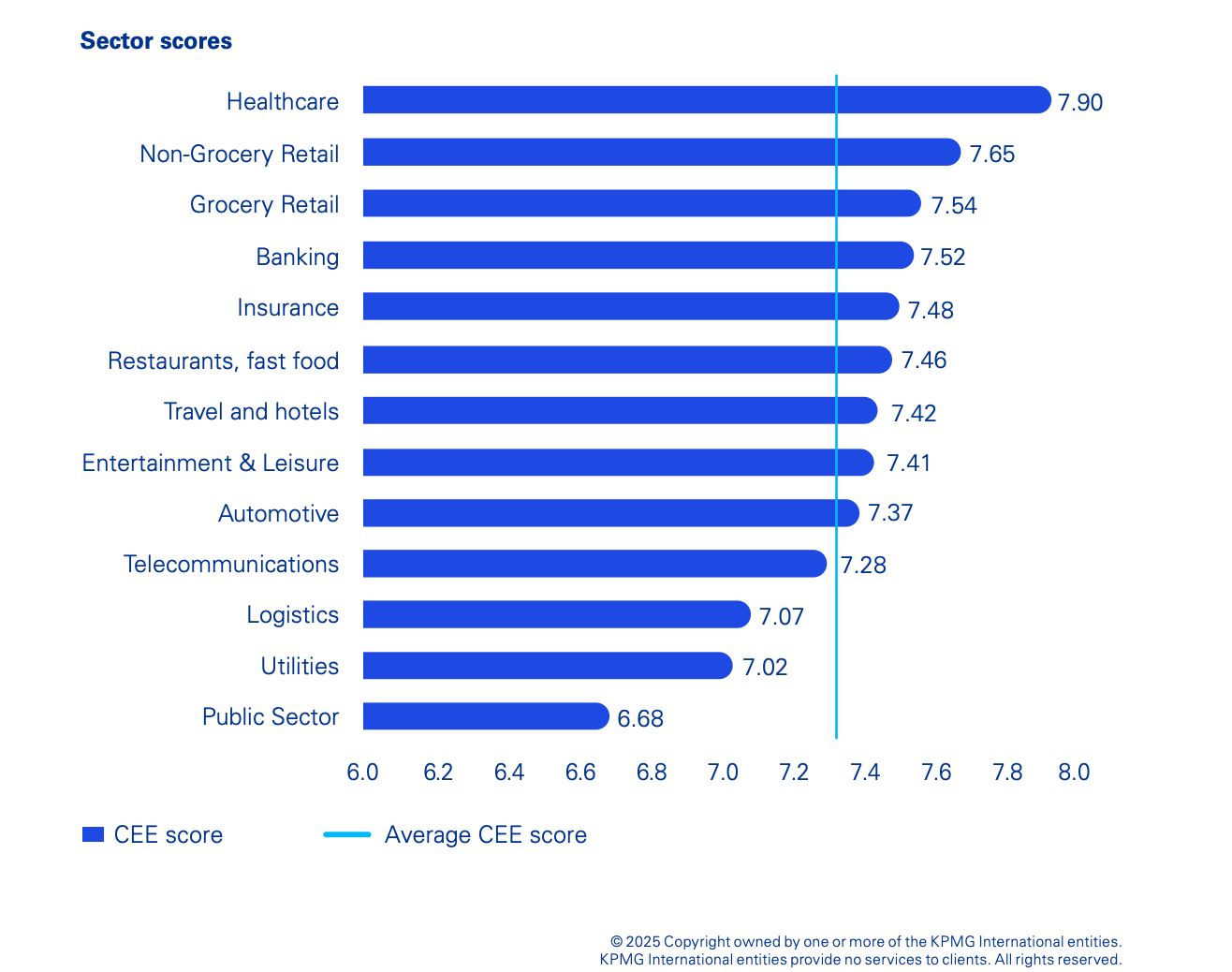
Source: KPMG, Global Customer Experience Excellence 2025–2026
This isn’t a curse; it’s an opportunity. When the starting point is low, a well-designed initiative can have a dramatic impact. Indeed, according to KPMG’s Australia report, the utilities sector recorded a 2.6% year-over-year improvement in 2025; strong emotional support, clearer service pathways and digital tools that increased transparency were the main drivers of that gain.
Laura Sharp and KPMG’s Framework: More Than a Report
The event’s host, Laura Sharp, stressed that this discussion was not just a panel but a strategic framework backed by a comprehensive KPMG report titled Redefining Customer Engagement in Utilities. Sharp, a director specializing in customer experience and transformation with more than a decade of experience in CX and service design, used the conversation to present a framework that tied the three participants’ perspectives together and made them actionable. The core finding, also emphasized in KPMG’s report, is this: Energy, gas and water companies are now measured not only by operational efficiency, but by how well they understand their customers and how effectively they engage with them.
The Right Channel, the Right Moment, the Right Kind of Empathy
One of the event’s strongest moments took direct aim at a common misconception about digitalization. Nicola Harris, Head of CX at Yorkshire Water, made the point concrete with a striking example:
“A customer with sewage outside their home doesn’t want to deal with a chatbot. They want to talk to a real person. However, what they do want is for their needs to be promptly understood and met. That’s where AI and other tech come in, helping us deliver services shaped to the customer with agents offering the right solutions more quickly. More widely, AI helps surface decision-useful insights across the business that can support the customer agenda.”
Asking “What does this customer want, and what do they need, at this moment?” before asking “Which channel should we open?” is the essence of CX design. In this framework, AI is positioned not as an automation tool but as a way to amplify human agents’ capabilities. Sharp framed KPMG’s approach in a similar way: the best tools should empower users at every level without overwhelming them, and successful implementations should combine product-led speed with human-centered engagement.
Compliance Is Not a Goal but a Minimum Threshold
One point of strong consensus at the event: regulatory compliance is not a goal but a hygiene factor. The UK’s Water (Special Measures) Act, which became law in 2025, paves the way for rules requiring water companies to involve consumers in significant decisions that affect customers. But the participants agreed that such regulations should be the natural byproduct of a corporate culture that has internalized the belief that “what is right for the customer is also right for the business.”
This perspective reflects a level of maturity that goes beyond regulatory pressure. Over time, the gulf between companies that chase compliance and companies that have internalized a customer-centric culture becomes clearly visible in both customer satisfaction and brand trust.
Vision Comes First, Technology Second
Duncan Knight, Head of Front Office at KPMG, corrected a common misconception about technology: technology and AI are powerful enablers, but not a silver bullet.
“You have to come back to critical questions about why this is important and the customer experiences you want to offer. Start with the vision, not the technology. (…) CX is a team game — it should be part of everyone’s brief across the business, to put the needs and perspectives of the customer at the heart of decisions. It doesn’t just sit with one department.”
One approach stood out as an effective strategy: focusing on “halo customer journeys.” That means identifying the experiences that matter most, pinpointing the “moments that matter” within those journeys, measuring where things stand in terms of customer outcomes and iterating on improvements step by step.
On innovation, Des Johnson argued for a bold but measured stance: “Don’t be scared to fail: control the cost of failure, not the rate of it. Keep focused on value in everything you do, by which I mean what will have value to the customer? You need a ruthless tracking of your metrics to validate or disprove your hypothesis. When you have a success, this builds confidence to scale quickly. Start small, move fast, validate success, scale.”
Data’s Journey to the “Golden Record”
Duncan Knight framed the data question this way: “The end goal is to have a unified or golden customer record — most organisations are on the unification journey. (…) Where does data sit now, how can it effectively be managed and governed, where should it be housed? (…) The sequencing is crucial too: think about data as you are digitising, not afterwards.”
Nicola Harris offered the most concrete example of how data quality has a direct human impact: “It’s key that we can surface the right data at the right time. When dealing with a vulnerable customer such as an elderly user, they may need priority support in the event of an incident but we need to know exactly what their needs are, whether that’s a disability or a mobility problem for example. More broadly, having that access to quality, accurate data can help us be more proactive and pre-emptive in meeting customers’ needs.”
Efficiency or Experience? Both.
In closing, Duncan Knight delivered what may have been the discussion’s most lasting message: “You can’t just chase operational cost gains through AI and other tech-based automations — you’ve got to think about the effect on CX too. Done right, AI can enable both: efficiency savings which you can invest in delighting the customer. That’s the real win-win that stands to be gained.”
The Türkiye Context: Recognizing the Opportunity
The dynamics discussed at KPMG’s event are universal, but they take on a different tone in every region. Türkiye’s energy and utilities sector is also right in the thick of this debate, with both a strong commitment to transformation and structural complexities all its own.
TEDAŞ’s appearance in the 2025 MENDEKS report as one of the energy sector’s leading brands in customer satisfaction is an important sign that the sector isn’t standing still. To build on this progress, the framework the event offered raises three highly valuable questions:
Are you measuring expectation inflation? Turkish consumers judge public services against the benchmark set by their digital service experiences. As I also stressed in my piece for HBR Türkiye, excellent experiences in the private sector are transforming what people demand of the public sector too. Tracking this expectation gap systematically shows where to focus.
Digitalization, or experience design? Nicola Harris’s sewage example holds true in every market, Türkiye included. Adding more channels and designing each channel for the right customer at the right moment are two very different things. On which journeys is human contact indispensable, and at which points does a smooth digital experience raise satisfaction? The answer lies in customer data.
Is the vulnerable customer segment visible? For utilities around the world, one of the most critical items on the agenda is a proactive approach to customers who are economically vulnerable or have different accessibility needs (let’s not forget that Türkiye’s population is aging rapidly). How visible does your data infrastructure make this segment?
Conclusion: Not Waiting for the Revolution, but Starting It
The message from KPMG’s event isn’t a call for the sector to “stage a revolution”; it’s an invitation to disciplined, measurable, human-centered progress. The utilities sector is at a turning point: organizations are now measured not only by operational efficiency, but by how well they understand their customers and how they engage with them.
This change is accelerating. And when change accelerates, the most advantageous position belongs to those who move early…
This piece was first published in Turkish in CX Bulletin on April 3, 2026. English translation.