A New Era in the Travel Experience: Customers Punish a Bumpy Journey, Not Expensive Service
The travel experience is made up of dozens of small touchpoints; a delayed suitcase or a small problem left unresolved at the front desk can change the tone of the entire experience.

As you know, the travel experience is never made up of a single moment. You buy a plane ticket; then come seat selection, check-in, baggage, the security line, the delay notice, boarding, the transfer, hotel check-in, room quality, the loyalty account, breakfast, check-out and the bill. Along the way, you actually encounter dozens of small touchpoints.
That’s why customer satisfaction in travel is often not an “average.” A delayed suitcase, a notification that arrives at the wrong time, a small problem left unresolved at the front desk or a confusing new rule in a loyalty program can change the tone of the entire experience.
That is exactly why QuestionPro’s Q1 2026 CX Benchmark report, which measures the US market, matters. Although the report shows Hyatt, Hilton and Marriott leading hospitality with NPS scores of 41, 40 and 39, respectively, it also shows that NPS across the sector fell from the previous quarter. According to the report’s commentary, price expectations, staff visibility, loyalty program changes and service consistency in hospitality contributed to that decline.
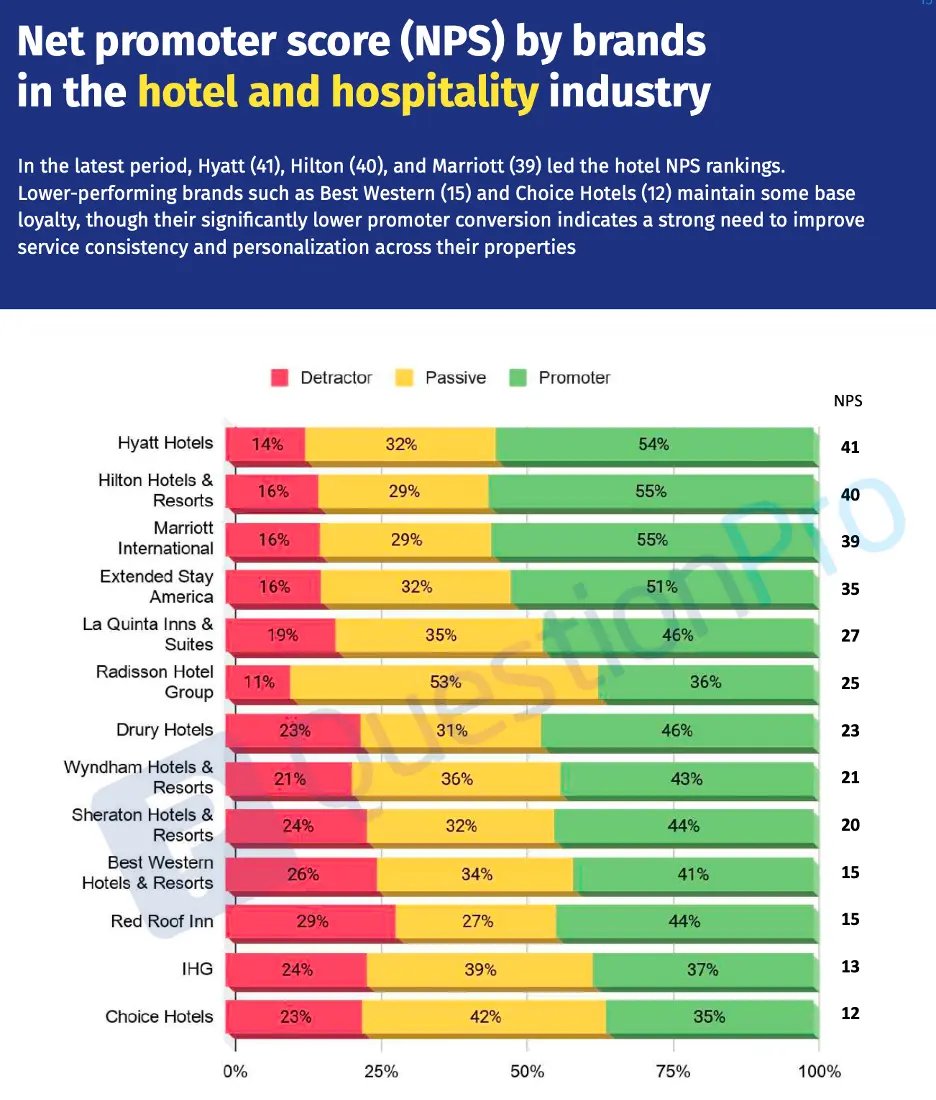
Source: QuestionPro, Benchmarking CX Metrics by Industry and Brands in the U.S., Q1 2026
Guests May Be Satisfied, but They May Not Recommend You
To me, the most interesting point in hospitality is this: QuestionPro’s summary findings note that Hotel & Hospitality NPS fell to 27, even as the sector’s CSAT and CES scores remained strong. In other words, guests may be satisfied with their last interaction and find transactions easy, yet still not strongly recommend the brand.
This is a very valuable warning for tourism in Türkiye.
Türkiye closed out 2025 with $65.2 billion in tourism revenue and 63.9 million visitors. Numbers on this scale are no longer simply a matter of “more tourists”; they show that the experience the country offers is a strategic asset that has to be protected at every touchpoint.
This is exactly where the risk lies for hotels in Türkiye. The room may be beautiful, the location may be good, the price may be acceptable for the season. But if check-in is slow, if employees have become less visible, if no one quickly takes ownership of a problem with the room, guests feel “processed” rather than “valued.” That feeling hits much harder, especially when prices are high.
That is why, when I wrote earlier in CX Bulletin about Wyndham’s quiet revolution in hospitality with AI, I took a positive view of technology. In Wyndham’s case, AI was designed not to eliminate human contact but to shorten transaction times, increase direct bookings and make waiting less of a burden for guests. This distinction is critical in hospitality. When technology stays invisible, it creates a sense of luxury; when it becomes a wall in front of the guest, it feels cold.
For Airlines, the Experience Begins the Moment a Flight Is Delayed
On the airline side, QuestionPro’s data paints a harsher picture. JetBlue leads by a wide margin with an NPS of 52. Delta Air Lines is at 35 and American Airlines at 30. By contrast, Frontier Airlines at -13 and Spirit Airlines at -18 are in negative territory. The report stresses that passengers place greater value on schedule reliability, clear policies, digital touchpoints and overall support quality.
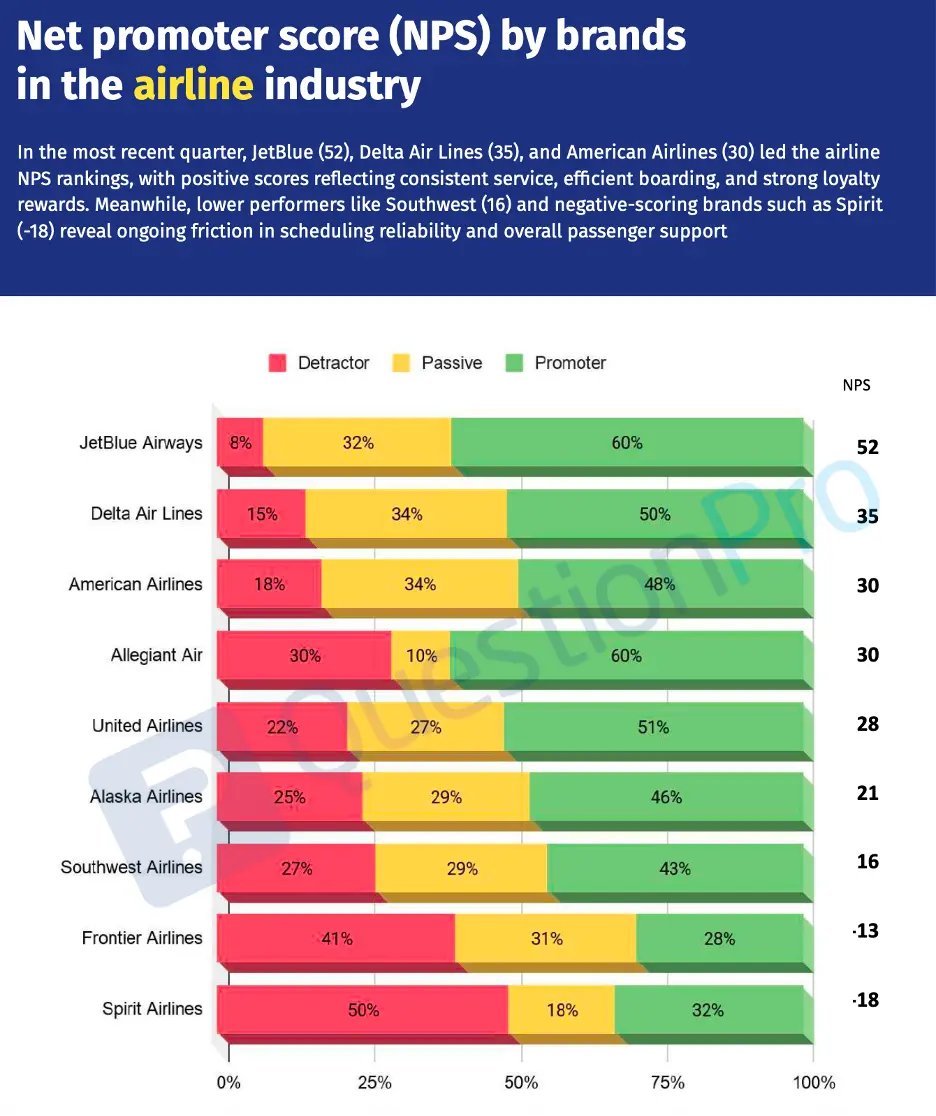
Source: QuestionPro, Benchmarking CX Metrics by Industry and Brands in the U.S., Q1 2026
Read alongside the global picture, this data becomes even clearer. According to IATA, air passenger demand rose 5.3% in 2025, with international demand growing 7.1%. ACI World, meanwhile, estimates that global passenger traffic reached 9.8 billion passengers in 2025 and expects it to climb to 10.2 billion in 2026. Demand is strong, but capacity, the supply chain, airport congestion and operational resilience remain the industry’s pressure points.
That is why the airline and airport experience in Türkiye should not be seen merely as “flight operations.” Passengers look at when they were informed of a delay, whether they could track their bags, whether they could reach the contact center, and whether the app actually worked in a crisis.
The Lesson for Türkiye: Tourism Is Not a Service but an Emotional Journey from Start to Finish
Türkiye has a strong travel sector. But our strengths can sometimes mislead us. Our culture of hospitality is a real advantage; yet with high volumes, rising prices and digital expectations, that advantage is not automatically preserved.
I believe hotel and airline brands in Türkiye need to focus on three things in particular:
The first is expectation management. If prices are rising, customers should feel that the service standard has risen too. The second is crisis communication. In moments such as delays, baggage problems, room issues or cancellations, customers should be given not just information but a sense that someone has taken ownership. The third is channel continuity. If the app, contact center, front desk, travel agency and field teams work in isolation from one another, the travel experience falls apart in the customer’s eyes.
Here, the central idea of the piece in which I discussed why AI investments in customer operations have not delivered the expected results applies to travel as well: technology improves the experience only if it empowers employees. Otherwise, it becomes a shiny barrier placed in front of the customer.
The New Luxury in Travel: Seamlessness
In travel, customers no longer look only at whether the flight leaves on time or the room is clean. Those are hygiene factors, things that should be in place anyway. The real difference emerges the moment the journey goes wrong.
The customer asks:
“Did they keep me informed?”
“Did they take ownership of my situation?”
“Did they give me options?”
“Did I have to do the work to solve the problem?”
What will elevate the travel experience in Türkiye is not more promises; it is making the promised experience more consistent, more transparent and less exhausting.
This piece was first published in Turkish in CX Bulletin on April 29, 2026. English translation.